
Tasty Tuesday: Protein Chocolate Mousse That Tastes Like Dessert and Works Like Fuel
Whether you're craving chocolate, need a post-workout snack, or just want a quick treat that doesn't derail your progress — this mousse is your new go-to.
Who says you can’t have dessert and hit your wellness goals at the same time?
This creamy, dreamy Protein Chocolate Mousse is proof that indulgence and nourishment can live on the same spoon. Made with clean, anti-inflammatory ingredients and no refined sugar, it satisfies your sweet tooth and supports your fitness, hormone, and gut health goals.
Whether you're craving chocolate, need a post-workout snack, or just want a quick treat that doesn't derail your progress — this mousse is your new go-to.
🍫 What Makes This Mousse So Good (For You)
This isn’t your average chocolate pudding. Every ingredient was intentionally chosen to nourish your body while delivering that rich, velvety texture we all crave.
Let’s break down the goodness.

Recipe: Protein Chocolate Mousse
🥣 Greek Yogurt (0% or 2% Fat)
High in protein (7–10g per ½ cup) to support muscle repair and satiety
Full of gut-healthy probiotics that aid digestion and support immunity
Rich in calcium, potassium, and B vitamins for strong bones and balanced energy
Provides creaminess without needing whipped cream or heavy cream
Yogurt is also lower in carbs and higher in nutritional value than dairy-based dessert alternatives.
💪 Chocolate Protein Powder
A game-changer for anyone looking to hit their daily protein goals without eating another chicken breast:
Adds 25–30g of protein depending on your brand
Helps with blood sugar balance and muscle recovery
Offers dessert-level chocolate flavor without the sugar crash
Choose a high-quality protein with no artificial sweeteners or gums for the cleanest version.
🍫 Unsweetened Cocoa Powder
Chocolate with benefits? Yes, please!
Packed with antioxidants, especially flavonoids that support heart and brain health
May help reduce inflammation and improve mood
Brings rich, deep chocolate flavor without added sugar
🍦 Vanilla Extract + Sweetener
Vanilla balances out the cocoa and protein powder while your choice of sweetener lets you customize the flavor. Try:
Stevia or monk fruit for a sugar-free option
Maple syrup or honey (in moderation) for a natural carb boost
🍓 Fresh Raspberries
Not just for garnish—raspberries are:
High in fiber (helping digestion and fullness)
Rich in vitamin C and anti-inflammatory compounds
A natural source of sweetness and vibrant flavor
Plus, berries are among the lowest sugar fruits, making them a smart choice for mindful eating.
🧪 Nutrition Breakdown (Per Serving):
Calories: 220–240
Protein: 35–38g
Carbs: 18–20g
Fiber: 4–6g
Fat: 2–6g (depending on yogurt and protein choice)
This mousse is a macro-balanced powerhouse disguised as dessert—ideal for anyone living the anti-inflammatory, high-protein, or weight-loss lifestyle.
🥄 How to Enjoy It
✅ Eat it as a dessert or snack
✅ Use it post-workout for muscle recovery
✅ Layer it into parfaits with granola or berries
✅ Add to freezer molds for a frozen treat
✅ Use as a dip for strawberries or bananas
Why It Fits Our Simplify Healthy Eating Philosophy
At TRE, we’re all about real food with real results. This recipe is:
✔️ Simple to prep (under 5 minutes)
✔️ Budget-friendly and made with pantry staples
✔️ High in protein and gut-friendly
✔️ Customizable based on your dietary needs
It proves you can have your mousse and eat it too—without wrecking your wellness plan.
Want More Healthy Dessert Hacks?
If this recipe hit the spot, wait until you dive into our 30-Day Anti-Inflammatory Meal Plan or the Simplify Healthy Eating Membership. Inside, you’ll find:
✨ Weekly recipes just like this—easy, healing, and delicious
✨ Grocery lists, prep guides, and community support
✨ Zero guesswork, just real results

5 Morning Habits to Naturally Balance Your Cortisol and Start Your Day Strong
Your morning sets the tone for your entire day—and if you're constantly feeling anxious, wired-but-tired, or just plain exhausted by noon, it might be time to rethink your cortisol curve.
Your morning sets the tone for your entire day—and if you're constantly feeling anxious, wired-but-tired, or just plain exhausted by noon, it might be time to rethink your cortisol curve.
Cortisol, your primary stress hormone, follows a natural rhythm. It’s meant to rise in the morning to help you wake up and focus, then slowly decline throughout the day. But modern habits like rushing out the door, scrolling your phone, or chugging coffee right after waking can throw that rhythm completely off.
Let’s break down 5 simple, science-backed habits that help balance your cortisol and build resilience from the moment your feet hit the floor.
☕ #1: Delay That Caffeine Hit
Wait 90–120 minutes after waking before sipping your coffee.
Why it matters:
Your cortisol naturally spikes upon waking. Adding caffeine immediately can push levels into overdrive—leading to afternoon crashes, anxiety, or disrupted sleep.
What to do instead:
Hydrate first. Sip warm lemon water or herbal tea and let your body wake up before caffeinating.
🌞 #2: Get Natural Morning Light
Expose yourself to natural sunlight for at least 10 minutes within an hour of waking.
Why it matters:
Morning light helps regulate your cortisol–melatonin cycle, keeping you alert during the day and sleepy at night. It also boosts mood, focus, and metabolism.
Pro tip:
Step outside—even on cloudy days. No sunglasses. Let the light hit your eyes and skin for a full circadian reset.
🍳 #3: Eat a Protein-First Breakfast
Aim for 25–30g of protein with your first meal.
Why it matters:
Starting your day with protein (instead of sugary carbs) stabilizes blood sugar, supports muscle repair, and prevents the insulin-cortisol rollercoaster that can lead to brain fog and cravings.
Examples:
Eggs with greens, Greek yogurt with hemp seeds, protein smoothie with nut butter.
🚶♀️ #4: Choose Gentle Movement
Skip the HIIT first thing—opt for low-impact movement like walking, stretching, or yoga.
Why it matters:
If your cortisol runs high, intense workouts in the morning can spike it further. Gentle movement helps activate your parasympathetic nervous system—aka the “rest and digest” mode.
Move mindfully:
Try a 15-minute nature walk, mobility flow, or sun salutation routine to start your day calm and grounded.
🧘♀️ #5: Practice 5-Minute Breathing
Start your morning with a short breathing practice.
Why it matters:
Breathwork activates the vagus nerve, slows your heart rate, and reduces cortisol. You don’t need 30 minutes—just 5 minutes of intention can change your entire day.
Try this:
Box breathing:
Inhale for 4 counts
Hold for 4 counts
Exhale for 4 counts
Hold for 4 counts
Repeat for 5 minutes and notice the shift.
Final Thoughts:
Balanced mornings = balanced cortisol = a more focused, peaceful YOU.
Start by mastering one of these habits at a time, and over the next few weeks, stack them together for a complete morning ritual that fuels your mind, body, and spirit.
You deserve a morning routine that doesn't drain you—but restores you.
Ready to build a full wellness routine that supports hormone health, energy, and healing?
✨ Grab the 30-Day Anti-Inflammatory Meal Plan to support your cortisol curve with the right foods
🌱 Join the Simplify Healthy Eating Membership for structure, recipes, and stress-free meal support
🧠 Reset your mental space with the New Beginnings Mindset Journal
📚 References
Caffeine and Cortisol Timing
Lovallo, W. R., et al. (2005). Caffeine stimulation of cortisol secretion across the waking hours in relation to caffeine intake levels. Psychosomatic Medicine, 67(5), 734–739.
https://pubmed.ncbi.nlm.nih.gov/16204431/Morning Sunlight and Circadian Rhythm
LeGates, T. A., Fernandez, D. C., & Hattar, S. (2014). Light as a central modulator of circadian rhythms, sleep, and affect. Nature Reviews Neuroscience, 15(7), 443–454.
https://pubmed.ncbi.nlm.nih.gov/24917305/Protein Intake and Cortisol Response
Clifton, P. M., & Keogh, J. B. (2017). Metabolic effects of high-protein diets. Nutrition & Metabolism, 14(1), 14.
https://pubmed.ncbi.nlm.nih.gov/18377787/Exercise Intensity and Cortisol
Hill, E. E., et al. (2008). Exercise and circulating cortisol levels: the intensity threshold effect. Journal of Endocrinological Investigation, 31(7), 587–591.
https://pubmed.ncbi.nlm.nih.gov/18787373/Breathwork and the Parasympathetic Nervous System
Ma, X., Yue, Z.-Q., Gong, Z.-Q., et al. (2017). The effect of diaphragmatic breathing on attention, negative affect and stress in healthy adults. Frontiers in Psychology, 8, 874.
https://pubmed.ncbi.nlm.nih.gov/28626434/
➡️ Follow @michelle11leslie for daily tips and encouragement.
⬇️Subscribe to the TheRelentlesslyEmpowered.com so you never miss a post.

Fitness Friday: 20-Minute Outdoor Walk-Run Workout
When it comes to cardio, you don’t need a gym membership or fancy equipment—just a good pair of sneakers and a plan. This 20-minute outdoor walk-run workout is designed to boost endurance, burn calories, and strengthen your heart, all while being easy to follow. Here’s how to do each segment for maximum results:
When it comes to cardio, you don’t need a gym membership or fancy equipment—just a good pair of sneakers and a plan. This 20-minute outdoor walk-run workout is designed to boost endurance, burn calories, and strengthen your heart, all while being easy to follow. Here’s how to do each segment for maximum results:

Cardio 20-minute outdoor walk-run workout chart with minute-by-minute intervals for brisk walking, jogging, running, and recovery.
0–3 MIN: Brisk Walk
Start with a brisk walk to warm up your muscles and elevate your heart rate. Keep your shoulders relaxed, arms swinging naturally, and core engaged. Aim for a pace that makes your breathing slightly quicker but still allows you to talk.
3–5 MIN: Jog or Light Run
Shift into a jog or light run. Land softly on the balls of your feet, keep your stride short, and avoid bouncing too much. This phase should feel like you’re working but not at your maximum effort.
5–6 MIN: Recovery Walk
Slow down to a comfortable walking pace. This recovery period helps lower your heart rate slightly while keeping your body in motion. Use this time to focus on deep breathing.
6–8 MIN: Moderate Run
Pick up the pace to a moderate run—faster than your light jog but not a full sprint. Keep your eyes forward, shoulders relaxed, and core tight. You should be breathing heavier but still in control.
8–9 MIN: Recovery Walk
Return to a recovery walk, letting your legs and lungs prepare for the next push. This active recovery helps prevent fatigue and injury.
9–11 MIN: Intense Run or Power Walk
For two minutes, go all out. If you’re running, aim for a near-sprint. If you prefer walking, switch to a power walk—pump your arms, take longer strides, and maintain a fast pace.
11–12 MIN: Recovery Walk
Ease back into a recovery walk, focusing on controlled breathing and posture.
12–14 MIN: Moderate Run
Return to a steady moderate run. Your goal here is to maintain consistent effort and keep your pace strong.
14–15 MIN: Recovery Walk
Once again, allow your heart rate to drop a bit while still moving forward.
15–18 MIN: Moderate Jog or Power Walk
Choose either a moderate jog or a strong, fast-paced walk. This is your last big push before the cooldown, so keep the energy up.
18–20 MIN: Cool Down Walk
Finish with a slow, easy walk to bring your heart rate down and relax your muscles. Use this time to take deep breaths and enjoy the feeling of accomplishment.
Why This Workout Works
This walk-run format alternates between periods of effort and recovery, making it perfect for boosting cardiovascular fitness, improving endurance, and burning calories without overstraining your body. Plus, it’s adaptable for all fitness levels—simply adjust your pace to match your current ability.
Pro Tip: Pair this workout with proper hydration, balanced nutrition, and recovery days for optimal results.
Subscribe TODAY⬇️ so you never miss when we post!

Smoothie of the Week: Carrot Cake Gut-Healer Smoothie
Who says dessert can’t be healthy? This week’s Smoothie of the Week is inspired by a cozy slice of carrot cake — but instead of sugar and frosting, you’re getting a powerhouse blend of gut-friendly, anti-inflammatory, and protein-rich ingredients that taste like a treat while nourishing your body from the inside out.
Who says dessert can’t be healthy? This week’s Smoothie of the Week is inspired by a cozy slice of carrot cake — but instead of sugar and frosting, you’re getting a powerhouse blend of gut-friendly, anti-inflammatory, and protein-rich ingredients that taste like a treat while nourishing your body from the inside out.
What’s Inside & Why It’s Good for You
1. ½ cup cooked & cooled carrots
Carrots are rich in beta-carotene (a precursor to vitamin A) for healthy skin, vision, and immune support. Cooling them after cooking increases resistant starch, which feeds beneficial gut bacteria.
2. 1 oz kombucha
Kombucha is a fermented tea packed with probiotics that help balance your gut microbiome, aid digestion, and support immunity.
3. 1 scoop collagen + plant protein blend
Collagen supports gut lining repair, joint health, and skin elasticity, while plant protein adds essential amino acids for muscle repair and long-lasting energy.
4. ¼ cup rolled oats
Oats are a great source of soluble fiber, particularly beta-glucan, which helps improve digestion, stabilize blood sugar, and keep you fuller for longer.
5. 1 tbsp almond butter
Almond butter brings in healthy fats, vitamin E, magnesium, and plant-based protein to boost satiety and support heart health.
6. ½ tsp cinnamon + pinch of ginger
Cinnamon helps balance blood sugar and reduce inflammation, while ginger aids digestion, reduces bloating, and provides anti-nausea benefits.
How to Make It
Add carrots, kombucha, protein blend, oats, almond butter, cinnamon, ginger, and ½–1 cup of almond milk or water to a blender.
Blend until smooth and creamy.
Pour into a glass, sprinkle a little cinnamon on top, and enjoy!
Why You’ll Love This Smoothie
Gut Healing – Probiotics from kombucha and prebiotics from oats and carrots work together for optimal digestion.
Anti-Inflammatory Power – Cinnamon, ginger, and collagen help calm inflammation from the inside out.
Dessert-Inspired Flavor – Sweet, spiced, and creamy — without the refined sugar crash.
Balanced Nutrition – A perfect blend of protein, healthy fats, and fiber for lasting energy.
Pro Tip: For an extra dessert-like treat, top with a sprinkle of crushed walnuts or unsweetened coconut flakes.
Subscribe TODAY⬇️ so you never miss when we post!

The Vagus Nerve: Your Body's Built-In Chill Switch
When it comes to regulating stress, boosting mood, and supporting overall health, there’s one powerful system in your body that doesn’t get nearly enough attention: the vagus nerve.
When it comes to regulating stress, boosting mood, and supporting overall health, there’s one powerful system in your body that doesn’t get nearly enough attention: the vagus nerve.
Known as the body’s “chill switch,” the vagus nerve is the longest cranial nerve and runs from your brainstem all the way down to your gut. It’s a key part of your parasympathetic nervous system—the part responsible for rest, digestion, and recovery.
If you’re constantly feeling anxious, exhausted, inflamed, or emotionally off-balance, your vagus nerve tone may be low—and learning how to activate and support this nerve could be a total game changer for your well-being.
What the Vagus Nerve Does (and Why It Matters)
When your vagus nerve is functioning optimally, your body feels safe, steady, and resilient. Here's how it helps regulate your system:
Slows your heart rate during rest and helps your body shift out of “fight-or-flight”
Stimulates digestion by telling your gut it’s safe to function normally
Lowers inflammation by triggering your body’s natural anti-inflammatory reflex
Promotes calm and emotional regulation by helping you downshift from stress
Supports healthy breathing patterns and a sense of internal balance
In short: if you want better energy, digestion, mood, and stress recovery—start with your vagus nerve.
6 Simple Ways to Support Your Vagus Nerve Daily
Ready to boost your vagal tone naturally? These simple, science-backed practices can help stimulate the vagus nerve and regulate your nervous system:
1. Deep, Slow Breathing
Breathing deeply, especially with longer exhales than inhales, stimulates the vagus nerve and shifts your body into rest-and-digest mode. Try this during moments of overwhelm or before sleep.
2. Cold Exposure
A splash of cold water on your face or a quick burst from a cold shower can help activate the vagus nerve and reduce stress signals. It’s like a nervous system reset button.
3. Humming, Chanting, or Singing
The vagus nerve connects to your vocal cords, so using your voice through humming or singing is a powerful and easy way to activate it—yes, singing in the shower counts!
4. Meditation or Restorative Yoga
Mindfulness practices help you stay relaxed and regulated. Gentle yoga poses and quiet meditation create space for your nervous system to recalibrate.
5. Alternate Nostril Breathing
This calming breathwork technique is especially helpful for nervous system regulation and balancing energy. It also helps stimulate special receptors that affect heart rate and blood pressure.
6. Laughter and Social Connection
Believe it or not, meaningful connection and shared laughter help tone the vagus nerve. Your body thrives in safe, joyful relationships—this is science, not just sentiment.
Final Takeaway
Your vagus nerve is like the volume knob on your stress response—it determines how quickly you can calm down, digest food, recover from inflammation, and emotionally regulate. By supporting this system intentionally, you give your body the tools it needs to heal, reset, and thrive.
The stronger your vagus tone, the better your body handles stress—and bounces back from it.
🧠 Ready to build resilience from the inside out?
Visit TheRelentlesslyEmpowered.com for tools, journals, meal plans, and more to support your body, mind, and spirit. Subscribe ⬇️ for more tips to help you along your wellness journey.

Tasty Tuesday: High-Protein Yogurt Dip That’s Big on Flavor and Low on Guilt
Need a snack that’s satisfying, savory, and supports your wellness goals? This High-Protein Yogurt Dip is the perfect blend of creamy, tangy, and zesty — made with just a handful of clean ingredients you probably already have in your kitchen.
Need a snack that’s satisfying, savory, and supports your wellness goals? This High-Protein Yogurt Dip is the perfect blend of creamy, tangy, and zesty — made with just a handful of clean ingredients you probably already have in your kitchen.
It’s the kind of go-to recipe that works for just about any occasion:
✔️ Pre-workout snack
✔️ Easy appetizer for guests
✔️ Meal prep hero for the week
✔️ Healthy swap for ranch, mayo, or sour cream
And the best part? It’s done in under 5 minutes.
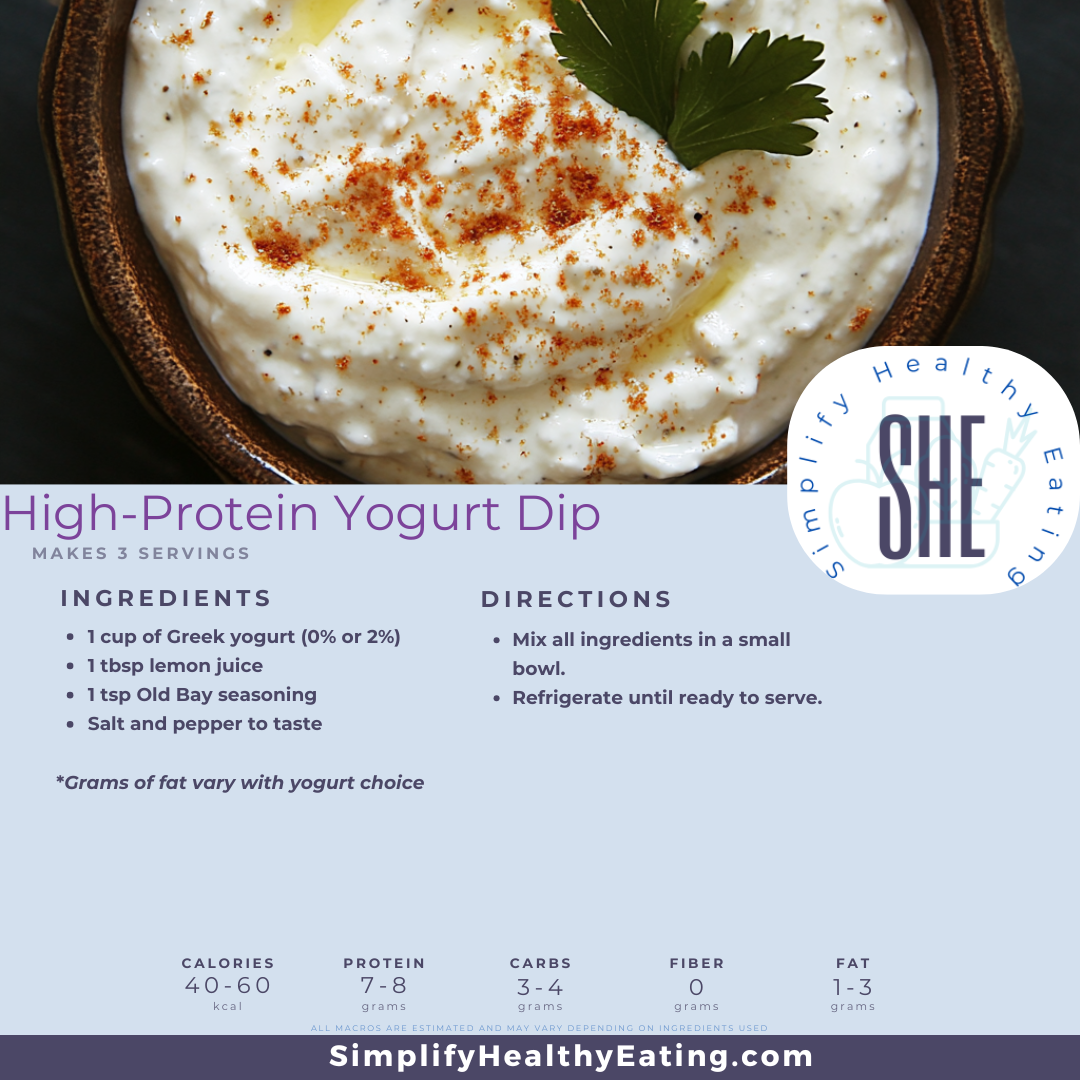
Recipe: High-Protein Yogurt Dip
🥣 Ingredients You Can Feel Good About
Let’s take a closer look at why this yogurt dip doesn’t just taste good — it does good, too.
🍦 Greek Yogurt (0% or 2%)
The star of the show! Greek yogurt is:
Packed with protein (7–8g per serving), helping stabilize blood sugar and keep you full
A natural source of probiotics, which support gut health, digestion, and immune function
High in calcium and vitamin B12, essential for bone strength and energy production
A great substitute for mayonnaise or sour cream, with far fewer calories and saturated fat
Whether you choose non-fat or 2%, you’re getting a creamy base with amazing versatility.
🍋 Lemon Juice
This little splash brings bright, zesty flavor and functional benefits:
A natural source of vitamin C, supporting immune health
Helps balance the dip’s richness without adding calories
Aids digestion and may help reduce bloating when paired with probiotic-rich foods
🧂 Old Bay Seasoning
Old Bay isn’t just for seafood — it's the secret weapon in this dip:
Adds bold, savory flavor without needing a long list of spices
Contains celery seed and paprika, which offer anti-inflammatory benefits
Keeps your snack exciting without added sugar or artificial ingredients
Feel free to experiment with Cajun spice or everything bagel seasoning for variety!
🔍 Nutritional Breakdown (Per Serving)
Calories: 40–60 kcal
Protein: 7–8g
Carbs: 3–4g
Fiber: 0g
Fat: 1–3g (depending on yogurt choice)
This dip is low-calorie, high-protein, and free from artificial junk. Perfect for anyone watching their macros or transitioning into a healthier lifestyle.
🍽️ Ways to Enjoy This High-Protein Yogurt Dip
Here are a few tasty ideas to put it to good use:
✅ Use it as a veggie dip with cucumbers, bell peppers, or snap peas
✅ Spread it on sandwiches or wraps instead of mayo
✅ Serve it with sardine fish cakes, grilled chicken, or salmon
✅ Thin it with water or olive oil and turn it into a salad dressing
✅ Use it to top grain bowls, tacos, or roasted veggies
Why We Love This Recipe for Anti-Inflammatory Living
At The Relentlessly Empowered, we’re all about recipes that deliver maximum nourishment with minimal fuss. This one’s a keeper because:
It’s gut-friendly, with probiotics and no inflammatory oils
It’s budget-friendly, using affordable staple ingredients
It’s meal prep-friendly, lasting in the fridge for up to 5 days
It’s family-friendly, with flavor everyone will enjoy
And because it’s so versatile, it fits seamlessly into any meal plan — from high-protein low-carb to anti-inflammatory to Mediterranean-style eating.
Ready to Simplify Your Healthy Eating Routine?
If this recipe got you excited, you’ll love what we’ve created inside the 30-Day Anti-Inflammatory Meal Plan and Meal Plan Membership. You’ll get:
✨ Weekly done-for-you grocery lists
✨ Easy, flavorful recipes with full macros
✨ Gut-healing food swaps + snack options like this one
✨ A supportive community to cheer you on

5 Unexpected Cortisol Triggers You’re Probably Ignoring (But Shouldn’t)
If you’ve been doing the “right things” for your wellness and still feel anxious, fatigued, bloated, or wired-but-tired… these 5 unexpected cortisol triggers might be the culprits.
We often think of stress as something loud—like an argument, a deadline, or a financial crisis. But the truth is, some of the biggest threats to your stress levels are quiet. They sneak into your daily routine, raising your cortisol levels without you even realizing it.
If you’ve been doing the “right things” for your wellness and still feel anxious, fatigued, bloated, or wired-but-tired… these 5 unexpected cortisol triggers might be the culprits.
☕ 1. That Afternoon Extra Coffee
We love a good pick-me-up, but here’s the deal: caffeine has a 5–6 hour half-life, meaning your 2 p.m. cup is still in your system well into the evening.
Why it matters:
Caffeine spikes cortisol, which can interfere with sleep, blood sugar, and your ability to truly relax. Over time, this adds up to chronic stress—even if you don’t feel it right away.
Cortisol-Smart Swap:
Try matcha, chicory coffee, or herbal adaptogenic teas in the afternoon. And aim to cut caffeine after 12 p.m. if you’re feeling wired at bedtime.
🧁 2. Food Sensitivities (Even Mild Ones!)
You might think, “I’m eating healthy!”—but even nutritious foods can be problematic if your body doesn’t tolerate them well.
Why it matters:
Mild intolerances to gluten, dairy, or even eggs can trigger inflammatory responses, which raise cortisol over time. You may not break out in hives, but if you feel bloated, sluggish, or foggy after eating certain foods—it’s worth paying attention.
Cortisol-Smart Tip:
Try an elimination approach or keep a food + mood diary to track how your body reacts. Prioritize anti-inflammatory, gut-friendly meals from our 30-Day Meal Plan to support healing.
📱 3. Social Media Scrolling
Endless scrolling may seem harmless—or even relaxing. But your brain thinks otherwise.
Why it matters:
The dopamine rollercoaster of likes, comparison, bad news, and overstimulation keeps your stress system in “alert mode.” That constant input drains your focus and raises baseline cortisol levels.
Cortisol-Smart Strategy:
Set phone-free boundaries (especially after dinner), use “do not disturb” at night, and curate your feed to feel more inspiring than draining.
💧 4. Dehydration
Did you know that just 1–2% dehydration can raise cortisol levels?
Why it matters:
Most people walk around chronically dehydrated, which adds stress to the body—even if you don’t feel “thirsty.” Fatigue, cravings, and brain fog are all signs your hydration might be off.
Cortisol-Smart Hydration Habits:
Start your morning with 16 oz of water before coffee. Add a pinch of sea salt or an electrolyte boost mid-day to keep cells nourished and stress responses in check.
💡 5. Artificial Light Exposure
That overhead light or phone scroll at bedtime? It’s messing with more than your melatonin—it’s disrupting your cortisol, too.
Why it matters:
Blue light suppresses melatonin and delays cortisol’s natural decline, keeping you wired at night and tired in the morning.
Cortisol-Smart Light Hygiene:
🔹 Use warm-toned lighting after sunset
🔹 Turn off screens 1 hour before bed
🔹 Consider blue light-blocking glasses or apps
🔹 Get natural morning light within 30 minutes of waking for circadian reset
Final Thoughts:
It’s time to give yourself grace—you're not “lazy” or “unmotivated.” Your body might just be overstimulated from everyday triggers you’ve been taught to ignore.
Let this Monday be your mindset shift:
💬 Healing isn’t just about doing more—it’s about noticing what needs to be released.
Start small. Be curious. And above all—be kind to yourself.
Ready to rebalance your cortisol and create a lifestyle that feels safe to your body?
🌿 Download the 30-Day Anti-Inflammatory Meal Plan for food that heals, not harms
💧 Join the Simplify Healthy Eating Membership for daily wellness tools
🧠 Explore our mindset journals to release stress from the inside out
➡️ TheRelentlesslyEmpowered.com
➡️ Follow @michelle11leslie for more stress-reducing tips

🌞 Fitness Friday: Morning Mobility Flow to Start Your Day Grounded + Energized
Your day doesn’t need to start with chaos. Start it with calm movement, clarity, and connection to your body instead.
Your day doesn’t need to start with chaos. Start it with calm movement, clarity, and connection to your body instead.
This 7-move Morning Mobility Flow will wake up stiff muscles, release tension, and center your mind before you take on the day. Flow through each move for 30–60 seconds and repeat 2–3 rounds.
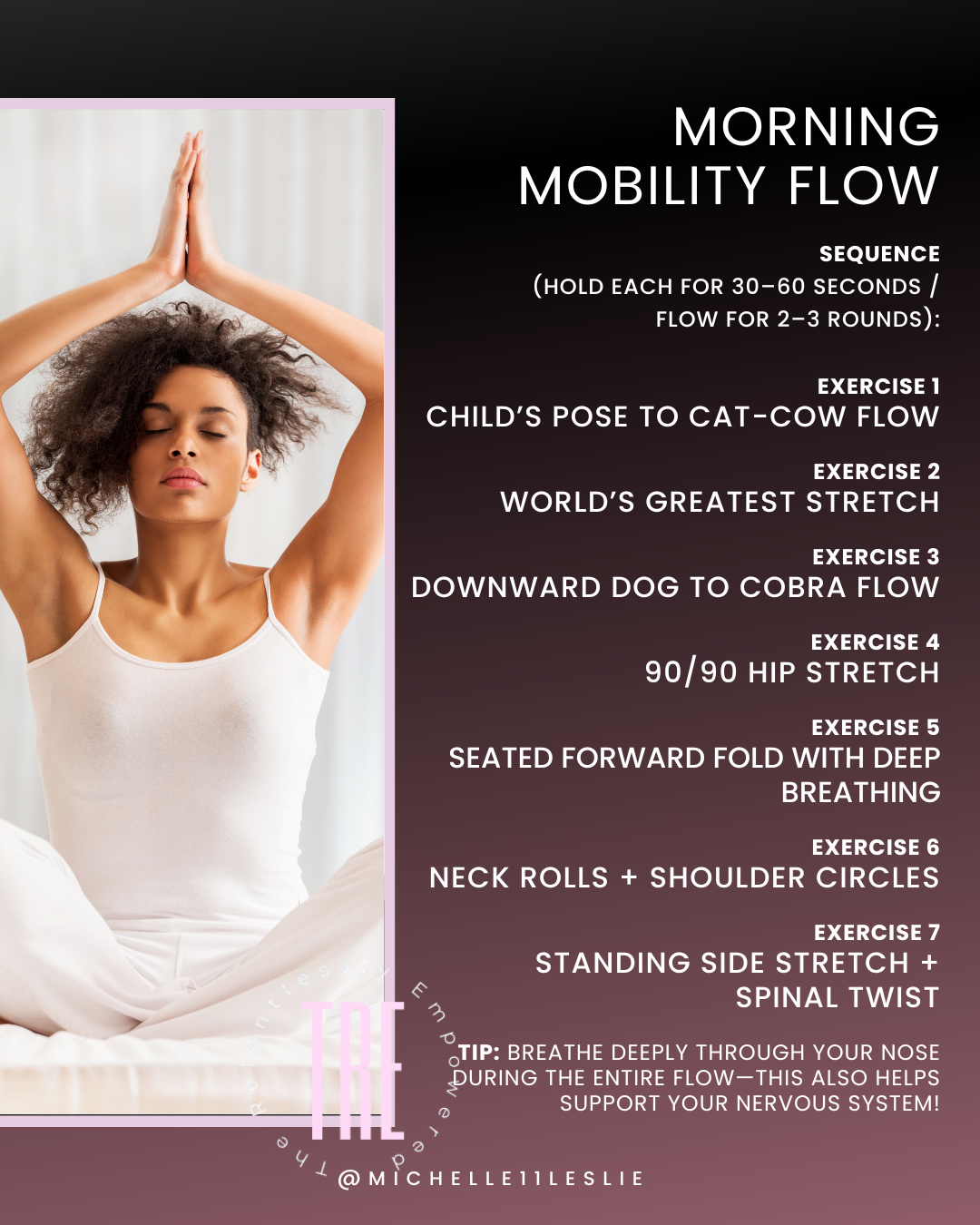
Morning Mobility Flow
Let’s walk through it together 👇🏽
🧘🏽♀️ The Morning Mobility Moves:
1. Child’s Pose to Cat-Cow Flow
👉 Start in child’s pose (knees wide, forehead down), then shift to hands and knees.
👉 Flow between arching your back (cow) and rounding your spine (cat) to mobilize your spine and relieve tension.
2. World’s Greatest Stretch
👉 Step one foot forward into a deep lunge, place opposite hand on the ground, and twist your torso toward the front knee, reaching the top arm to the sky.
✅ Opens hips, thoracic spine, and hamstrings.
3. Downward Dog to Cobra Flow
👉 Push back into Downward Dog (hips up, heels reaching toward floor).
👉 Then flow forward into Cobra (chest lifted, hips down, shoulders relaxed).
✅ Stretches spine, calves, hamstrings, and strengthens the back.
4. 90/90 Hip Stretch
👉 Sit with one leg in front bent at 90°, and the other behind you at 90°.
👉 Lean forward gently over the front shin.
✅ Loosens up deep hip muscles and improves mobility.
5. Seated Forward Fold with Deep Breathing
👉 Sit with legs extended, hinge forward at the hips and breathe deeply into your belly.
✅ Releases tight hamstrings and calms the nervous system.
6. Neck Rolls + Shoulder Circles
👉 Slowly roll your neck in gentle circles; follow with large, slow shoulder circles.
✅ Relieves neck and shoulder tension—especially helpful if you sleep tight or sit a lot.
7. Standing Side Stretch + Spinal Twist
👉 Stand tall, reach one arm overhead and lean to the side.
👉 Then twist gently from the waist, arms open wide.
✅ Lengthens side body and improves spinal mobility.
🧠 Tip: Inhale through your nose and exhale slowly through your mouth the whole time—this helps reset your nervous system and sets a peaceful tone for your day.
🌱 Movement is powerful... but it’s only part of the story.
If you’re not pairing your mindful movement with intentional nutrition, you’re missing the full wellness picture.
That’s why we created:
🥗 The 30-Day Anti-Inflammatory Meal Plan – delicious recipes that heal from within.
🥗 The Simplify Healthy Eating Membership – ongoing support and monthly plans to make clean eating easy and sustainable.
🛑 Ditch the guesswork.
✅ Start your day strong in every way—body, mind, and plate.

Thirsty Thursday: Bone Broth – A Gut-Healing Sip Worth Savoring
This comforting, savory drink isn’t just for cold winter nights — it’s a powerful, healing beverage that can work wonders for your gut, joints, skin, and overall wellness. Whether you sip it straight from a mug or use it as the base for soups and stews, bone broth is the ultimate multitasking health elixir.
We’re switching it up this week! Instead of our usual fruity or protein-packed drink feature, today’s Thirsty Thursday spotlight is all about a warm, nourishing classic: bone broth.
This comforting, savory drink isn’t just for cold winter nights — it’s a powerful, healing beverage that can work wonders for your gut, joints, skin, and overall wellness. Whether you sip it straight from a mug or use it as the base for soups and stews, bone broth is the ultimate multitasking health elixir.

A graphic of a cup of bone broth listing the wellness benefits of drinking it daily.
Why Bone Broth Deserves a Spot in Your Wellness Routine
1. Rich in Collagen for Gut Lining Repair
Bone broth is a natural source of collagen, which helps strengthen and repair the gut lining. This is especially important for those dealing with digestive issues, bloating, or leaky gut.
2. Packed with Amino Acids that Reduce Inflammation
The amino acids glycine and proline found in bone broth are known to reduce inflammation, support tissue repair, and promote joint health.
3. Supports Healthy Gut Bacteria
A healthy gut microbiome is essential for digestion, immunity, and even mood regulation. Bone broth’s minerals and compounds help feed beneficial bacteria and keep your gut ecosystem balanced.
4. Easy to Digest & Absorb
Unlike some nutrient-dense foods that can be heavy on digestion, bone broth delivers vitamins, minerals, and protein in a form your body can easily absorb — perfect for when your system needs something gentle.
How to Enjoy Bone Broth
Sip it warm between meals for a satisfying, savory pick-me-up.
Use it as a cooking base for soups, stews, or sautéed veggies.
Add herbs and spices for an extra flavor and health boost.
Pro Tip:
If you’re looking to make it a daily habit, prep a big batch at the start of the week and store it in the fridge for quick heating.
Bottom line: Bone broth is more than just comfort in a cup — it’s a nutrient-rich powerhouse that supports gut health, joint strength, and overall vitality.
Subscribe⬇️so you never miss when we post!
Smoothie of the Week: Mixed Berry Probiotic Smoothie
If you’re looking for a quick, delicious, and gut-friendly way to start your day, our Mixed Berry Probiotic Smoothie is the perfect choice! Packed with protein, probiotics, fiber, and antioxidants, this blend not only fuels your body but also supports digestion, boosts energy, and keeps you feeling full longer.

Smoothie Recipe: Mixed Berry Probiotic Smoothie
What’s Inside & Why It’s Good for You
1. ¾ cup plain Greek yogurt
Greek yogurt is loaded with probiotics — the healthy bacteria your gut needs for optimal digestion and immune function. It’s also rich in calcium for bone health and high in protein, which helps keep you satisfied and supports muscle repair.
2. ¾ cup frozen mixed berries
Berries like blueberries, strawberries, raspberries, and blackberries are packed with antioxidants that fight inflammation and support heart health. They’re also low in calories but high in vitamins like C and K, plus fiber to help keep your digestive system happy.
3. 1 scoop vanilla protein powder
Protein powder adds an extra boost of muscle-building fuel, making this smoothie perfect for post-workout recovery or a satisfying breakfast. It helps curb cravings and supports a steady energy release throughout the day.
4. 1 tablespoon flaxseed meal
Flaxseeds are a powerhouse of omega-3 fatty acids, fiber, and lignans (antioxidants that may help balance hormones). They support heart health, digestion, and even promote glowing skin.
How to Make It
Add Greek yogurt, frozen berries, protein powder, and flaxseed meal to a blender.
Pour in ½–1 cup of water or unsweetened almond milk, depending on your preferred thickness.
Blend until smooth, pour into a glass, and enjoy!
Why You’ll Love This Smoothie
Gut Health Support – The probiotics in Greek yogurt help maintain a balanced gut microbiome.
Anti-Inflammatory Power – Berries and flaxseed fight inflammation, which supports overall wellness.
Balanced Nutrition – Protein, healthy fats, and fiber keep you satisfied for hours.
Quick & Easy – Ready in under 5 minutes, making it perfect for busy mornings.
Pro Tip: For an extra antioxidant boost, toss in a handful of fresh spinach or a sprinkle of cinnamon before blending.
Subscribe ⬇️so you never miss when we post!

5 Common Adrenal Support Mistakes (and What to Do Instead)
When your adrenals are stressed, your body starts whispering before it screams. But most people miss those whispers. As a health coach, I see the same five mistakes over and over again when it comes to adrenal health—and most of them come from people trying to feel better but going about it the wrong way.
Are you actually listening to your body—or just pushing through like it’s normal to feel drained all the time?
When your adrenals are stressed, your body starts whispering before it screams. But most people miss those whispers. As a health coach, I see the same five mistakes over and over again when it comes to adrenal health—and most of them come from people trying to feel better but going about it the wrong way.
Let’s unpack these mistakes and what you can do instead to support your body in a more sustainable way.
Mistake #1: Powering Through the 3PM Slump
That afternoon crash isn’t always about needing more caffeine—it’s often a red flag from your nervous system. When you keep pushing through with coffee or sugar, you override the signals your body is trying to send.
Try this instead: Take a short pause. A 10-minute break with your eyes closed, a breathwork session, or even a step outside can help you reset without overtaxing your adrenals.
Mistake #2: “Rewarding” Stress with Sugar, Alcohol, or Binge-Watching
It feels good in the moment—but these habits often end up making things worse. You might feel a quick hit of relief, but underneath, you’re feeding the very cycle that’s burning you out.
Try this instead: Build recovery rituals that actually restore you. Whether it’s journaling, stretching, reading, or calling a friend—choose habits that fuel your healing, not mask your symptoms.
Mistake #3: Ignoring Your Body’s Stress Signals
Those nagging headaches, poor sleep, mood swings, or gut issues aren’t random. They’re warning signs that your body is out of balance. The longer you ignore them, the louder they get.
Try this instead: Keep a simple stress journal. Track how you feel daily. Look for patterns. Noticing your body’s early signals gives you a chance to course-correct before full burnout sets in.
Mistake #4: Taking Random Supplements Without Testing or Research
Not every supplement is right for every body. What worked for your friend—or your favorite influencer—could actually make things worse for you if your body’s needs are different.
Try this instead: Get tested and talk to a professional. Knowing your unique hormone and stress patterns helps you build a supplement routine that’s actually supportive, not harmful.
Mistake #5: Going from Zero to 100 with Health Changes
You’re hyped and ready to turn your life around—so you overhaul your entire routine overnight. The problem? That kind of intensity can overwhelm your already-depleted system and lead to more exhaustion.
Try this instead: Start small. Focus on one or two habits at a time. Build momentum slowly. Consistency and sustainability matter way more than perfection.
Final Thoughts
You don’t need to fix everything overnight. But you do need to listen—to the fatigue, the cravings, the irritability, the brain fog. These are all signals that your body is asking for support.
Small shifts, intentional habits, and a willingness to tune in are how you start truly healing.
✨ Looking for more tools to support your energy and emotional balance?
Visit TheRelentlesslyEmpowered.com to explore meal plans, mindset tools, and faith-based resources for whole-body wellness.

Tasty Tuesday: Easy Baked Sardine Fish Cakes That Nourish and Satisfy
They're crispy on the outside, tender on the inside, and loaded with anti-inflammatory ingredients that don’t just taste good—they do good for your body. Whether you're trying to clean up your diet, support your metabolism, or simply eat more whole foods, this Tasty Tuesday recipe checks all the boxes.
Looking for a quick, protein-packed dinner that supports heart health, brain function, and gut wellness? These Easy Baked Sardine Fish Cakes are about to be your new go-to!
They're crispy on the outside, tender on the inside, and loaded with anti-inflammatory ingredients that don’t just taste good—they do good for your body. Whether you're trying to clean up your diet, support your metabolism, or simply eat more whole foods, this Tasty Tuesday recipe checks all the boxes.
Let’s break it down.

Recipe: Easy Baked Sardine Fish Cakes
🐟 Why Sardines Deserve a Spot on Your Plate
Sardines are one of the most underrated superfoods in the sea. These tiny fish are:
Packed with omega-3 fatty acids, which support brain function, reduce inflammation, and protect your heart
High in calcium, thanks to their soft, edible bones—great for bone health and muscle function
Rich in protein, helping you stay full longer and support lean muscle
Low on the food chain, meaning they contain fewer toxins and heavy metals than larger fish like tuna
Sardines are also shelf-stable, affordable, and sustainably sourced. That’s a triple win.
🥚 The Power of Eggs
Eggs are not only a binder in this recipe—they're a nutritional powerhouse:
High-quality complete protein, supporting muscle repair and hormone production
Contain choline, a nutrient essential for brain health and metabolism
Rich in vitamins B12, D, and selenium—all crucial for immunity and energy
Plus, they help the fish cakes hold their shape without needing any heavy fillers.
🧅 Green Onions for Flavor + Detox Support
These flavorful greens add more than just a punch of freshness. Green onions:
Are rich in antioxidants, especially quercetin, which helps fight inflammation
Contain sulfur compounds that support liver detoxification
Aid digestion with their natural prebiotic fiber
🥄 Dijon Mustard + Old Bay: Flavor and Function
Dijon mustard brings bold flavor without added sugar or artificial junk. It’s also made with turmeric, which has anti-inflammatory properties.
Old Bay or seafood seasoning blends contain spices like celery seed and paprika that may support digestion and blood circulation.
🍞 Let’s Talk Panko Breadcrumbs
While traditional breadcrumbs can be heavy, panko is lighter and crispier. Used in moderation, they give the cakes texture without making them soggy. If you're gluten-free, feel free to swap in almond flour or gluten-free panko.
🧠 Nutritional Snapshot (Per Serving):
Calories: 200–220 kcal
Protein: 17–19g
Carbs: 6–8g
Fat: 12–14g
Fiber: 1g
This meal is macro-balanced, meaning it has protein, healthy fats, and complex carbs in just the right ratio to keep you satisfied and energized.
🧑🍳 Pro Tips for the Perfect Fish Cake
✅ Don’t skip the resting time—letting the mixture sit helps the panko absorb moisture and improves texture.
✅ Spray with olive oil before baking for that crispy, golden finish.
✅ Serve with a squeeze of lemon, a dollop of Greek yogurt, or a simple side salad for a full meal.
Why This Recipe Works for Anti-Inflammatory Living
At The Relentlessly Empowered, we love recipes that are:
Easy to prep
Rich in anti-inflammatory nutrients
Family-friendly and flavorful
Budget-conscious
These fish cakes support everything from gut health to brain clarity to heart wellness—and they’re free from white flour, added sugar, or inflammatory oils.
Ready to Simplify Healthy Eating?
If you loved this recipe, there’s so much more where that came from. Our 30-Day Anti-Inflammatory Meal Plan and Meal Plan Membership make clean eating simple with done-for-you grocery lists, step-by-step recipes, and full nutrition breakdowns.
✨ Heal your gut. Boost your energy. Save money on takeout.
Grab your plan and join a wellness community that actually gets it.


Why Sleep Is Your #1 Cortisol Reset Button (and How to Master It)
When we think of stress relief, we often reach for surface-level solutions—smoothie bowls, supplements, or yoga classes. But sometimes the most powerful wellness upgrade is the simplest one—SLEEP
When we think of stress relief, we often reach for surface-level solutions—smoothie bowls, supplements, or yoga classes. But sometimes the most powerful wellness upgrade is the simplest one—SLEEP.
Sleep isn’t just about feeling rested. It’s your body’s built-in reset button—especially when it comes to regulating cortisol, your primary stress hormone.
If you’ve been stuck in survival mode, waking up groggy, feeling foggy by 3 p.m., and battling cravings or burnout, your sleep hygiene might be sabotaging your healing.
Let’s break it down…
🧠 What Just One Night of Poor Sleep Can Do:
🔺 Increase cortisol by 37–45%
🍩 Boost hunger hormones (hello, cravings) by 24%
💉 Reduce insulin sensitivity, making blood sugar swings more likely
🧩 Impairs cognitive function (decision fatigue is real!)
💥 Decrease willpower, making healthy choices harder
When your sleep is off, your whole system suffers. And the kicker? Cortisol and sleep have a two-way relationship:
➡️ High cortisol disrupts sleep
➡️ Poor sleep raises cortisol
Breaking this cycle requires intentional evening habits—not just wishful thinking.
🌙 Your Cortisol-Friendly Evening Routine
These tips may seem small, but together they can transform your sleep quality, reduce stress, and help you show up as your best self:
⏰ Set a consistent bedtime (yes, even on weekends!)
💡 Dim lights 2 hours before bed to cue melatonin production
🍽️ Stop eating 3 hours before bed to let digestion rest
📵 Create a tech-free zone 60 minutes before sleep to reduce stimulation
🌡️ Cool your bedroom to 65–68°F (18–20°C) for optimal rest
🛑 Use blackout curtains or an eye mask to block melatonin disruptors
🤸🏾♀️ Do 5–10 minutes of gentle stretching or deep breathing to transition out of “go mode”
💡 Why This Matters for Women on a Healing Journey
If you're navigating hormone imbalances, recovering from burnout, or just trying to feel like you again, sleep is one of the most underrated healing tools you have access to—for free.
No supplement, workout, or detox can replace what quality sleep does for your adrenal health, mental clarity, and emotional regulation.
This week, challenge yourself to make sleep sacred. Protect your peace. Prioritize your evening rhythm. And most of all—give yourself permission to rest deeply.
Need support creating a lifestyle that nourishes your body from the inside out?
✔️ Grab the 30-Day Anti-Inflammatory Meal Plan to fuel your sleep + recovery
✔️ Join the Simplify Healthy Eating Membership for recipes and guidance that honor your healing season
✔️ Check out our Faith + Mindset Journals to help you reset mentally and spiritually
➡️ Start your healing journey today at TheRelentlesslyEmpowered.com
➡️ Follow @michelle11leslie on IG for daily tools and encouragement
Subscribe TODAY⬇️so you never miss when we post!

🔥 Fitness Friday: Total-Body Strength in Just 15 Minutes! 💪🏽
Pressed for time but still want results? This 15-minute Dumbbell EMOM (Every Minute on the Minute) is your no-excuses, total-body strength builder. Here’s how to crush it:
If you’ve only got 15 minutes, but still want to feel strong, sculpted, and energized—this one’s for you.
This Dumbbell EMOM (Every Minute on the Minute) is all about efficient strength training that boosts your metabolism and tones your entire body. Here's how it works ⬇️
🕐 How It Works:
Each minute, you’ll perform a specific number of reps for one movement. Once you're done, use the rest of that minute to recover before starting the next move.
Complete all 5 exercises, then repeat the circuit 3x for 15 total minutes.

15-Minute Dumbbell EMOM
🔥 The Moves (and how to do them right):
0–1 MIN: Dumbbell Squats (12–15 reps)
👉 Stand tall, dumbbells at sides or shoulders.
👉 Sit back into your hips, lowering until thighs are parallel to the ground.
👉 Press through your heels to stand.
✅ Focus: Glutes, quads, core.
1–2 MIN: Bent-Over Rows (10–12 reps)
👉 Hinge forward with dumbbells hanging under your shoulders.
👉 Pull weights toward your waist, squeezing shoulder blades together.
✅ Focus: Back, biceps, posture strength.
2–3 MIN: Push Press (10 reps)
👉 Dumbbells at shoulders, slight knee bend.
👉 Drive through your legs to press weights overhead.
✅ Focus: Shoulders, arms, explosive power.
3–4 MIN: Alternating Reverse Lunges (12 reps total)
👉 Step one leg back, drop into a lunge.
👉 Push through the front heel to return to standing, alternate sides.
✅ Focus: Legs, glutes, balance, core.
4–5 MIN: Dumbbell Deadlifts (12 reps)
👉 Hinge at your hips, lowering dumbbells along your thighs.
👉 Keep a flat back, squeeze glutes to rise.
✅ Focus: Hamstrings, glutes, lower back.
💡 Tip: Choose weights that allow you to finish each set in about 40 seconds—leaving 20 seconds to recover and reset.
🧠 Real Talk:
You can’t out-train poor nutrition.
All the reps in the world won’t hit the same if your meals aren’t fueling your recovery, strength, and energy.
That’s why we created:
🍽️ The 30-Day Anti-Inflammatory Meal Plan
🍽️ The Simplify Healthy Eating Meal Plan Membership
These aren’t “quick fixes.” They’re sustainable tools designed to help you heal, fuel, and thrive—while saving money and time at the grocery store.
💥 Your Wellness = Movement + Mindful Eating
You're doing the work in the gym. Now let's match that energy in the kitchen.

Smoothie of the Week: Mixed Berry Probiotic Smoothie – Your Gut-Loving, Immune-Boosting Morning Hero
Looking for a quick, delicious way to boost your gut health, balance your hormones, and stay full until lunch?
This week’s Smoothie of the Week is not just pretty—it’s powerful.
Looking for a quick, delicious way to boost your gut health, balance your hormones, and stay full until lunch?
This week’s Smoothie of the Week is not just pretty—it’s powerful.
Meet the Mixed Berry Probiotic Smoothie—a creamy, fruity, protein-packed blend that supports digestion, improves energy, and fuels your body with anti-inflammatory goodness.
Let’s break down the ingredients and why this smoothie deserves a regular spot in your rotation.
🥣 Mixed Berry Probiotic Smoothie Recipe
Ingredients
¾ cup frozen mixed berries
¾ cup plain Greek yogurt (unsweetened)
1 scoop vanilla protein powder
1 tbsp flaxseed meal

Smoothie Recipe: Mixed Berry Probiotic Smoothie
🌟 Ingredient Benefits
🍓 Mixed Berries (Blueberries, Strawberries, Raspberries)
Rich in antioxidants like anthocyanins that protect cells from oxidative stress
Naturally anti-inflammatory, which helps reduce bloating and inflammation
A great source of fiber, which feeds good gut bacteria and improves digestion
🍦 Plain Greek Yogurt
Loaded with probiotics to support gut health and improve immune function
High in protein, which stabilizes blood sugar and supports muscle repair
Contains calcium and B12 for bone and brain health
💪 Vanilla Protein Powder
Helps you meet your daily protein needs for hormone balance and muscle recovery
Reduces hunger and cravings by stabilizing blood sugar
Choose a clean, low-sugar option for optimal results
🌾 Flaxseed Meal
A powerful plant-based source of omega-3s (ALA), which support heart and brain health
Rich in lignans, which can help balance estrogen levels
Excellent source of soluble and insoluble fiber, aiding digestion and promoting regularity
🔥 Why This Smoothie Works
This blend is a triple threat:
✅ It nourishes your gut microbiome with live cultures and fiber
✅ It fights inflammation with antioxidant-rich berries and flax
✅ It keeps you full and focused with the perfect protein–fiber–fat combo
Whether you're breaking your fast, recovering from a workout, or need a midday blood sugar-friendly snack—this smoothie does it all.
🧠 Bonus Tip: Want to Boost It Even More?
Add any of the following to customize your smoothie based on your goals:
🥬 Handful of spinach for extra magnesium and folate
🥥 MCT oil for brain and energy support
🧂 Pinch of pink salt for adrenal support and hydration
💬 Final Thoughts
Healthy eating doesn’t have to be complicated—or bland.
When you simplify with nutrient-packed smoothies like this one, you’re giving your body exactly what it needs to heal, energize, and thrive.
💡 Keep this recipe saved, and tag us when you make it!
Want more gut-loving, anti-inflammatory recipes like this? We’ve got you covered.
🔗 Next Steps to Level Up Your Wellness:
✅ Grab our 30-Day Anti-Inflammatory Meal Plan for more smoothies, snacks, and healing meals
✅ Join the Simplify Healthy Eating Membership to get weekly recipes and coaching
✅ Follow @michelle11leslie for new Smoothie of the Week drops, nutrition tips, and motivation

Grounding: The Earth’s Free Healing Power Your Wellness Routine Might Be Missing
In a world filled with supplements, screens, and artificial everything, it’s easy to forget that some of the most powerful wellness tools are completely free—like the ground beneath your feet.
In a world filled with supplements, screens, and artificial everything, it’s easy to forget that some of the most powerful wellness tools are completely free—like the ground beneath your feet.
If you’ve ever felt calmer, more focused, or even lighter after walking barefoot on the beach or sitting in the grass, you’ve experienced grounding—also known as earthing—in action.
Let’s break down what grounding really is, why it works, and how you can use it to elevate your physical, emotional, and spiritual wellness.
🌱 What Is Grounding?
Grounding is the practice of directly connecting your body to the Earth’s natural electric charge—usually by walking barefoot on natural surfaces like grass, sand, or soil. It can also be achieved using grounding tools indoors when outdoor access is limited.
This isn’t woo-woo—it’s electrical biology.
🔬 The Science Behind Grounding
The surface of the Earth is rich in free electrons—tiny charged particles that flow into your body when you come into contact with the ground. These electrons act like natural antioxidants, neutralizing free radicals in the body, calming the nervous system, and reducing inflammation.
In fact, grounding has been shown in studies to:
Lower cortisol levels
Improve HRV (heart rate variability)
Support immune function
Reduce delayed-onset muscle soreness (DOMS) after intense workouts
💪 5 Powerful Benefits of Grounding
Reduces Inflammation
Research shows just 30 minutes of grounding can reduce inflammation markers in the body.Improves Sleep Quality
Grounding helps regulate your cortisol-melatonin cycle, leading to deeper, more restorative sleep.Decreases Stress & Anxiety
Direct contact with the Earth has been shown to shift the nervous system from sympathetic (fight or flight) to parasympathetic (rest and digest) mode.Accelerates Recovery
Athletes use grounding to recover faster, reduce muscle soreness, and speed up healing post-exercise.Supports Heart Health
Grounding improves blood viscosity, circulation, and heart rate variability—important indicators of cardiovascular health.
🌎 How to Practice Grounding Daily
You don’t need to live near a beach to reap the benefits. Try incorporating one or more of these simple grounding techniques into your daily routine:
✅ Walk barefoot on grass, soil, sand, or even concrete for 15–30 minutes
✅ Swim in natural bodies of water like oceans or lakes
✅ Garden with bare hands in the soil
✅ Sit or lie directly on the ground while meditating or journaling
✅ Use grounding mats or sheets if you’re in a high-rise or have limited outdoor access
💬 Final Thoughts:
The Earth was designed to heal you—don’t forget to touch it.
Grounding is one of the simplest ways to restore balance in your nervous system, reduce stress naturally, and reconnect with the healing rhythms of nature.
Let this Wellness Wednesday be your reminder:
🦶 Kick off your shoes.
🌿 Feel the Earth beneath you.
🧘♀️ And let your healing begin—one barefoot step at a time.
Want More Simple, Powerful Wellness Tools?
🌱 Download the 30-Day Anti-Inflammatory Meal Plan for gut-healing, hormone-balancing recipes
🧘♀️ Grab the New Beginnings Mindset Journal to pair spiritual grounding with physical grounding
🌊 Join our Simplify Healthy Eating Membership to build a lifestyle that supports healing from the inside out
➡️ Visit TheRelentlesslyEmpowered.com
➡️ Follow @michelle11leslie for more science-backed, faith-rooted wellness tips
📚 References:
Chevalier, G., Sinatra, S. T., Oschman, J. L., Delany, R. M. (2013). Earthing: Health Implications of Reconnecting the Human Body to the Earth's Surface Electrons. Journal of Environmental and Public Health.
https://doi.org/10.1155/2012/291541Brown, D., Chevalier, G., & Hill, M. (2010). Pilot study on the effect of grounding on delayed-onset muscle soreness. The Journal of Alternative and Complementary Medicine, 16(3), 265-273.
https://doi.org/10.1089/acm.2009.0399Ghaly, M., & Teplitz, D. (2004). The biologic effects of grounding the human body during sleep as measured by cortisol levels and subjective reporting of sleep, pain, and stress. Journal of Alternative and Complementary Medicine, 10(5), 767-776.

The Gut-Brain Connection Explained: Why Your Belly Might Be Controlling Your Mood
Have you ever had a “gut feeling” about something? Or noticed that when you're anxious, your stomach feels tight or upset? That’s no coincidence.
Have you ever had a “gut feeling” about something? Or noticed that when you're anxious, your stomach feels tight or upset? That’s no coincidence.
Science is now confirming what many of us have sensed all along — your gut and your brain are in constant communication. This powerful relationship is known as the gut-brain connection, and it's one of the most overlooked keys to better mental and physical health.
Let’s break it down.
Your Gut and Brain Are Always Talking
Your digestive system isn’t just about breaking down food. It's actually home to its own complex neural network, often referred to as the enteric nervous system — or what many experts call your second brain.
This system is deeply wired into your central nervous system. That means what’s happening in your gut can directly impact how you think, feel, and function day to day. This connection is called the gut-brain axis — and it runs both ways.
Translation: What’s going on in your belly affects your brain—and vice versa.
90% of Your Serotonin Is Made in Your Gut
You’ve heard of serotonin, right? It’s the “feel-good” hormone that helps regulate your mood, sleep, and overall sense of well-being.
Here’s the kicker: about 90% of your serotonin is produced in your gut, not your brain.
That means if your gut is inflamed, imbalanced, or overwhelmed by processed foods, stress, or antibiotics, it can literally change how you feel mentally and emotionally. Poor gut health = low serotonin = low mood.
Symptoms of Poor Gut Health on the Mind
When your gut is struggling, your brain often pays the price. Here’s what that can look like:
Mood swings that seem to come out of nowhere
Anxiety that’s hard to calm
Trouble concentrating or brain fog
Feeling “off” even when nothing’s wrong externally
These aren’t just mental health issues — they may be gut health symptoms in disguise.
When Your Gut Thrives, So Does Your Mind
The flip side? When your gut is healthy and happy, your brain benefits too.
✔️ You think more clearly
✔️ You feel more emotionally balanced
✔️ You sleep better
✔️ You respond to stress more calmly
It’s all connected.
Taking care of your gut means you're also caring for your mental clarity, emotional health, and even your hormonal balance. That’s the power of the gut-brain axis in action.
Your Second Brain Is in Your Belly
This might blow your mind: your gut has its own nervous system — the enteric nervous system — which can function independently of the brain in your head.
It’s like a mini brain working around the clock to:
Regulate digestion
Manage immune responses
Send signals to your central nervous system
Balance hormones and neurotransmitters
So when people say “listen to your gut,” they’re not just being poetic—they’re being scientifically accurate.
What Can You Do to Support a Healthy Gut-Brain Connection?
Here are a few powerful ways to support your gut (and by extension, your brain):
✨ Eat more fermented foods like sauerkraut, kimchi, kefir, and yogurt
✨ Prioritize prebiotic fiber from foods like garlic, onions, bananas, and oats
✨ Limit processed foods and refined sugar
✨ Manage stress with tools like journaling, prayer, deep breathing, and gentle movement
✨ Stay hydrated and get good sleep
✨ Consider a high-quality probiotic or anti-inflammatory meal plan
Final Thoughts: Your Gut Deserves More Credit
Your digestive system is so much more than a food processor—it’s a vital part of your mental health, emotional regulation, and overall wellness.
Want to feel clearer, calmer, and more connected? Start with your gut.
Let’s Get You Started on the Right Track…
💡 Grab the 30-Day Anti-Inflammatory Meal Plan — designed to reset your gut, reduce inflammation, and improve mood, energy, and digestion.
💡 Or check out the Simplify Healthy Eating Membership for done-for-you weekly plans and accountability.
Remember:
A healthy gut = a healthier mind.
And when your gut thrives, so do YOU.
References
Carabotti, M., et al. (2015). The gut-brain axis: interactions between enteric microbiota, central and enteric nervous systems. Annals of Gastroenterology. https://www.ncbi.nlm.nih.gov/pmc/articles/PMC4367209/
Gershon, M. D. (1998). The Second Brain: A Groundbreaking New Understanding of Nervous Disorders of the Stomach and Intestine. HarperCollins.
Clarke, G., et al. (2012). The microbiome-gut-brain axis during early life regulates the hippocampal serotonergic system in a sex-dependent manner. Molecular Psychiatry. https://www.nature.com/articles/mp2012105
Sudo, N., et al. (2004). Postnatal microbial colonization programs the hypothalamic-pituitary-adrenal system for stress response in mice. Journal of Physiology. https://www.ncbi.nlm.nih.gov/pmc/articles/PMC1664920/
Mayer, E. A., et al. (2015). Gut/brain axis and the microbiota. Journal of Clinical Investigation. https://www.jci.org/articles/view/76304
Cryan, J. F., & Dinan, T. G. (2012). Mind-altering microorganisms: the impact of the gut microbiota on brain and behaviour. Nature Reviews Neuroscience. https://www.nature.com/articles/nrn3346

3 Hidden Habits That Are Secretly Sabotaging Your Stress Levels (and What to Do Instead)
Let’s be real—most of us are doing “all the right things” to manage stress: working out, eating clean, pouring a glass of wine to unwind. But what if I told you some of those exact habits could be backfiring—and making your stress levels worse?
Let’s be real—most of us are doing “all the right things” to manage stress: working out, eating clean, pouring a glass of wine to unwind. But what if I told you some of those exact habits could be backfiring—and making your stress levels worse?
Welcome to your Monday Mindset reset. If you're struggling with anxiety, burnout, or that constant feeling of being on edge, it might be time to check in with your cortisol—the stress hormone that plays a huge role in how we feel physically, emotionally, and mentally.
Here are 3 sneaky things that might be stressing you out more than you realize—and what to do instead to support your healing journey.
1. Using Intense Exercise to Relieve Stress (When You're Already Stressed)
We’ve all heard that exercise is a great stress reliever—and it can be. But if your body is already under chronic stress, high-intensity interval training (HIIT), boot camps, or heavy lifting could be doing more harm than good.
Why? Because intense workouts spike cortisol. And when your cortisol is already elevated from emotional or physical stress, stacking a tough workout on top of that can lead to fatigue, poor sleep, and burnout.
Mindful Movement Solution:
Swap HIIT for healing movement. Think:
✅ Walking outdoors
✅ Gentle yoga or Pilates
✅ Swimming or mobility flows
These types of movement regulate your nervous system and support recovery rather than fight against it.
2. Skipping Meals or Going Super Low-Carb While Stressed
If you’ve ever skipped a meal or gone keto to “stay lean” while juggling a busy schedule, your body might be paying the price.
When you’re under stress, skipping meals or going low-carb creates a double cortisol spike. Your body sees fasting and low-carb eating as additional threats—fueling the “fight or flight” response and throwing your hormones out of whack.
Balanced Fuel Solution:
Aim for regular meals with balanced macros, especially moderate complex carbs (like sweet potatoes, oats, or quinoa) that help calm the nervous system. Your stressed-out body needs nourishment—not restriction.
3. Using Alcohol to “Unwind” at Night
We get it—after a long day, that glass of wine feels like self-care. But here’s the truth: alcohol initially relaxes the body but disrupts deep sleep, worsens anxiety the next day, and triggers a rebound cortisol spike during the night when it’s metabolized.
Restorative Alternatives:
✨ Sip on magnesium-rich herbal teas (like chamomile or lemon balm)
✨ Do 5–10 minutes of gentle stretching or deep breathing
✨ Take an Epsom salt bath to decompress naturally
These habits lower cortisol gently—no rebound crash.
Final Thoughts: Mindset Matters for Hormone Health
The key to managing stress isn’t doing more, it’s doing what’s right for your body. When you honor your nervous system and stop pushing through overwhelm, you create space for healing.
Let this Monday be the beginning of a new mindset:
💬 Rest is productive.
💬 Gentle is powerful.
💬 Fuel is healing.
Ready to support your body and mind on a deeper level?
Download our 30-Day Anti-Inflammatory Meal Plan or join the Simplify Healthy Eating Membership to get expert-designed support that helps regulate cortisol, reduce inflammation, and promote healing from the inside out.
➡️ Join us for a FREE 5-Day Mindset Challenge
➡️ Follow @michelle11leslie on Instagram for daily wellness tips
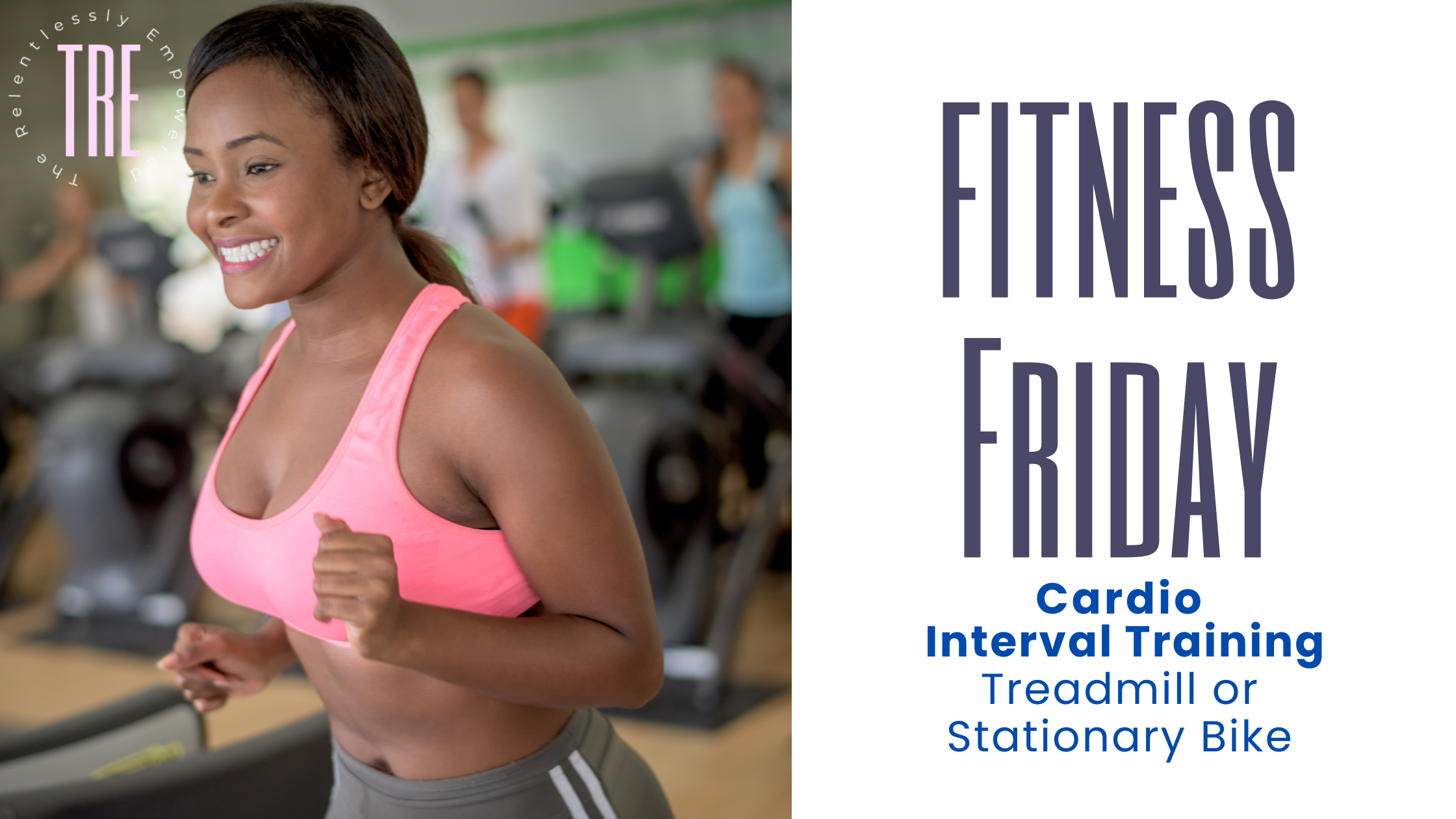
📣 Fitness Friday: Let’s Talk Cardio Intervals! 🏃🏽♀️🚴🏽♂️
Want to torch calories, boost your heart health, and increase energy—all in under 25 minutes? Say less. Here's how to crush your cardio using a treadmill or stationary bike:
Want to torch calories, boost your heart health, and increase energy—all in under 25 minutes? Say less. Here's how to crush your cardio using a treadmill or stationary bike:
🔥 STEP 1: WARM-UP (3–5 min)
Start with a light walk or slow pedal to ease your body in and get that heart rate up gradually. Think of this as setting the tone—not sprinting out the gate.
⚡ STEP 2: MAIN WORKOUT (12–15 min)
Alternate between 3 one-minute rounds:
1 min Moderate Pace (RPE 5/10)
1 min All-Out Effort (RPE 8/10)
1 min Easy Recovery (RPE 3–4/10)
Repeat this block 4–5 times for major cardio benefits!
💆🏽♀️ STEP 3: COOL DOWN (2–3 min)
Wrap it up with light movement and deep breathing to calm your system and kickstart recovery.
💡Pro Tip: Cardio alone won't cut it. Pairing movement with the right nutrition is where the real magic happens! Our 30-Day Anti-Inflammatory Meal Plan and the Simplify Healthy Eating Meal Plan Membership give you everything you need to support your goals—from the inside out.
🍽️ Ready to fuel your workouts and your life?
⬆️Grab your plan and join the wellness wave today!
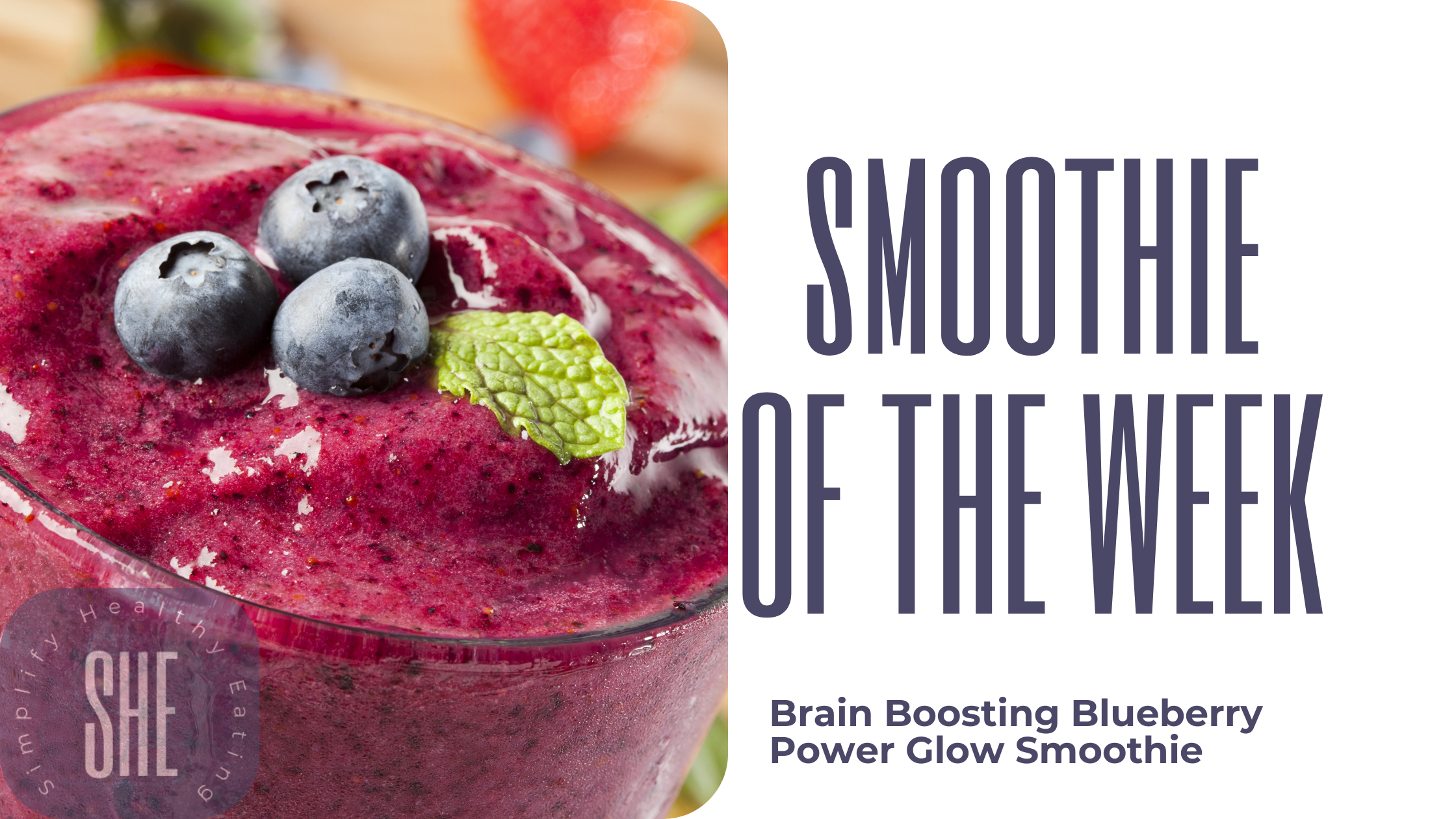
🫐 Smoothie of the Week: Brain Boosting Blueberry Power Glow Smoothie
Need a brain boost and a beauty boost? This week’s smoothie is doing double duty! The Blueberry Power Glow Smoothie is your go-to blend for sharper focus, glowing skin, and sustained energy—made with ingredients that fuel both mind and body.
Need a brain boost and a beauty boost? This week’s smoothie is doing double duty! The Blueberry Power Glow Smoothie is your go-to blend for sharper focus, glowing skin, and sustained energy—made with ingredients that fuel both mind and body.
Whether you’re powering through meetings, chasing goals, or healing from burnout, this purple powerhouse is here to help you show up clear-headed and radiant.
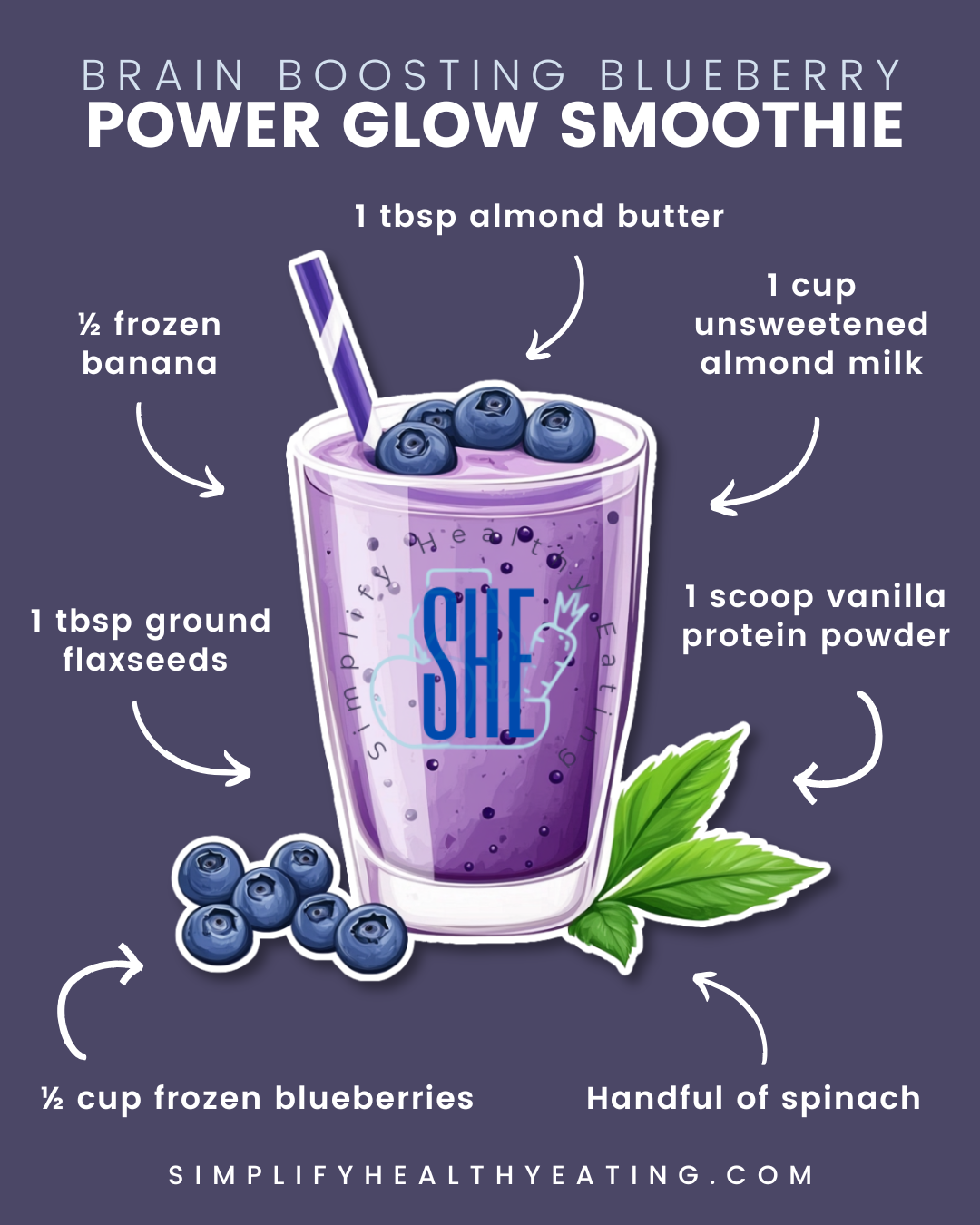
Recipe: Brain Boosting Blueberry Power Glow Smoothie
🧠 What’s in This Glow-Up in a Glass?
Each sip of this smoothie is packed with brain-loving, skin-nourishing ingredients to keep your body and your mindset aligned.
½ cup frozen blueberries – Blueberries are rich in anthocyanins and antioxidants that protect brain cells, fight inflammation, and support healthy aging.
½ frozen banana – A creamy texture and natural sweetness, plus potassium to support nervous system function.
1 tbsp ground flaxseeds – Loaded with omega-3 fatty acids and fiber to support hormone balance, brain health, and gut function.
1 tbsp almond butter – A healthy fat that fuels mental clarity and helps regulate blood sugar.
1 scoop vanilla protein powder – Keeps you satisfied and supports lean muscle and metabolism.
1 cup unsweetened almond milk – A light, dairy-free base rich in vitamin E for skin and immune health.
A handful of spinach – A gentle green packed with iron, folate, and chlorophyll to support cognitive function and detoxification.
✨ Why It Works
This smoothie is perfect if you’re:
✔️ Feeling mentally foggy or fatigued
✔️ Looking for a clean, anti-inflammatory breakfast option
✔️ Focused on hormone balance, skin clarity, or brain function
✔️ Trying to boost energy without caffeine crashes
It’s creamy, clean, and bursting with flavor—with no refined sugar or dairy in sight. Just real ingredients with real benefits.
🔧 Need a Plan to Stay Consistent?
At TheRelentlesslyEmpowered.com, we know it’s not always easy to make healthy choices every day—especially when life gets loud. That’s why we created tools to help you stay grounded in your goals:
💥 FREE 5-Day Building A Relentless Mindset Challenge
🥗 FREE 3-Day Anti-Inflammatory Meal Plan
📅 Meal Plan Memberships & Wellness Guides
Whether you’re just getting started or ready to go deeper, our resources are here to support your journey—physically, mentally, and spiritually.
🧃 Smart Swaps & Customizations
Want to switch it up?
Sub spinach for kale if you want a slightly stronger green taste.
No almond butter? Try cashew butter or sunflower seed butter.
Add a scoop of collagen for extra glow support.
Feeling bloated? Add a pinch of ginger for gut relief.
💬 Let’s Glow Together
Tried it and loved it? Drop a 💜 in the comments or tag @michelle11leslie on Instagram and show us your smoothie moment. And if you’re ready for even more feel-good fuel, check out our wellness store and free challenges to help you simplify healthy eating—without restriction or overwhelm.