

The Circadian Anchor Cardio Circuit: A Morning Workout for Energy, Blood Sugar Support, and Better Sleep
There is a reason I keep coming back to the idea that your body loves signals.
Morning light is a signal.
Movement is a signal.
Food is a signal.
Bedtime is a signal.
And when those signals happen with some degree of consistency, your body has a much easier time figuring out when it is supposed to be alert and when it is supposed to start winding down.
That is the idea behind this Circadian Anchor Cardio Circuit.
It is not about burning the maximum number of calories possible before breakfast.
It is not punishment for what you ate yesterday.
And it definitely is not one of those workouts where somebody is screaming at you to “earn” your food.
We’re using movement differently.
The purpose of this circuit is to give the body a clear daytime cue: we are awake, we are moving, and the day has begun.
When practical, doing the workout outdoors or near bright natural light in the morning can combine two strong circadian cues—light exposure and physical activity—in the same short routine.
And for busy women over 40?
Ten intentional minutes before the day runs away with you can be far more realistic than waiting for the mythical hour of free time that never shows up.
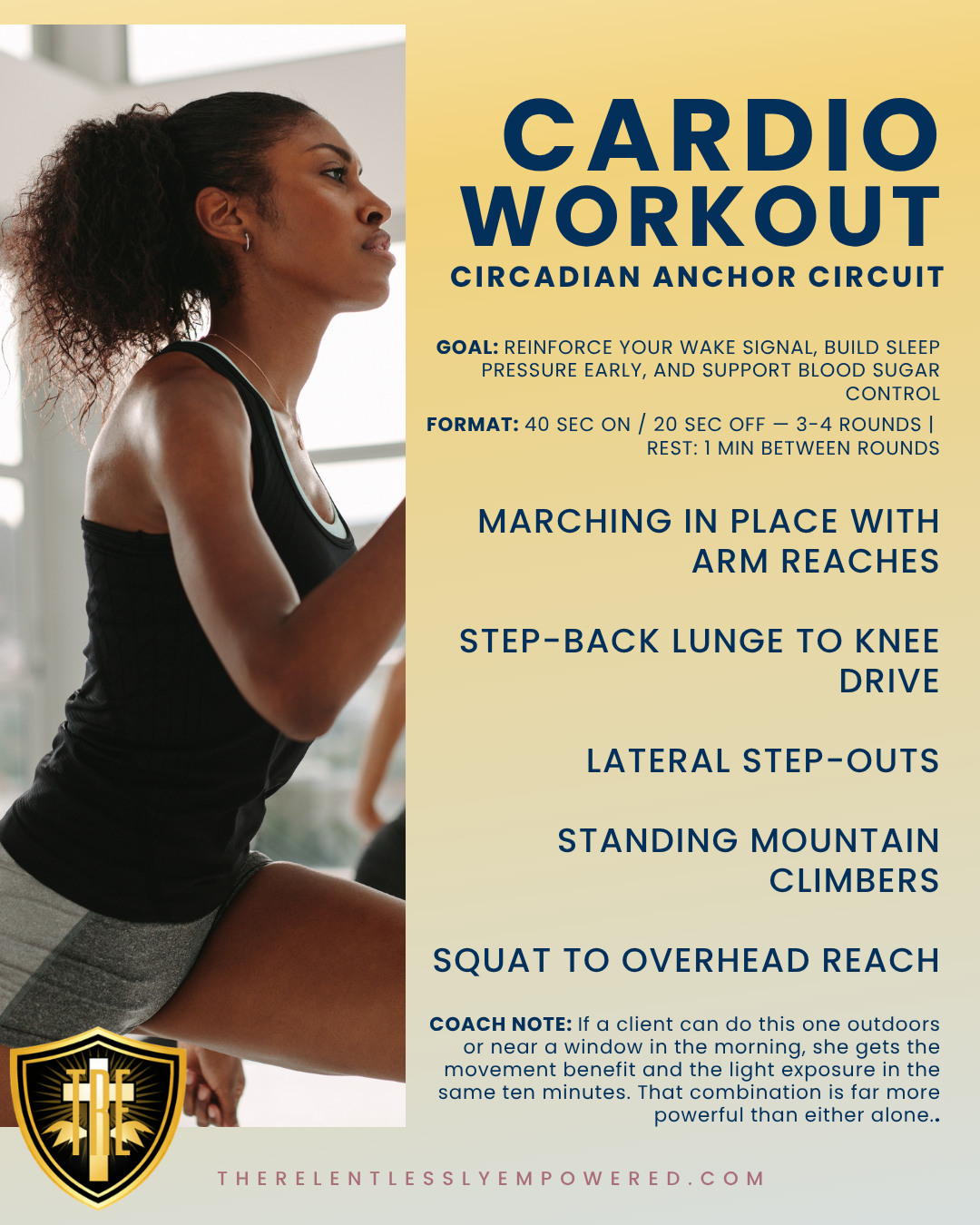
The Circadian Anchor Circuit
Goal: Support morning alertness, create meaningful physical activity early in the day, and help establish a consistent wake-and-move routine.
Format:
40 seconds of movement
20 seconds of rest
Complete 3–4 rounds
Rest approximately 1 minute between rounds
The five exercises are:
Marching in Place With Arm Reaches
Step-Back Lunge to Knee Drive
Lateral Step-Outs
Standing Mountain Climbers
Squat to Overhead Reach
Let’s break every one of them down.
Move 1: Marching in Place With Arm Reaches
This is the perfect way to get the body moving without immediately asking your joints to do something dramatic at 7 a.m.
How to do it
Stand tall with your feet about hip-width apart.
Brace your core gently and relax your shoulders.
Begin marching in place by lifting one knee and then the other.
As one knee lifts, reach the opposite arm overhead.
Continue alternating sides in a natural marching rhythm.
Land softly through the foot rather than stomping.
Gradually increase the height of the knees or speed of the march if you want more intensity.
What to focus on
Keep your torso upright rather than leaning backward.
Let the arms move freely.
Think about making the body long through the crown of the head.
Modification
Keep the knees low and use smaller arm movements.
You can also keep one hand on a chair or countertop if balance is a concern.
Progression
Turn the march into a faster power march and drive the arms more aggressively.
Why it belongs here
Marching elevates the heart rate gradually, warms the hips, and creates whole-body movement without requiring jumping.
For women who do not enjoy high-impact cardio, this can be a very useful substitute.
Move 2: Step-Back Lunge to Knee Drive
This move combines lower-body strength, balance, coordination, and cardiovascular work.
How to do it
Stand tall with your feet under your hips.
Shift your weight into your right leg.
Step your left foot backward into a reverse-lunge position.
Bend both knees comfortably, lowering only as far as you can while maintaining control.
Push through the front foot to return to standing.
As you come up, drive the left knee forward and upward toward hip height.
Pause briefly.
Step the same leg backward again and repeat.
Switch sides halfway through the interval or alternate legs each repetition.
Form cues
Keep most of your weight centered over the front leg.
Keep the front knee tracking in the same direction as the toes.
Maintain a tall torso.
Avoid rushing the transition from the lunge to the knee drive.
Modification
Skip the deep lunge.
Simply step one foot backward, tap the floor, return to standing, and lift the knee.
Use a wall, chair, or countertop for balance if needed.
Progression
Increase the depth of the lunge or add a stronger knee drive.
Why it belongs here
You get strength work for the glutes, thighs, and hips while simultaneously challenging balance and raising heart rate.
That makes it particularly efficient for a short circuit.
Move 3: Lateral Step-Outs
Not every cardio movement needs to go forward and backward.
Our bodies need side-to-side movement too.
How to do it
Stand with your feet together or hip-width apart.
Soften your knees slightly.
Step your right foot out to the side.
Shift some of your weight toward that leg.
Bring your left foot toward the right.
Then reverse direction.
Continue stepping side to side.
Allow your arms to swing naturally or reach them forward and back for additional movement.
Make it more athletic
Sit the hips back slightly as you step, almost like a shallow side squat.
That recruits more of the glutes and thighs.
Modification
Take very small lateral steps.
Progression
Increase the step width and speed while keeping the movement controlled.
Why it belongs here
Lateral movement challenges the hips differently than walking or marching and can help strengthen muscles responsible for pelvic and lower-body stability.
Move 4: Standing Mountain Climbers
You do not have to get on the floor to do mountain climbers.
This standing version gives you many of the cardiovascular and coordination benefits with considerably less impact.
How to do it
Stand tall with your feet hip-width apart.
Raise your arms overhead.
Drive your right knee toward your chest while simultaneously bringing both hands—or the opposite elbow—down toward the knee.
Return the foot to the floor and extend the arms again.
Repeat with the left knee.
Continue alternating.
Form cues
Brace the abdominal muscles gently as the knee comes up.
Keep your chest lifted.
Avoid pulling your neck forward.
Modification
Slow the movement down and lift the knee only as high as feels comfortable.
Progression
Move faster while maintaining control, almost like running in place with a stronger knee drive.
Why it belongs here
This exercise gets the arms, legs, and trunk working together and can raise heart rate quickly without requiring jumping.
Move 5: Squat to Overhead Reach
Now we finish the circuit with a full-body movement.
How to do it
Stand with your feet approximately shoulder-width apart.
Turn the toes out slightly if that feels natural.
Brace your core.
Push your hips backward as if you were sitting into a chair.
Bend the knees and lower into a comfortable squat.
Keep your chest lifted.
Push through your feet to stand.
As you reach the top, extend both arms overhead.
Then lower the arms and begin the next squat.
Form cues
Let the knees track in the same direction as the toes.
Keep your entire foot connected to the floor.
Only squat as deeply as you can control.
Modification
Place a chair behind you.
Sit lightly onto the chair, then stand and reach overhead.
Progression
Move with slightly more speed or add light dumbbells once the movement is comfortable.
Why Morning Movement Can Be a Powerful Habit
Exercise is beneficial regardless of the time you choose to do it.
So I am not interested in creating another wellness rule saying:
“You HAVE to exercise in the morning.”
You don't.
The workout you can consistently complete is usually more valuable than the theoretically perfect one that never happens.
But morning exercise can offer an additional behavioral advantage:
It gives your day an anchor.
Wake.
See light.
Move.
Eat.
Begin the day.
That repeated sequence can help establish a routine your body and brain recognize.
And if you spend most of your day sitting behind a computer, getting movement early means you have already interrupted sedentary time before the inbox even gets disrespectful.😂
What About Blood Sugar?
Physical activity helps muscles use glucose for energy and is an important part of supporting healthy glucose regulation.
That does not mean ten minutes of cardio “fixes insulin resistance.”
It means regular movement is one part of a much larger system that may include nutrition, sleep, stress management, strength training, medications when needed, and medical care.
That distinction matters.
Movement supports the system. It is not magic.
Try the 10-Minute Morning Anchor
If you are just getting started, you do not even need four rounds.
Begin with two.
Open the curtains.
Step outside if conditions allow.
Do the circuit.
Then get on with your day.
We are not trying to win the 6 a.m. Wellness Olympics.
We are building a signal:
Morning means light and movement.
Repeat it often enough and you have a system.