
Low-Sugar Green Protein Smoothie: A Creamy, High-Protein Way to Start the Day
Smoothies have a reputation for being healthy by default, but that isn’t always the case.
Throw several servings of fruit, sweetened yogurt, juice, honey, and flavored milk into the blender and that innocent-looking smoothie can quickly become closer to dessert than a balanced meal.
That doesn’t mean fruit is bad or that carbohydrates need to be feared.
It means we can build smoothies more intentionally.
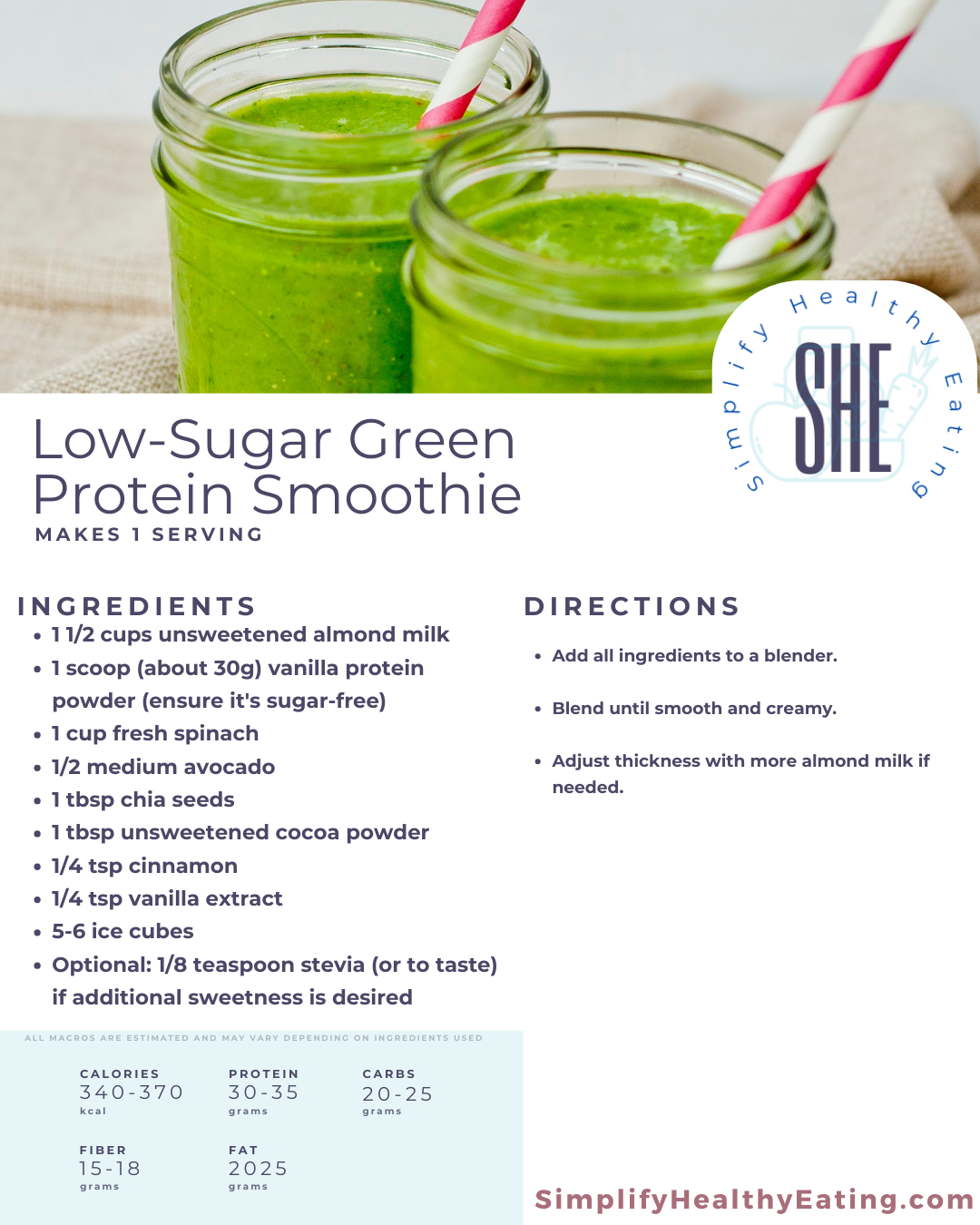
Low-Sugar Green Protein Smoothie Recipe
This Low-Sugar Green Protein Smoothie was designed with a different formula in mind:
Protein + fiber + healthy fats + plants.
Instead of relying on several cups of fruit for flavor and texture, this smoothie gets its creaminess from avocado, its fiber from chia seeds and spinach, and its staying power from protein powder and healthy fats.
And yes, we snuck some cocoa in there too, because healthy eating does not have to taste like punishment.
Ingredients
1½ cups unsweetened almond milk
1 scoop, about 30 grams, sugar-free vanilla protein powder
1 cup fresh spinach
½ medium avocado
1 tablespoon chia seeds
1 tablespoon unsweetened cocoa powder
¼ teaspoon cinnamon
¼ teaspoon vanilla extract
5–6 ice cubes
Optional: stevia to taste
Add everything to a blender and blend until completely smooth. Add a little additional almond milk if you prefer a thinner consistency.
Why These Ingredients Work So Well Together
Protein Powder: The Foundation
Protein transforms this from a vegetable drink into something much closer to a balanced mini-meal.
Protein supports the maintenance and repair of muscle tissue and can also help increase satiety, which is especially useful when a smoothie is replacing breakfast or serving as a substantial snack.
For women over 40, maintaining adequate protein intake becomes particularly important as preserving lean muscle becomes an increasingly important part of healthy aging.
Look for a protein powder that fits your dietary needs and doesn't contain large amounts of added sugar.
Spinach: Nutrition Without Overpowering the Flavor
Spinach is one of my favorite smoothie vegetables because once it is blended with cocoa, vanilla, and avocado, you barely know it is there.
Spinach provides folate, vitamin K, carotenoids, and minerals including magnesium and potassium.
It also gives you an easy serving of leafy greens before the day has gotten busy enough to start negotiating with you.
Because sometimes "I'll eat vegetables later" turns into 8:30 p.m. and three french fries.
We've all been there.
Avocado: Creaminess Plus Healthy Fat
Avocado eliminates the need for ice cream-style smoothie bases while making the finished drink rich and creamy.
It contributes primarily monounsaturated fats, along with fiber, potassium, and other micronutrients.
Fat also slows digestion compared with a smoothie made almost entirely from rapidly digested carbohydrates, helping create a more satisfying drink.
Chia Seeds: Small Ingredient, Big Nutritional Contribution
Chia seeds bring fiber, plant-based omega-3 alpha-linolenic acid, protein, and minerals.
Their soluble fiber also absorbs liquid, which helps thicken the smoothie naturally.
That combination of protein, fiber, and fat is exactly why chia fits so beautifully into the TRE approach to building more satisfying meals.
Unsweetened Cocoa Powder: Chocolate Without the Sugar Bomb
Cocoa isn't just here to make spinach easier to love.
Unsweetened cocoa contains polyphenols and provides minerals including magnesium and iron.
Choosing unsweetened cocoa allows you to get rich chocolate flavor without automatically adding a large amount of sugar.
Cinnamon
Cinnamon adds sweetness and warmth without needing additional sugar.
Research has also explored cinnamon in relation to glucose metabolism, although it should not be treated as a substitute for nutrition, medication, or medical treatment.
Here, its most important job is simple:
Make healthy food taste good enough that you'll actually want it again.
Unsweetened Almond Milk
Unsweetened almond milk provides the liquid base without adding much sugar. Many commercial brands are also fortified with nutrients such as calcium and vitamin D, although amounts vary significantly by brand.
Check your label.
Why This Smoothie May Be Helpful for Blood-Sugar-Conscious Eating
No smoothie can "control" blood sugar by itself.
But the structure of a meal matters.
Compared with a smoothie composed mainly of juice and fruit, this recipe includes substantial protein, fiber, and fat. Those nutrients generally slow digestion and make the drink more satisfying.
That's an important distinction.
The goal isn't:
Avoid carbohydrates.
The goal is:
Build carbohydrates into meals that also contain protein, fiber, and healthy fats.
Balanced plates apply to the blender too.
When to Enjoy It
This smoothie can work well as:
a quick breakfast
a post-workout option
a substantial afternoon snack
a meal when you don't have time to cook
an easy way to add leafy greens to your day
If it is being used as a complete meal and you have higher energy needs, you can adjust the portion or pair it with another whole-food item.
The TRE Takeaway
Healthy eating doesn't require removing every carbohydrate from your kitchen.
It requires learning how to build meals that work together.
This smoothie demonstrates that beautifully:
Protein. Fiber. Healthy fats. Vegetables. Flavor.
No complicated detox.
No "fat-burning" miracle ingredient.
Just a practical system you can repeat.