

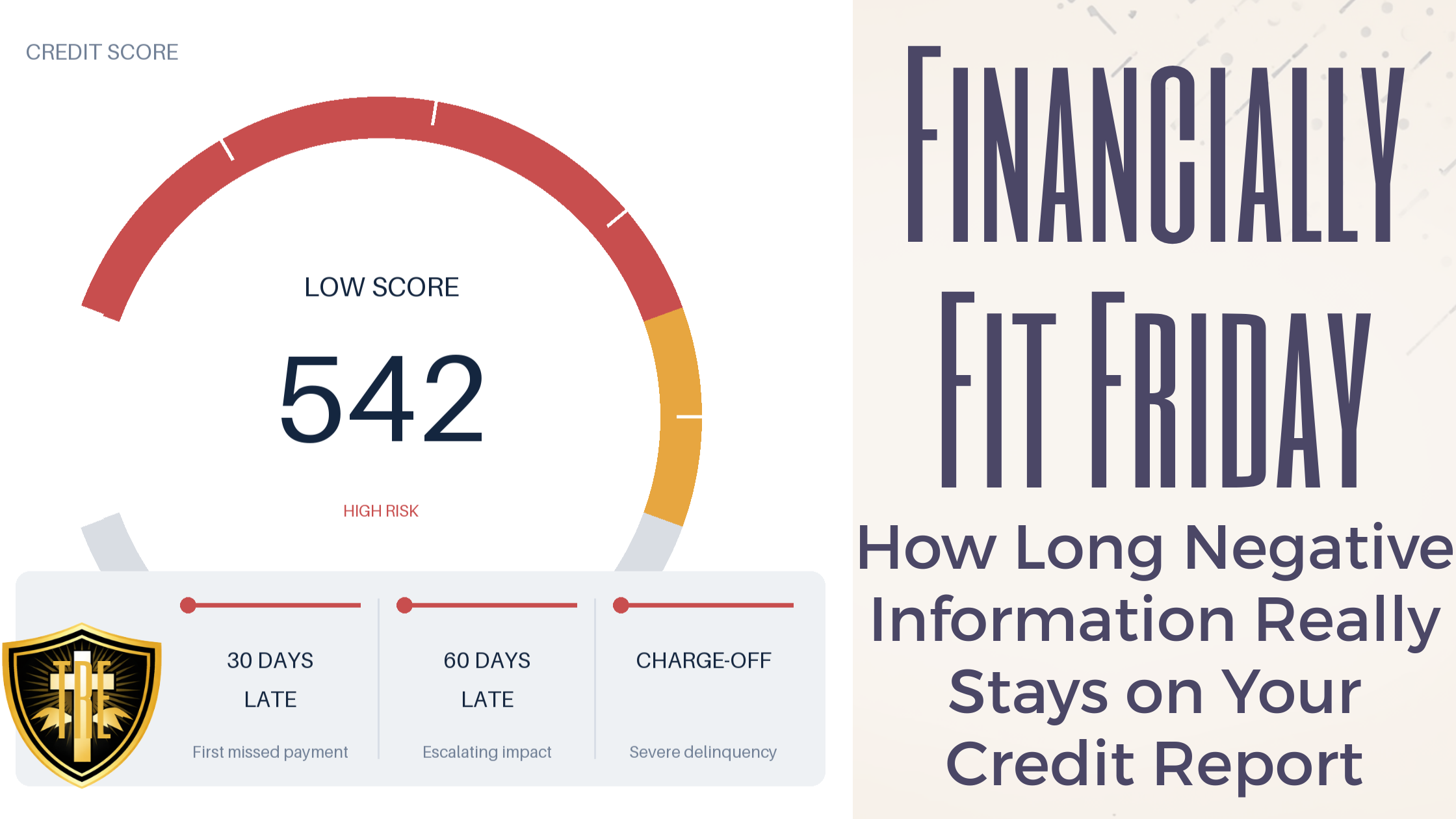
Financially Fit Fridays: How Long Negative Information Really Stays on Your Credit Report
Negative credit information is not permanent.
Credit reports are built on time, patterns, and progress — not punishment.
One of the most discouraging beliefs people carry about credit is this:
“I messed up once — and now I’m stuck forever.”
That belief keeps people frozen.
But here’s the truth many don’t hear soon enough:
Negative credit information is not permanent.
Credit reports are built on time, patterns, and progress — not punishment.
Today, let’s talk honestly about how long negative information stays on your credit report, what actually matters most, and why patience paired with consistency works.
First: Credit Reports Have a Memory — Not a Grudge
Credit systems track history, but they don’t hold moral judgments.
They record:
what happened
when it happened
how long ago it occurred
And most importantly:
👉 older negative information matters less than recent positive behavior
This is where hope lives.
How Long Common Negative Items Stay on Your Credit Report
Here’s a clear breakdown — no jargon.
Late Payments
Typically remain for 7 years
Impact lessens over time
Recent late payments matter more than old ones
💡 A late payment from years ago is far less damaging than a missed payment today.
Collections & Charge-Offs
Usually remain for 7 years from the original delinquency date
Paid or unpaid status may matter differently depending on scoring model
Important reminder:
Paying a collection doesn’t erase the past — but it can improve future lending decisions and peace of mind.
Bankruptcies
Chapter 7: up to 10 years
Chapter 13: up to 7 years
This sounds heavy — but many people begin rebuilding credit well before the bankruptcy falls off.
Time + consistency still apply.
Foreclosures
Typically remain for 7 years
Again, impact decreases as positive behavior is added after the event.
Hard Inquiries
Remain for 2 years
Usually affect scores only briefly
Inquiries are temporary — not life sentences.
What Matters More Than What’s Still There
This is key.
Your credit score is influenced more by:
what you’re doing now
recent payment behavior
current balances
Than by old negative items quietly aging in the background.
That’s why people can:
rebuild credit before items fall off
qualify for increases and new lines of credit
see steady improvement even with older marks still present
Progress doesn’t wait for perfection.
Why Time Feels Slower When You’re Rebuilding
When you’re healing — physically, emotionally, or financially — time can feel cruelly slow.
But credit rewards:
patience
predictability
restraint
The same way health improves through consistent habits, not dramatic overhauls.
Each on-time payment quietly works in your favor.
What NOT to Do While Waiting
While negative information ages, avoid:
repeatedly disputing accurate information out of frustration
chasing “instant deletion” promises
opening accounts just to feel productive
giving up because progress isn’t immediate
Time works best when you don’t fight it.
Your Only Action Step This Week
Just one.
Choose one positive habit and commit to repeating it for the next 30 days.
Examples:
on-time payment
lower balance
fewer applications
You don’t need to rush the clock.
You just need to stay consistent while it moves.
Faith, Patience & Trusting the Process
Waiting doesn’t mean nothing is happening.
Scripture reminds us that growth often occurs underground — unseen, uncelebrated, but very real.
If you’re rebuilding, trust this:
your past doesn’t cancel your future
your patience is producing progress
your credit story is still being written
You are not defined by what happened.
You are shaped by what you do next.
What’s Coming Next
In the next Financially Fit Fridays post, we’ll talk about:
Credit boundaries — how to avoid financial self-sabotage.
Because rebuilding isn’t just about numbers — it’s about habits.
If this post brought relief, save it or share it with someone who’s been discouraged by the waiting.
And as always, explore the free and low-cost resources available at The Relentlessly Empowered, created to support your whole wellness journey — finances included.
Educational Disclaimer
The content shared in this Financially Fit Fridays series is for educational and informational purposes only and is not intended as financial, legal, or credit repair advice. Everyone’s financial situation is unique. Readers are encouraged to do their own research or consult with qualified professionals before making financial decisions. Our goal is to empower you with understanding — not pressure you into action.
Financially Fit Fridays: The First 3 Things to Focus On If Your Credit Is “Bad”
Let’s start here — honestly.
If your credit is “bad,” it doesn’t mean you were careless, irresponsible, or reckless.
Sometimes it means life hit hard.
I know this personally.
After my divorce, my income was cut by nearly a third. I was receiving absolutely no financial support, yet the bills, responsibilities, and debt didn’t shrink with my circumstances. I did what so many people do in survival mode — I tried to keep up.
Let’s start here — honestly.
If your credit is “bad,” it doesn’t mean you were careless, irresponsible, or reckless.
Sometimes it means life hit hard.
I know this personally.
After my divorce, my income was cut by nearly a third. I was receiving absolutely no financial support, yet the bills, responsibilities, and debt didn’t shrink with my circumstances. I did what so many people do in survival mode — I tried to keep up.
Then my stroke happened.
And overnight, my ability to work — to earn — was taken away.
That wasn’t poor planning.
That wasn’t financial immaturity.
That was life.
And like many people who go through health crises, financial stress followed quickly. Payments fell behind. Credit suffered. Not because I didn’t care — but because my priority was surviving.
So if you’re reading this feeling discouraged by your credit, I want you to hear this clearly:
You are not alone — and this is not the end of your story.
Step 1: Stop the Bleeding (Stabilize What You Can)
When everything feels overwhelming, the first goal isn’t fixing the past.
It’s stopping further damage.
After my divorce and health crisis, I couldn’t undo what had already happened — but I could focus on preventing new late payments where possible.
That looked like:
identifying which accounts were still open
making minimum payments when I could
prioritizing consistency over perfection
Why this matters:
recent late payments hurt more than old ones
on-time payments are the strongest positive signal in credit rebuilding
Even one account paid on time, consistently, starts shifting your profile.
Stability comes before improvement.
Step 2: Reduce What’s Actively Hurting Your Score
When income drops suddenly — whether from divorce, illness, or job loss — balances often climb just trying to stay afloat.
That was true for me too.
So instead of trying to “fix everything,” I focused on reducing the biggest pressure points:
high balances
accounts near their limits
Even small reductions matter.
Credit utilization is one of the fastest areas to improve — and lowering balances gradually helped me regain control without overwhelming myself.
This isn’t about being debt-free overnight.
It’s about creating breathing room.
Step 3: Commit to Consistency — Not Intensity
This step changed everything for me.
When you’re trying to recover financially, it’s tempting to:
dispute everything at once
apply for new credit too quickly
look for fast fixes
But credit doesn’t respond well to panic.
It responds to patterns.
Once I focused on:
steady payments
thoughtful decisions
letting time do its work
Things slowly began to change.
And today? I’m seeing the results:
qualifying for credit limit increases
being approved for new lines of credit
watching my credit profile strengthen month by month
Not because I rushed — but because I stayed consistent.
Time really does heal financial wounds when paired with patience and wisdom.
What NOT to Do When You’re Rebuilding
If your credit is struggling, resist the urge to:
apply for multiple accounts at once
close accounts out of frustration
pay for “quick fix” promises
shame yourself into silence
I’ve learned this the hard way:
Urgency creates more damage than delay.
Why These Three Steps Matter Most
Rebuilding credit is a lot like rebuilding health.
You don’t start with intensity.
You start with stability.
You don’t aim for perfection.
You aim for consistency.
And you don’t judge yourself for where you had to survive.
You focus on where you’re going.
Your Only Action Step This Week
Just one.
Choose one account and make one intentional, on-time payment.
That’s it.
No pressure to do more.
No requirement to fix everything.
One promise kept with yourself is how momentum begins.
Faith, Healing & Financial Restoration
Rebuilding after loss — whether emotional, physical, or financial — is holy work.
Scripture reminds us that restoration takes time, patience, and grace. And grace applies here too.
I am living proof that:
a hard season doesn’t disqualify you
financial recovery is possible
your current score is not your final destination
You are not behind.
You are rebuilding.
And rebuilding is strength.
What’s Coming Next
In the next Financially Fit Fridays post, we’ll talk about:
Credit cards — how to use them without letting them use you.
Because tools can support healing when used with understanding.
If this post resonated with you, save it or share it with someone who’s navigating a hard financial season.
And as always, explore the free and low-cost resources available at The Relentlessly Empowered, created to support your whole wellness journey — finances included.
Educational Disclaimer
The content shared in this Financially Fit Fridays series is for educational and informational purposes only and is not intended as financial, legal, or credit repair advice. Everyone’s financial situation is unique. Readers are encouraged to do their own research or consult with qualified professionals before making financial decisions. Our goal is to empower you with understanding — not pressure you into action.
Financially Fit Fridays: Common Credit Myths That Keep People Stuck
There are few topics surrounded by more misinformation than credit.
Well-meaning advice passed down from family.
Half-truths shared online.
Rules that sound responsible but quietly cause harm.
Many people aren’t struggling with credit because they’re careless — they’re struggling because they’re operating on myths instead of clarity.
Let’s clear a few of the most common ones.
There are few topics surrounded by more misinformation than credit.
Well-meaning advice passed down from family.
Half-truths shared online.
Rules that sound responsible but quietly cause harm.
Many people aren’t struggling with credit because they’re careless — they’re struggling because they’re operating on myths instead of clarity.
Let’s clear a few of the most common ones.
Myth #1: “Checking Your Credit Hurts Your Score”
This is one of the biggest reasons people avoid looking at their credit at all.
The truth:
Checking your own credit report or score is a soft inquiry — it does not lower your score.
What can affect your score is applying for new credit that triggers a hard inquiry. Simply viewing your information is safe and encouraged.
Avoidance doesn’t protect your credit.
Awareness does.
Myth #2: “You Have to Carry a Balance to Build Credit”
This one is incredibly common — and incredibly costly.
The truth:
You do not need to carry a balance or pay interest to build credit.
Credit systems care about:
on-time payments
responsible usage
Not about how much interest you pay.
Paying your balance in full (or keeping it low) is often the healthiest option.
Myth #3: “Closing Credit Cards Helps Your Score”
This advice often comes from a desire to “start fresh.”
The truth:
Closing accounts can:
reduce available credit
shorten credit history
Both of which can lower your score.
This doesn’t mean you should keep every account forever — it just means decisions should be informed, not emotional.
Myth #4: “All Debt Is Bad”
This belief can lead to fear-based financial decisions.
The truth:
Not all debt functions the same way.
There’s a difference between:
strategic, manageable debt
high-interest, stress-inducing debt
Financial wellness isn’t about never using credit — it’s about using it intentionally and wisely.
Myth #5: “Once Your Credit Is Bad, It’s Always Bad”
This myth keeps people stuck longer than necessary.
The truth:
Credit is dynamic.
Scores change
Negative marks age
New patterns matter more than old mistakes
Rebuilding doesn’t happen overnight — but it does happen with consistency.
Myth #6: “You Need a High Income to Have Good Credit”
This one creates unnecessary discouragement.
The truth:
Credit scores are not based on income.
They are based on behavior patterns, not how much money you make.
Small, steady actions can build strong credit — regardless of income level.
Myth #7: “You Have to Fix Everything at Once”
This myth fuels overwhelm.
The truth:
Credit improves through focused, repeatable habits, not massive overhauls.
Trying to do everything at once often leads to burnout or avoidance.
One step at a time is not slow — it’s sustainable.
Why Letting Go of Myths Matters
Myths create:
fear
hesitation
shame-based decisions
Truth creates:
clarity
confidence
momentum
When you stop fighting imaginary rules, you free up energy to focus on what actually works.
Your Only Action Step This Week
Just one.
Notice which credit myth you’ve been operating under — and gently release it.
Replace it with:
“I’m learning how this system works.”
That shift changes everything.
Faith, Wisdom & Unlearning
Wisdom isn’t just about gaining new knowledge — it’s also about unlearning what no longer serves us.
Letting go of fear-based beliefs is part of stewardship. And grace applies here too.
You are not behind.
You are becoming informed.
And informed people make empowered choices.
What’s Coming Next
In the next Financially Fit Fridays post, we’ll explore:
The first 3 things to focus on if your credit is ‘bad.’
Simple. Practical. No overwhelm.
If this post challenged something you were taught, save it or share it with someone who’s trying to do better — not perfect.
And as always, explore the free and low-cost resources available at The Relentlessly Empowered, created to support your whole wellness journey.
Educational Disclaimer
The content shared in this Financially Fit Fridays series is for educational and informational purposes only and is not intended as financial, legal, or credit repair advice. Everyone’s financial situation is unique. Readers are encouraged to do their own research or consult with qualified professionals before making financial decisions. Our goal is to empower you with understanding — not pressure you into action.
Financially Fit Fridays: How to Check Your Credit Safely — And What to Look For
For many people, checking their credit feels like opening a door they’re afraid to walk through.
What if it’s worse than I thought?
What if I don’t understand what I’m looking at?
What if checking it makes things worse?
Let’s start here:
For many people, checking their credit feels like opening a door they’re afraid to walk through.
What if it’s worse than I thought?
What if I don’t understand what I’m looking at?
What if checking it makes things worse?
Let’s start here:
Checking your credit does not hurt you.
Checking it unsafely or without understanding can create stress — but awareness itself is not the enemy.
Today, we’re walking through how to check your credit safely, intentionally, and without overwhelm.
First: The Two Things People Confuse
Before we go any further, let’s clear up a major misconception.
There is a difference between:
Checking your credit report
Applying for credit
Checking your own credit:
is informational
does not lower your score
is considered a soft inquiry
Applying for credit:
can involve a hard inquiry
may temporarily lower your score
Simply looking at your credit is safe.
Where to Check Your Credit Safely
You have a few trustworthy options. These allow you to view your information without impacting your score.
1. Annual Credit Report
You are entitled to free credit reports from the three major bureaus:
Experian
Equifax
TransUnion
These reports show:
accounts
balances
payment history
collections
inquiries
They do not always show your score — but they show the data behind it.
💡 Tip: Read the report like a document, not a verdict.
2. Free Credit Monitoring Tools
Many reputable platforms offer free credit monitoring with no impact on your score.
These can help you:
track changes
spot errors
build familiarity over time
The goal isn’t obsession — it’s awareness.
What to Look For (Don’t Try to Read Everything)
When you first open your report, don’t try to understand every line.
Focus on four things:
Accounts you recognize
Do the listed accounts actually belong to you?Payment status
Are accounts current, late, or in collections?Balances vs. limits
How much is being used compared to what’s available?Negative marks
Late payments, collections, charge-offs — note them without panic.
You are gathering information, not assigning blame.
What to Ignore (For Now)
On your first review, you can ignore:
minor score fluctuations
old closed accounts you don’t remember yet
jargon you don’t understand
Understanding comes with repetition — not pressure.
How Often Should You Check?
For beginners or rebuilders:
Once a month is more than enough
Even once every few months is okay
The goal is consistency, not monitoring every change.
If You See Something That Upsets You
Pause.
Take a breath.
Remember:
credit reports reflect past moments — not your future
most negative marks fade with time and consistency
nothing requires immediate action today
You don’t need to fix everything at once.
You just need clarity.
Your Only Action Step This Week
You know the pattern by now — one step.
This week, choose a safe way to view your credit report.
No applications.
No decisions.
Just information.
And when you’re done, close the page and do something grounding. You did something brave.
Faith, Courage & Clarity
Courage doesn’t mean the absence of fear — it means choosing understanding anyway.
Wisdom grows when we face reality gently, without condemnation. Financial wellness, like healing, begins with truth wrapped in grace.
What’s Coming Next
In the next Financially Fit Fridays post, we’ll talk about:
Common credit myths that keep people stuck.
Because once the myths lose their power, forward movement becomes easier.
If this post made checking your credit feel less intimidating, save it or share it with someone who needs reassurance. And as always, explore the free and low-cost resources available at The Relentlessly Empowered, created to support your whole wellness journey — including finances.
Educational Disclaimer
The content shared in this Financially Fit Fridays series is for educational and informational purposes only. It is not intended as financial, legal, or credit repair advice.
Everyone’s financial situation is unique, and readers are encouraged to do their own research or consult with qualified professionals before making financial decisions.
Our goal is to empower you with understanding — not pressure you into action.