


Financially Fit Fridays: Credit Cards — How to Use Them Wisely (Without Letting Them Use You)
For many people, credit cards come with baggage.
Fear.
Guilt.
Regret.
Especially if there was a season where cards were used to survive — not splurge.
If that’s you, I want to say this first:
Credit cards aren’t the problem.
Lack of guidance and support usually is.
For many people, credit cards come with baggage.
Fear.
Guilt.
Regret.
Especially if there was a season where cards were used to survive — not splurge.
If that’s you, I want to say this first:
Credit cards aren’t the problem.
Lack of guidance and support usually is.
Used without understanding, credit cards can create stress.
Used with intention, they can become a powerful tool for rebuilding and stability.
What Credit Cards Are Meant to Do
At their core, credit cards are designed to:
show consistent payment behavior
provide short-term flexibility
help build credit history
They are not meant to:
replace income
fund long-term lifestyle gaps
carry emotional spending
When cards are used intentionally, they support financial wellness instead of sabotaging it.
Rule #1: Use Credit Cards Like a Debit Card With a Delay
One of the healthiest mindsets is this:
If you don’t have the cash for it, don’t charge it.
That doesn’t mean you need the money sitting untouched — but it does mean the purchase should already fit within your real-life budget.
Credit cards work best when they’re used as a payment method, not a borrowing strategy.
Rule #2: Keep Balances Low — Even If You Pay on Time
On-time payments matter — but balances matter too.
High balances can:
increase stress
raise utilization
slow credit growth
A helpful guideline:
aim to keep balances below 30% of your limit
lower is even better when possible
This doesn’t mean never using the card — it means using it strategically.
Rule #3: Pay More Than the Minimum When You Can
Minimum payments keep accounts current — but they prolong debt.
When possible:
pay the statement balance
or at least pay more than the minimum
Even small extra payments reduce interest and speed up progress.
This isn’t about perfection — it’s about momentum.
Rule #4: Don’t Chase Rewards Before Stability
Cash back, points, and miles can be tempting — but they should never drive spending.
Rewards only help if:
you were already going to spend the money
you can pay the balance responsibly
Rebuilding seasons call for clarity over perks.
Rule #5: One or Two Cards Are Enough
You don’t need a wallet full of cards to build credit.
In fact:
fewer cards are easier to manage
fewer cards reduce overwhelm
consistency matters more than quantity
One well-managed card beats five neglected ones.
If Credit Cards Have Hurt You Before
It’s okay to be cautious.
It’s okay to:
set lower limits
automate payments
use cards only for one category (like gas or groceries)
Wisdom isn’t avoidance — it’s boundaries.
Your Only Action Step This Week
Just one.
Choose one credit card and assign it a clear purpose.
Examples:
groceries
gas
one recurring bill
Then commit to managing that one card well.
That’s how confidence grows.
Faith, Stewardship & Boundaries
Stewardship isn’t about deprivation — it’s about intention.
Boundaries with credit cards aren’t punishment.
They’re protection.
When you choose clarity over impulse, you’re honoring both your future and your peace.
What’s Coming Next
In the next Financially Fit Fridays post, we’ll explore:
How long negative information really stays on your credit report.
Because understanding time frames brings relief — and patience.
If this post helped shift how you see credit cards, save it or share it with someone rebuilding trust with money.
And as always, explore the free and low-cost resources available on the Home page, created to support your whole wellness journey.
Educational Disclaimer
The content shared in this Financially Fit Fridays series is for educational and informational purposes only and is not intended as financial, legal, or credit repair advice. Everyone’s financial situation is unique. Readers are encouraged to do their own research or consult with qualified professionals before making financial decisions. Our goal is to empower you with understanding — not pressure you into action.
Financially Fit Fridays: The First 3 Things to Focus On If Your Credit Is “Bad”
Let’s start here — honestly.
If your credit is “bad,” it doesn’t mean you were careless, irresponsible, or reckless.
Sometimes it means life hit hard.
I know this personally.
After my divorce, my income was cut by nearly a third. I was receiving absolutely no financial support, yet the bills, responsibilities, and debt didn’t shrink with my circumstances. I did what so many people do in survival mode — I tried to keep up.
Let’s start here — honestly.
If your credit is “bad,” it doesn’t mean you were careless, irresponsible, or reckless.
Sometimes it means life hit hard.
I know this personally.
After my divorce, my income was cut by nearly a third. I was receiving absolutely no financial support, yet the bills, responsibilities, and debt didn’t shrink with my circumstances. I did what so many people do in survival mode — I tried to keep up.
Then my stroke happened.
And overnight, my ability to work — to earn — was taken away.
That wasn’t poor planning.
That wasn’t financial immaturity.
That was life.
And like many people who go through health crises, financial stress followed quickly. Payments fell behind. Credit suffered. Not because I didn’t care — but because my priority was surviving.
So if you’re reading this feeling discouraged by your credit, I want you to hear this clearly:
You are not alone — and this is not the end of your story.
Step 1: Stop the Bleeding (Stabilize What You Can)
When everything feels overwhelming, the first goal isn’t fixing the past.
It’s stopping further damage.
After my divorce and health crisis, I couldn’t undo what had already happened — but I could focus on preventing new late payments where possible.
That looked like:
identifying which accounts were still open
making minimum payments when I could
prioritizing consistency over perfection
Why this matters:
recent late payments hurt more than old ones
on-time payments are the strongest positive signal in credit rebuilding
Even one account paid on time, consistently, starts shifting your profile.
Stability comes before improvement.
Step 2: Reduce What’s Actively Hurting Your Score
When income drops suddenly — whether from divorce, illness, or job loss — balances often climb just trying to stay afloat.
That was true for me too.
So instead of trying to “fix everything,” I focused on reducing the biggest pressure points:
high balances
accounts near their limits
Even small reductions matter.
Credit utilization is one of the fastest areas to improve — and lowering balances gradually helped me regain control without overwhelming myself.
This isn’t about being debt-free overnight.
It’s about creating breathing room.
Step 3: Commit to Consistency — Not Intensity
This step changed everything for me.
When you’re trying to recover financially, it’s tempting to:
dispute everything at once
apply for new credit too quickly
look for fast fixes
But credit doesn’t respond well to panic.
It responds to patterns.
Once I focused on:
steady payments
thoughtful decisions
letting time do its work
Things slowly began to change.
And today? I’m seeing the results:
qualifying for credit limit increases
being approved for new lines of credit
watching my credit profile strengthen month by month
Not because I rushed — but because I stayed consistent.
Time really does heal financial wounds when paired with patience and wisdom.
What NOT to Do When You’re Rebuilding
If your credit is struggling, resist the urge to:
apply for multiple accounts at once
close accounts out of frustration
pay for “quick fix” promises
shame yourself into silence
I’ve learned this the hard way:
Urgency creates more damage than delay.
Why These Three Steps Matter Most
Rebuilding credit is a lot like rebuilding health.
You don’t start with intensity.
You start with stability.
You don’t aim for perfection.
You aim for consistency.
And you don’t judge yourself for where you had to survive.
You focus on where you’re going.
Your Only Action Step This Week
Just one.
Choose one account and make one intentional, on-time payment.
That’s it.
No pressure to do more.
No requirement to fix everything.
One promise kept with yourself is how momentum begins.
Faith, Healing & Financial Restoration
Rebuilding after loss — whether emotional, physical, or financial — is holy work.
Scripture reminds us that restoration takes time, patience, and grace. And grace applies here too.
I am living proof that:
a hard season doesn’t disqualify you
financial recovery is possible
your current score is not your final destination
You are not behind.
You are rebuilding.
And rebuilding is strength.
What’s Coming Next
In the next Financially Fit Fridays post, we’ll talk about:
Credit cards — how to use them without letting them use you.
Because tools can support healing when used with understanding.
If this post resonated with you, save it or share it with someone who’s navigating a hard financial season.
And as always, explore the free and low-cost resources available at The Relentlessly Empowered, created to support your whole wellness journey — finances included.
Educational Disclaimer
The content shared in this Financially Fit Fridays series is for educational and informational purposes only and is not intended as financial, legal, or credit repair advice. Everyone’s financial situation is unique. Readers are encouraged to do their own research or consult with qualified professionals before making financial decisions. Our goal is to empower you with understanding — not pressure you into action.
Financially Fit Fridays: Common Credit Myths That Keep People Stuck
There are few topics surrounded by more misinformation than credit.
Well-meaning advice passed down from family.
Half-truths shared online.
Rules that sound responsible but quietly cause harm.
Many people aren’t struggling with credit because they’re careless — they’re struggling because they’re operating on myths instead of clarity.
Let’s clear a few of the most common ones.
There are few topics surrounded by more misinformation than credit.
Well-meaning advice passed down from family.
Half-truths shared online.
Rules that sound responsible but quietly cause harm.
Many people aren’t struggling with credit because they’re careless — they’re struggling because they’re operating on myths instead of clarity.
Let’s clear a few of the most common ones.
Myth #1: “Checking Your Credit Hurts Your Score”
This is one of the biggest reasons people avoid looking at their credit at all.
The truth:
Checking your own credit report or score is a soft inquiry — it does not lower your score.
What can affect your score is applying for new credit that triggers a hard inquiry. Simply viewing your information is safe and encouraged.
Avoidance doesn’t protect your credit.
Awareness does.
Myth #2: “You Have to Carry a Balance to Build Credit”
This one is incredibly common — and incredibly costly.
The truth:
You do not need to carry a balance or pay interest to build credit.
Credit systems care about:
on-time payments
responsible usage
Not about how much interest you pay.
Paying your balance in full (or keeping it low) is often the healthiest option.
Myth #3: “Closing Credit Cards Helps Your Score”
This advice often comes from a desire to “start fresh.”
The truth:
Closing accounts can:
reduce available credit
shorten credit history
Both of which can lower your score.
This doesn’t mean you should keep every account forever — it just means decisions should be informed, not emotional.
Myth #4: “All Debt Is Bad”
This belief can lead to fear-based financial decisions.
The truth:
Not all debt functions the same way.
There’s a difference between:
strategic, manageable debt
high-interest, stress-inducing debt
Financial wellness isn’t about never using credit — it’s about using it intentionally and wisely.
Myth #5: “Once Your Credit Is Bad, It’s Always Bad”
This myth keeps people stuck longer than necessary.
The truth:
Credit is dynamic.
Scores change
Negative marks age
New patterns matter more than old mistakes
Rebuilding doesn’t happen overnight — but it does happen with consistency.
Myth #6: “You Need a High Income to Have Good Credit”
This one creates unnecessary discouragement.
The truth:
Credit scores are not based on income.
They are based on behavior patterns, not how much money you make.
Small, steady actions can build strong credit — regardless of income level.
Myth #7: “You Have to Fix Everything at Once”
This myth fuels overwhelm.
The truth:
Credit improves through focused, repeatable habits, not massive overhauls.
Trying to do everything at once often leads to burnout or avoidance.
One step at a time is not slow — it’s sustainable.
Why Letting Go of Myths Matters
Myths create:
fear
hesitation
shame-based decisions
Truth creates:
clarity
confidence
momentum
When you stop fighting imaginary rules, you free up energy to focus on what actually works.
Your Only Action Step This Week
Just one.
Notice which credit myth you’ve been operating under — and gently release it.
Replace it with:
“I’m learning how this system works.”
That shift changes everything.
Faith, Wisdom & Unlearning
Wisdom isn’t just about gaining new knowledge — it’s also about unlearning what no longer serves us.
Letting go of fear-based beliefs is part of stewardship. And grace applies here too.
You are not behind.
You are becoming informed.
And informed people make empowered choices.
What’s Coming Next
In the next Financially Fit Fridays post, we’ll explore:
The first 3 things to focus on if your credit is ‘bad.’
Simple. Practical. No overwhelm.
If this post challenged something you were taught, save it or share it with someone who’s trying to do better — not perfect.
And as always, explore the free and low-cost resources available at The Relentlessly Empowered, created to support your whole wellness journey.
Educational Disclaimer
The content shared in this Financially Fit Fridays series is for educational and informational purposes only and is not intended as financial, legal, or credit repair advice. Everyone’s financial situation is unique. Readers are encouraged to do their own research or consult with qualified professionals before making financial decisions. Our goal is to empower you with understanding — not pressure you into action.
Financially Fit Fridays: How to Check Your Credit Safely — And What to Look For
For many people, checking their credit feels like opening a door they’re afraid to walk through.
What if it’s worse than I thought?
What if I don’t understand what I’m looking at?
What if checking it makes things worse?
Let’s start here:
For many people, checking their credit feels like opening a door they’re afraid to walk through.
What if it’s worse than I thought?
What if I don’t understand what I’m looking at?
What if checking it makes things worse?
Let’s start here:
Checking your credit does not hurt you.
Checking it unsafely or without understanding can create stress — but awareness itself is not the enemy.
Today, we’re walking through how to check your credit safely, intentionally, and without overwhelm.
First: The Two Things People Confuse
Before we go any further, let’s clear up a major misconception.
There is a difference between:
Checking your credit report
Applying for credit
Checking your own credit:
is informational
does not lower your score
is considered a soft inquiry
Applying for credit:
can involve a hard inquiry
may temporarily lower your score
Simply looking at your credit is safe.
Where to Check Your Credit Safely
You have a few trustworthy options. These allow you to view your information without impacting your score.
1. Annual Credit Report
You are entitled to free credit reports from the three major bureaus:
Experian
Equifax
TransUnion
These reports show:
accounts
balances
payment history
collections
inquiries
They do not always show your score — but they show the data behind it.
💡 Tip: Read the report like a document, not a verdict.
2. Free Credit Monitoring Tools
Many reputable platforms offer free credit monitoring with no impact on your score.
These can help you:
track changes
spot errors
build familiarity over time
The goal isn’t obsession — it’s awareness.
What to Look For (Don’t Try to Read Everything)
When you first open your report, don’t try to understand every line.
Focus on four things:
Accounts you recognize
Do the listed accounts actually belong to you?Payment status
Are accounts current, late, or in collections?Balances vs. limits
How much is being used compared to what’s available?Negative marks
Late payments, collections, charge-offs — note them without panic.
You are gathering information, not assigning blame.
What to Ignore (For Now)
On your first review, you can ignore:
minor score fluctuations
old closed accounts you don’t remember yet
jargon you don’t understand
Understanding comes with repetition — not pressure.
How Often Should You Check?
For beginners or rebuilders:
Once a month is more than enough
Even once every few months is okay
The goal is consistency, not monitoring every change.
If You See Something That Upsets You
Pause.
Take a breath.
Remember:
credit reports reflect past moments — not your future
most negative marks fade with time and consistency
nothing requires immediate action today
You don’t need to fix everything at once.
You just need clarity.
Your Only Action Step This Week
You know the pattern by now — one step.
This week, choose a safe way to view your credit report.
No applications.
No decisions.
Just information.
And when you’re done, close the page and do something grounding. You did something brave.
Faith, Courage & Clarity
Courage doesn’t mean the absence of fear — it means choosing understanding anyway.
Wisdom grows when we face reality gently, without condemnation. Financial wellness, like healing, begins with truth wrapped in grace.
What’s Coming Next
In the next Financially Fit Fridays post, we’ll talk about:
Common credit myths that keep people stuck.
Because once the myths lose their power, forward movement becomes easier.
If this post made checking your credit feel less intimidating, save it or share it with someone who needs reassurance. And as always, explore the free and low-cost resources available at The Relentlessly Empowered, created to support your whole wellness journey — including finances.
Educational Disclaimer
The content shared in this Financially Fit Fridays series is for educational and informational purposes only. It is not intended as financial, legal, or credit repair advice.
Everyone’s financial situation is unique, and readers are encouraged to do their own research or consult with qualified professionals before making financial decisions.
Our goal is to empower you with understanding — not pressure you into action.
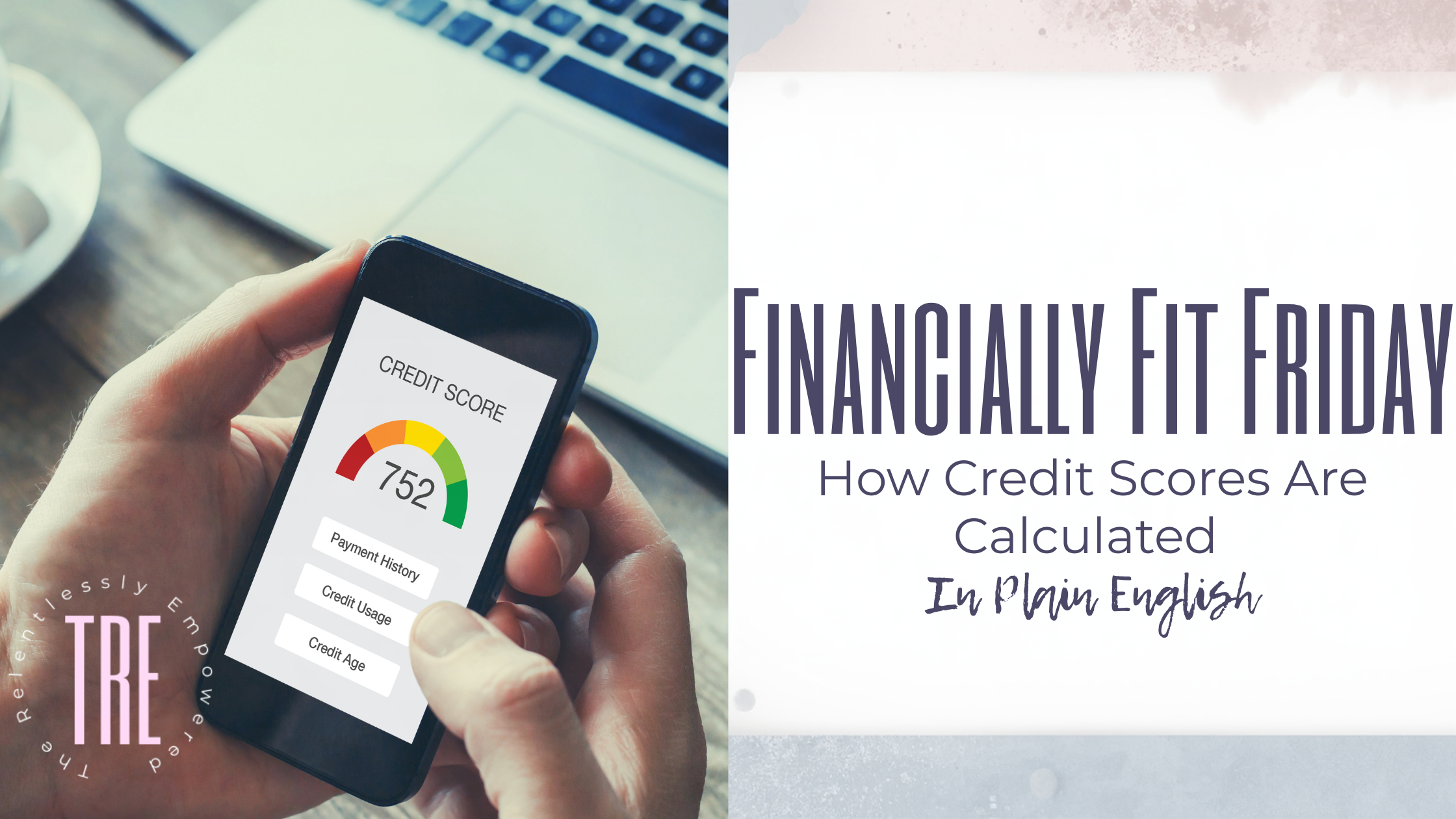
Financially Fit Fridays: How Credit Scores Are Calculated — In Plain English
If you’ve ever checked your credit score and thought,
“How did they even come up with this number?”
you’re not alone.
Credit scores can feel random — like they change without warning or logic. But the truth is, credit scores are calculated using specific, predictable factors. Once you understand them, you stop guessing and start making intentional moves.
Let’s break it down — simply, clearly, and without overwhelm.
If you’ve ever checked your credit score and thought,
“How did they even come up with this number?”
you’re not alone.
Credit scores can feel random — like they change without warning or logic. But the truth is, credit scores are calculated using specific, predictable factors. Once you understand them, you stop guessing and start making intentional moves.
Let’s break it down — simply, clearly, and without overwhelm.
The 5 Factors That Shape Your Credit Score
Most credit scores are based on five main categories. You don’t need to master them all at once — just understand how they work together.
1. Payment History (≈ 35%)
This is the biggest factor.
It answers one question:
Do you pay your bills on time?
What helps:
On-time payments
Catching up on past-due accounts
Consistency over time
What hurts:
Late payments
Accounts sent to collections
Missed payments (especially recent ones)
💡 Important note:
One late payment doesn’t ruin your life — but patterns matter. Recent behavior carries more weight than old mistakes.
2. Credit Usage / Utilization (≈ 30%)
This looks at how much of your available credit you’re using.
Example:
You have a credit card with a $1,000 limit
You’re using $800 of it
→ That’s 80% utilization (high)
Lower utilization generally helps your score.
A common guideline:
Aim to use 30% or less of your available credit when possible
This doesn’t mean you’re “bad” for using credit — it just means balance matters.
3. Length of Credit History (≈ 15%)
This factor considers:
How long your accounts have been open
The age of your oldest account
Longer histories help because they show patterns over time.
This is why:
Closing old accounts can lower a score
Starting over completely isn’t always helpful
You don’t need decades of history — just stability and patience.
4. Credit Mix (≈ 10%)
This looks at the types of credit you have, such as:
credit cards
installment loans (car, student loan, personal loan)
You are not required to have everything.
This factor simply rewards responsible variety over time.
No need to open accounts just to “check a box.”
5. New Credit / Inquiries (≈ 10%)
This reflects:
how often you apply for new credit
how many hard inquiries appear on your report
Too many applications in a short period can signal risk — not because you’re irresponsible, but because it can look unstable from a system perspective.
Slow and intentional beats rushed and reactive.
What Matters Most for Beginners
If you’re new to credit or rebuilding, focus on just two things first:
Paying on time
Keeping balances manageable
Those two alone influence more than half of your score.
You don’t need perfection.
You need consistency.
Why Scores Can Change Month to Month
Credit scores are dynamic — they update as new information is reported.
That means:
Paying down a balance can help quickly
A late payment can temporarily hurt
Improvement is possible sooner than you think
Scores are snapshots — not permanent labels.
Your Only Action Step This Week
Just one, again.
Choose one account and commit to on-time payment.
Not everything.
Not a full overhaul.
Just one clear promise you keep with yourself.
Momentum starts there.
Faith, Patience & Progress
Growth rarely happens instantly — and credit is no different.
Scripture speaks often about wisdom, stewardship, and faithfulness in small things. Financial health is built the same way: quietly, consistently, and without shame.
You are not late.
You are learning the system.
And learning changes outcomes.
What’s Coming Next
In the next Financially Fit Fridays post, we’ll cover:
How to check your credit safely — and what to look for when you do.
Because awareness plus understanding is where confidence is born.
If this post made credit feel clearer, save it or share it with someone who’s been afraid of the numbers.
And as always, explore the free and low-cost resources available at The Relentlessly Empowered, created to support your whole wellness journey — finances included.
Educational Disclaimer
The content shared in this Financially Fit Fridays series is for educational and informational purposes only. It is not intended as financial, legal, or credit repair advice.
Everyone’s financial situation is unique, and readers are encouraged to do their own research or consult with qualified professionals before making financial decisions.
Our goal is to empower you with understanding — not pressure you into action.

Financially Fit Fridays: What Credit Actually Is — And What It Is NOT
If you’ve ever checked your credit score and thought,
“How did they even come up with this number?”
you’re not alone.
One of the biggest reasons credit feels intimidating is because it’s often talked about in extremes.
Either it’s framed as something you should never touch…
or something you should somehow master overnight.
Neither is helpful — especially if you’re new to credit or rebuilding after a hard season.
So today, let’s clear the noise and get grounded in truth.
Because understanding what credit actually is — and what it is not — removes so much unnecessary fear.
What Credit Actually Is
At its core, credit is simply a record of borrowing behavior over time.
It tracks:
whether payments are made on time
how much available credit is being used
how long accounts have been open
how often new credit is requested
That’s it.
Credit is not mysterious.
It’s not emotional.
And it’s not personal — even though it often feels that way.
Think of it like a report card for patterns, not a verdict on your worth.
What Credit Is NOT (This Matters More Than You Think)
Let’s gently dismantle some common misconceptions.
Credit is NOT:
a reflection of your intelligence
proof that you’re irresponsible
a measure of your value or discipline as a person
a permanent sentence
Many people with “bad” credit weren’t reckless — they were surviving.
Medical bills.
Job loss.
Divorce.
Caring for others before yourself.
Credit systems don’t account for context — but we can.
Why This Distinction Is So Important
When people believe credit defines them, they tend to:
avoid checking it
delay learning about it
make decisions from fear instead of clarity
But when you understand credit as a neutral system, something shifts.
You stop asking:
“What’s wrong with me?”
And start asking:
“How does this work — and what’s my next best step?”
That shift alone creates momentum.
Credit Is a Tool — Just Like Anything Else
Just like:
food can nourish or harm depending on how it’s used
exercise can strengthen or injure without guidance
boundaries can protect or isolate depending on intention
Credit can either support stability or create stress — depending on understanding and use.
The goal of financial wellness isn’t avoidance.
It’s informed, intentional use.
Why Beginners Often Feel Conflicted
Many people are told:
“Never use credit”
“Credit cards are dangerous”
“Debt is always bad”
But the truth is more nuanced.
Credit isn’t inherently good or bad.
It’s leverage — and leverage requires wisdom.
Avoidance doesn’t build credit.
Blind use doesn’t either.
Education does.
Your Only Action Step This Week
Again — just one.
This week, notice how you talk to yourself about money and credit.
Pay attention to:
shame-based thoughts
“I’m bad with money” narratives
fear-driven avoidance
And gently interrupt them with:
“I’m learning. I’m allowed to learn.”
That awareness creates space for better decisions later.
Faith & Financial Understanding
Wisdom is a recurring theme throughout Scripture — not instant perfection.
Learning how systems work is not a lack of faith.
It’s stewardship.
And stewardship includes:
patience
humility
grace with yourself
You are not late.
You are not failing.
You are becoming informed.
What’s Coming Next
In the next Financially Fit Fridays post, we’ll break down:
How credit scores are calculated — in plain English.
No jargon.
No overwhelm.
Just clarity.
Because once you understand the pieces, the system stops feeling so intimidating.
If this post brought clarity, save it or share it with someone who’s been afraid to even start.
And if you’re ready to continue learning, explore the free and low-cost resources available here at The Relentlessly Empowered, designed to support your whole life — not just one piece of it.
Financially Fit Fridays: Why Credit Feels So Overwhelming — And Why It Doesn’t Have to Be
For many people, just seeing the word credit can trigger a physical response.
A tight chest.
A pit in the stomach. That urge to scroll past, avoid, or tell yourself, “I’ll deal with that later.”
If that’s you, I want you to hear this first:
For many people, just seeing the word credit can trigger a physical response.
A tight chest.
A pit in the stomach. That urge to scroll past, avoid, or tell yourself, “I’ll deal with that later.”
If that’s you, I want you to hear this first:
Nothing is wrong with you.
Most of us were never taught how credit works — only how to fear it. And when credit becomes associated with past mistakes, survival seasons, divorce, illness, or simply trying to make ends meet, it stops feeling like a financial tool and starts feeling like a judgment.
But here’s the truth that doesn’t get said often enough:
Credit is not a reflection of your character.
It’s a system. And systems can be learned.
Why Credit Feels So Heavy
Credit feels overwhelming for three main reasons:
It’s invisible.
You can’t see a credit score the way you see a bank balance. That makes it feel abstract, confusing, and out of control.It’s tied to shame.
Missed payments. Maxed-out cards. Collections. Life happening faster than income. Many people associate credit with moments they were just trying to survive.It’s talked about in extremes.
Either fear-based (“Never use credit!”) or flashy (“Just do this one trick!”). Neither helps someone who simply wants stability.
When you mix confusion + shame + urgency, avoidance makes sense. Avoidance is often the body’s way of saying, “This feels unsafe.”
A Reframe That Changes Everything
Let’s gently reset the narrative:
Credit is a tool — not a moral scorecard.
It was designed to measure patterns of behavior, not worth, intelligence, or discipline as a human being. And like any tool, it works best when you understand how it functions.
You don’t need to become a finance expert.
You don’t need to fix everything at once.
You don’t even need to love dealing with money.
You just need clarity — one layer at a time.
What Credit Actually Does (In Simple Terms)
At its core, credit answers one question:
How consistently do you do what you say you’ll do with borrowed money?
That’s it.
Credit systems look at:
whether payments are made on time
how much of available credit is being used
how long accounts have existed
how often new credit is opened
Notice what’s not on that list:
your income
your education
your faith
your intentions
your healing journey
This is important because it means your past doesn’t disqualify your future — it just informs the starting point.
Why Beginners Get Stuck
Many people don’t move forward because they believe:
“I need to fix everything before I start”
“My credit is too far gone”
“I’ll look at it when I’m less stressed”
But financial wellness doesn’t come after life settles down.
It’s built during imperfect seasons.
Just like nutrition or mindset, small consistent actions matter more than big emotional swings.
Your Only Action Step This Week
That’s right — one step.
This week, simply commit to learning without judgment.
No pulling reports yet.
No applications.
No decisions.
Just permission to say:
“I’m allowed to understand this without shame.”
Awareness is the first form of empowerment.
Faith & Financial Healing
Scripture reminds us that wisdom grows in understanding, not condemnation.
Financial growth — like physical and emotional healing — is a process. And grace belongs in this conversation too.
You are not behind.
You are rebuilding.
And rebuilding is a strength.
What’s Coming Next
In the coming months of Financially Fit Fridays, we’ll walk through:
what credit really is (and isn’t)
how scores are calculated
how to check your credit safely
how to rebuild after hard seasons
how to use credit without fear
Step by step. No rush. No shame.
Because wellness includes peace — and peace includes finances.
If this post felt grounding, save it or share it with someone who needs permission to start gently.
And if you’re ready to continue the journey, explore the free and low-cost resources available here at The Relentlessly Empowered — designed to support your whole life, not just one area.
Educational Disclaimer
The content shared in this Financially Fit Fridays series is for educational and informational purposes only. It is not intended as financial, legal, or credit repair advice.
Everyone’s financial situation is unique, and readers are encouraged to do their own research or consult with qualified professionals before making financial decisions.
Our goal is to empower you with understanding — not pressure you into action.