
5 Journal Prompts for Volume Eating & Food Freedom
There is a difference between eating less and eating well.
And honestly? A lot of us were never taught that.
We were taught to shrink the plate, skip the snack, cut the carbs, ignore hunger, drink more water, and “be disciplined.” We were taught that if we felt full, we probably did something wrong. We were taught that the smaller the portion, the better the choice.
There is a difference between eating less and eating well.
And honestly? A lot of us were never taught that.
We were taught to shrink the plate, skip the snack, cut the carbs, ignore hunger, drink more water, and “be disciplined.” We were taught that if we felt full, we probably did something wrong. We were taught that the smaller the portion, the better the choice.
But for many women, especially women over 35 who are juggling stress, hormones, work, caregiving, fatigue, emotional eating, and years of diet culture, restriction does not create peace.
It creates a cycle.
You eat too little.
You feel proud for a few hours.
Then your body gets loud.
The cravings kick in.
You overeat later.
Then guilt shows up.
Then you promise to “do better tomorrow.”
That is not food freedom.
That is food fear dressed up as discipline.
Volume eating offers a different approach. It is not about eating endlessly or ignoring your body’s needs. It is about learning how to build full, nourishing, satisfying meals with foods that give your body what it actually needs: protein, fiber, water, color, texture, nutrients, and satisfaction.
But before the plate changes, the mindset has to change too.
That is where journaling becomes powerful.
Journaling helps you slow down long enough to notice the beliefs that are driving your food choices. Because sometimes the issue is not that you do not know what to eat. Sometimes the issue is that your thoughts around food are still rooted in restriction, guilt, fear, and punishment.
So today, let’s walk through five journal prompts to help you reset your mindset around volume eating and food freedom.
Prompt 1: Where Have I Been Confusing Eating Less With Eating Well?
This is a big one.
For many women, “healthy eating” has been reduced to “how little can I eat and still make it through the day?”
A small breakfast feels responsible.
A skipped lunch feels disciplined.
A tiny salad feels like progress.
A low-calorie snack feels like control.
But eating less is not automatically eating well.
Eating well means your body is actually being supported.
It means your meals help stabilize your energy. It means you are getting enough protein to support muscle. It means you are eating enough fiber to support fullness and digestion. It means your plate has color, nutrients, and enough food to carry you through your real life.
Because let’s be honest: your body is not just sitting around all day waiting to be smaller.
Your body is working. Thinking. Moving. Healing. Processing stress. Managing hormones. Supporting your brain. Carrying you through meetings, errands, responsibilities, workouts, family needs, and everything else on your plate.
So when you journal through this prompt, ask yourself:
Where did I learn that less food means better discipline?
When do I feel proud of myself for eating too little?
What happens later in the day when I under-eat?
Am I truly nourished, or am I just trying to feel in control?
This is not about judging yourself. It is about telling the truth.
Because once you realize that eating less has not always been the same as eating well, you can begin building a better relationship with your plate.
Prompt 2: How Does My Body Feel After a High-Volume Meal vs. a Restrictive One?
Your body gives you feedback all day long.
The problem is, many of us were trained to ignore it.
We ignore hunger until it becomes a craving.
We ignore fatigue until we crash.
We ignore fullness because we are afraid of it.
We ignore satisfaction because we think we are supposed to suffer.
But your body is not trying to sabotage you. It is trying to communicate.
A restrictive meal may look “good” on paper, but how does it feel in your body?
Do you feel satisfied?
Do you feel calm?
Do you feel energized?
Do you feel clear-headed?
Can you move on with your day without obsessing over food?
Or do you feel distracted, irritable, shaky, tired, snacky, and mentally stuck on what you are going to eat next?
Now compare that with a high-volume, balanced meal.
A high-volume meal might include lean protein, lots of vegetables, fruit, beans, potatoes, whole grains, soup, salad, or other fiber-rich foods that help your body feel full and supported.
It does not have to be fancy.
It could be a big breakfast bowl with eggs, sautéed vegetables, avocado, and fruit.
It could be a hearty salad with chicken, beans, roasted vegetables, and a flavorful dressing.
It could be soup with lean protein, vegetables, and a side of whole-grain toast.
It could be a smoothie bowl with Greek yogurt, berries, chia seeds, and protein.
The question is not, “Was this meal small enough?”
The question is, “Did this meal support me?”
Use your journal to compare the difference.
How do I feel physically after eating a restrictive meal?
How do I feel emotionally after eating a restrictive meal?
How do I feel after a full, balanced, high-volume meal?
Which meals help me feel peaceful instead of preoccupied?
That awareness can help you stop choosing meals based on fear and start choosing meals based on support.
Prompt 3: What Beliefs About Food Portion Size Am I Still Carrying That Aren’t Serving Me?
Some of our food beliefs are not even ours.
They came from diet programs.
They came from family comments.
They came from magazines.
They came from social media.
They came from watching other women apologize for being hungry.
They came from years of being told that smaller is always better.
So now, when you sit down to eat a full plate, you may feel uncomfortable before you even take the first bite.
Not because the food is wrong.
But because an old belief got activated.
Maybe you believe:
“I should not need this much food.”
“Eating a full plate means I lack control.”
“Carbs will make me gain weight.”
“I have to earn this meal.”
“If I am full, I overdid it.”
“I should always leave the table a little hungry.”
“Women are supposed to eat small portions.”
Whew.
That is a lot to carry.
And it gets heavy.
This prompt helps you separate old programming from present-day wisdom. Because the truth is, a full plate does not mean you are failing. A full plate can be an act of care, especially when it is built with foods that nourish your body.
Portion size should not be driven by shame. It should be guided by your body’s needs, your goals, your hunger, your activity level, your health priorities, and your ability to stay consistent.
Journal through this honestly:
What did I learn about portion sizes growing up?
Do I feel guilty when my plate looks full?
Do I compare my portions to other people’s plates?
What food rules am I still following that no longer serve me?
What would I believe about food if I trusted my body more?
You may find that the issue is not the plate.
It is the story you have been telling yourself about the plate.
Prompt 4: What Would It Feel Like to Eat a Full, Satisfying Plate — Without Guilt?
Take a moment and really imagine this.
You sit down to a meal that is colorful, filling, balanced, and satisfying.
There is protein on the plate.
There is fiber.
There are vegetables.
There is flavor.
There is enough food.
And instead of guilt, you feel peace.
No calculating.
No punishing.
No bargaining.
No “I’ll make up for this tomorrow.”
No shrinking yourself to prove you are worthy of results.
Just nourishment.
For some women, that may feel emotional. Because food guilt has been around for so long that peace at the plate feels unfamiliar.
But unfamiliar does not mean wrong.
It just means you are practicing something new.
Food freedom does not mean eating without structure. It means eating without shame.
It means you can have goals and still feed your body.
It means you can want fat loss and still eat enough.
It means you can enjoy food without feeling like you failed.
It means you can build a full plate without turning it into a moral decision.
Because food is not a character test.
It is nourishment. It is fuel. It is support. It is also allowed to be enjoyable.
When you journal this prompt, let yourself answer without filtering.
What would change if I stopped feeling guilty for being full?
How would my meals feel if I trusted myself more?
What would it feel like to eat enough earlier in the day?
How would my evening cravings change if I stopped under-eating?
What kind of peace am I actually craving around food?
Sometimes the thing we are craving is not more snacks.
Sometimes we are craving permission.
Permission to eat.
Permission to be satisfied.
Permission to stop fighting our bodies.
Permission to build a plate that actually supports us.
Prompt 5: What Is One Volume Eating Swap I Can Make This Week That Would Feel Easy and Sustainable?
This is where we take the reflection and turn it into action.
Because food freedom is not built by thinking about change forever.
It is built one practical choice at a time.
The key word here is sustainable.
Not extreme.
Not overwhelming.
Not a complete kitchen makeover.
Not a brand-new identity by Monday morning.
Just one swap.
Maybe you add a big handful of spinach or peppers to your eggs.
Maybe you add roasted vegetables to your lunch bowl.
Maybe you swap a tiny snack for Greek yogurt with berries and chia seeds.
Maybe you add a side salad to dinner instead of trying to eat a smaller dinner.
Maybe you make a vegetable-based soup to pair with your meals.
Maybe you add beans or lentils to a salad for more fiber and fullness.
Maybe you stop skipping breakfast and build a protein-rich plate instead.
Volume eating becomes easier when it feels doable.
This is not about perfection. This is about creating meals that help your body feel safe, satisfied, and supported.
Use your journal to choose one small step:
What meal leaves me the hungriest right now?
Where can I add more fiber, color, or protein?
What is one easy volume eating swap I can make this week?
What foods do I actually enjoy that also help me feel full?
How can I make this change simple enough to repeat?
That last question matters.
Because if you cannot repeat it, it is not your system yet.
And what we are building here is not another diet.
We are building a way of eating that supports your real life.
Volume Eating Is Not About Eating Perfectly
Volume eating is not a magic trick. It is not a new set of rules to obsess over. It is not about forcing yourself to eat foods you hate or turning every meal into a math problem.
It is simply a way to help your body feel more satisfied by choosing more foods that provide volume, nutrients, and fullness.
It can help you move away from the restriction mindset and toward a more supportive way of eating.
For women who have spent years trying to shrink their portions, this can feel like a major mindset shift.
But it is a necessary one.
Because your body was not created to be punished into wellness.
Your body deserves care.
Your body deserves nourishment.
Your body deserves consistency.
Your body deserves meals that support your energy, your brain, your mood, your metabolism, and your peace.
And you deserve to stop being afraid of a full plate.
A Gentle Food Freedom Practice for This Week
Here is a simple practice to try:
Choose one meal this week and build it with volume in mind.
Start with protein.
Add vegetables or fruit.
Add a fiber-rich carbohydrate.
Add a healthy fat.
Add flavor you actually enjoy.
Then notice how you feel afterward.
Not with judgment.
With curiosity.
Ask yourself:
Did this meal satisfy me?
Did I feel calmer around food afterward?
Did I have fewer cravings later?
Did I feel more energized?
Did I enjoy the meal?
Did this feel like something I could repeat?
That is how you begin rebuilding trust with your body.
One meal.
One thought.
One journal prompt.
One new pattern at a time.
If this conversation is hitting home for you, there’s still time to join the FREE 21-Day Happy Brain Challenge.
This challenge is for the woman who is tired of trying to build healthy habits from a place of stress, guilt, burnout, and all-or-nothing thinking.
Over 21 days, we will focus on simple mindset shifts, daily wellness rhythms, and practical encouragement to help you feel more grounded, more consistent, and more supported in your health journey.
Because sustainable wellness is not just about what is on your plate.
It is also about what is happening in your mind.
So if you have been saying, “I need to get back on track,” this is your reminder: you do not have to wait for a perfect Monday. You do not have to have it all figured out. You do not have to start from shame.
There’s still time to join us.
Come take the next step inside the FREE 21-Day Happy Brain Challenge and give yourself permission to reset your mindset, nourish your body, and rebuild habits that actually feel sustainable.
Reset Your Mindset for Volume Eating: Why More of the Right Foods Can Help You Stop Overeating
For years, so many women have been taught that eating less is the path to results.
Less food.
Smaller plates.
Fewer carbs.
Tiny portions.
Skip breakfast.
Drink water when you’re hungry.
Push through cravings.
Be “good.”
But let’s tell the truth: for a lot of women, especially women over 35 who are juggling work, family, stress, hormones, fatigue, and real-life responsibilities, restriction does not create freedom.
For years, so many women have been taught that eating less is the path to results.
Less food.
Smaller plates.
Fewer carbs.
Tiny portions.
Skip breakfast.
Drink water when you’re hungry.
Push through cravings.
Be “good.”
But let’s tell the truth: for a lot of women, especially women over 35 who are juggling work, family, stress, hormones, fatigue, and real-life responsibilities, restriction does not create freedom.
It often creates the exact opposite.
It creates obsession. It creates overeating later. It creates guilt after meals. It creates that all-or-nothing cycle where you’re “good” all day, starving by 4 p.m., and then wondering why you’re picking through the pantry at night.
That is not a character flaw.
That is your body trying to survive a system that was never designed to support you.
Volume eating is not about stuffing yourself. It is not about eating endlessly. And it is definitely not about ignoring your body’s signals.
Volume eating is about choosing foods that give your body fullness, fiber, hydration, nutrients, and satisfaction without forcing you into a restrictive mindset.
In other words, it is about learning how to build a full plate that works with your body instead of constantly fighting against it.
Mindset Shift #1: “Eating More Food Will Make Me Gain Weight”
This is one of the biggest mental blocks around volume eating.
Many women hear “eat more” and immediately think, “Absolutely not. That’s how I gain weight.”
But the question is not simply, “Am I eating more food?”
The better question is: What kind of food am I eating more of?
There is a major difference between eating more ultra-processed snack foods that leave you hungry again in an hour and eating more vegetables, lean proteins, beans, berries, soups, salads, whole grains, and high-fiber foods that actually help your body feel nourished.
A full plate of grilled chicken, roasted vegetables, greens, avocado, beans, and a fiber-rich carbohydrate is not the same as a small plate of chips, cookies, or a low-protein “diet” meal that leaves you searching for more food later.
Volume eating helps you focus on foods that take up more space on the plate and in your stomach while also providing nutrition your body can actually use.
That is why the mindset shift matters:
Old thought: Eating more food will make me gain weight.
New thought: Eating more of the right food is exactly how I stop overeating.
Because when your meals are too small, too dense, too low in protein, or too low in fiber, your body keeps asking for more. Not because you lack discipline. Because it still has needs.
Mindset Shift #2: “I Need to Restrict to See Results”
Restriction can feel productive in the beginning because it gives you a sense of control.
But control is not the same as sustainability.
You can restrict for a few days. Maybe even a few weeks. But eventually, your body pushes back. Hunger increases. Cravings get louder. Energy drops. Your mood shifts. You start thinking about food constantly.
That is not failure.
That is biology.
Your body is designed to protect you. When it senses that food is limited, it does what it can to get your attention.
This is why so many women feel like they are starting over every Monday. The problem is not that they are weak. The problem is that the plan was too restrictive to begin with.
Volume eating gives you another way.
Instead of asking, “How little can I eat and still function?” you begin asking, “How can I build meals that keep me full, satisfied, energized, and consistent?”
That shift changes everything.
Because consistency is where results come from. Not punishment. Not starving. Not trying to prove you can survive on coffee, a boiled egg, and vibes.
A better plate might include protein, fiber-rich carbohydrates, healthy fats, and lots of colorful produce. That kind of meal supports fullness, energy, digestion, blood sugar balance, and cravings.
The goal is not to eat the smallest amount possible.
The goal is to eat in a way you can actually live with.
Old thought: I need to restrict to see results.
New thought: Restriction is what’s been keeping me stuck. Volume is what sets me free.
Mindset Shift #3: “A Small Plate Means I’m Being Good”
Let’s go ahead and retire the idea that tiny portions equal virtue.
A small plate does not automatically mean you are being disciplined.
Sometimes a small plate means you are under-eating.
Sometimes it means you are setting yourself up to snack all night.
Sometimes it means you are ignoring the fact that your body has been running all day on stress, caffeine, and willpower.
And let’s be honest: many women have been trained to see fullness as something to fear.
But fullness is not the enemy.
Being comfortably full after a balanced meal is a good thing. It means your body received enough nourishment to move on with life without begging for more food every 30 minutes.
A full plate of the right foods can be one of the smartest things you put in front of your body.
That does not mean every plate needs to be huge. It means your plate should be supportive.
A supportive plate may include:
Protein to help with fullness and muscle support.
Vegetables and fruits for fiber, volume, antioxidants, and hydration.
Slow-digesting carbohydrates for energy.
Healthy fats for satisfaction.
Flavor, seasoning, and texture so the meal actually feels enjoyable.
This is especially important for busy women who are trying to stabilize energy, reduce cravings, and stop living in the restrict-binge cycle.
Old thought: A small plate means I’m being good.
New thought: A full plate of the right foods is the smartest thing I can put in front of my body.
Mindset Shift #4: “I Shouldn’t Feel This Hungry — I Just Ate”
This is where a lot of guilt creeps in.
You eat a small, “healthy” meal and then an hour later you’re hungry again. Then the self-talk starts:
“What is wrong with me?”
“Why am I always hungry?”
“I have no discipline.”
“I just ate. I shouldn’t need more food.”
But hunger after a small, dense meal is often biology, not weakness.
For example, a small protein bar may have calories, but it might not have enough volume, fiber, or real satisfaction to keep you full. A tiny bowl of cereal might be quick, but it may not give your body the protein and fiber it needs. A small salad with no protein, no healthy fat, and no real substance may look “healthy,” but it might not hold you.
Your body is not only counting calories. It is responding to fullness, nutrients, hormones, blood sugar, stress, sleep, hydration, and satisfaction.
That means two meals with the same calories can feel completely different in your body.
One might leave you full for hours.
The other might have you searching for snacks before your next meeting.
This is why volume eating can be so powerful. Foods with water, fiber, and protein help create fullness in a way that feels supportive instead of restrictive.
Think soups, stir-fries, salads with protein, smoothie bowls with fiber, roasted vegetables, berries, beans, lentils, Greek yogurt bowls, egg scrambles with vegetables, or lean protein bowls with greens and whole-food carbs.
You do not have to shame your hunger.
You can learn from it.
Old thought: I shouldn’t feel this hungry — I just ate.
New thought: Hunger after a small, dense meal is biology, not weakness. My body needs volume.
Mindset Shift #5: “I Don’t Deserve to Eat a Full Plate”
This one goes deeper than food.
Some women are not just afraid of eating more. They feel like they have to earn nourishment.
They feel like they need to be smaller before they deserve a full plate. They feel like they have to punish themselves for yesterday. They feel like fullness means failure.
But your body is not your enemy.
Your body has carried you through stress, grief, work, caregiving, long days, hard seasons, and life transitions. Your body keeps showing up for you, even when you have not always known how to show up for it.
You do not have to earn food.
You do not have to punish your body into change.
You can nourish your body and still have goals. You can want fat loss and still eat enough. You can pursue better health without making your body feel unsafe.
That is the heart of sustainable wellness.
Not restriction.
Not shame.
Not punishment.
Not “starting over” every Monday.
But learning how to care for your body with structure, wisdom, and consistency.
Old thought: I don’t deserve to eat a full plate.
New thought: My body works hard for me every single day. It deserves to be fully fed.
What Volume Eating Can Look Like in Real Life
Volume eating does not have to be complicated. It can be as simple as adding more supportive foods to meals you already eat.
Instead of a small bowl of pasta alone, add grilled chicken, roasted vegetables, spinach, and a side salad.
Instead of a tiny breakfast that leaves you hungry, try eggs with vegetables, fruit, and a high-fiber carb.
Instead of snacking through the afternoon, build a lunch with protein, greens, beans or sweet potatoes, healthy fats, and flavor.
Instead of skipping meals to “save calories,” eat enough earlier in the day so you are not battling cravings at night.
This is not about perfection. This is about creating a system your body can trust.
Because when your body trusts that it will be fed, cravings often become easier to manage. When your meals are balanced, your energy becomes more stable. When you stop fearing food, consistency becomes easier.
And consistency is the real goal.
The Real Reset Starts in Your Mindset
Volume eating is not just a nutrition strategy. It is a mindset reset.
You are learning to believe that fullness is allowed.
You are learning that nourishment is not the same as overeating.
You are learning that eating enough can actually help you stop overdoing it later.
You are learning that your body needs support, not punishment.
That is why this conversation matters.
Because the plate is not the only thing that needs to change.
The thoughts behind the plate need to change too.
There’s Still Time to Join the 21-Day Happy Brain Challenge
If you’ve been feeling mentally foggy, emotionally drained, inconsistent, or stuck in the cycle of knowing what to do but struggling to actually do it, there’s still time to join the FREE 21-Day Happy Brain Challenge.
This challenge is designed to help you reset your mind, support your habits, and start creating simple daily rhythms that help you feel more clear, grounded, and consistent.
Over 21 days, you’ll focus on practical wellness, mindset, and encouragement that supports the way you eat, think, move, and show up for yourself.
No pressure.
No perfection.
No shame.
Just one intentional step at a time.
There’s still time to join us inside the FREE 21-Day Happy Brain Challenge. Get started here and take your next step toward a healthier mindset, a more nourished body, and a routine you can actually sustain.
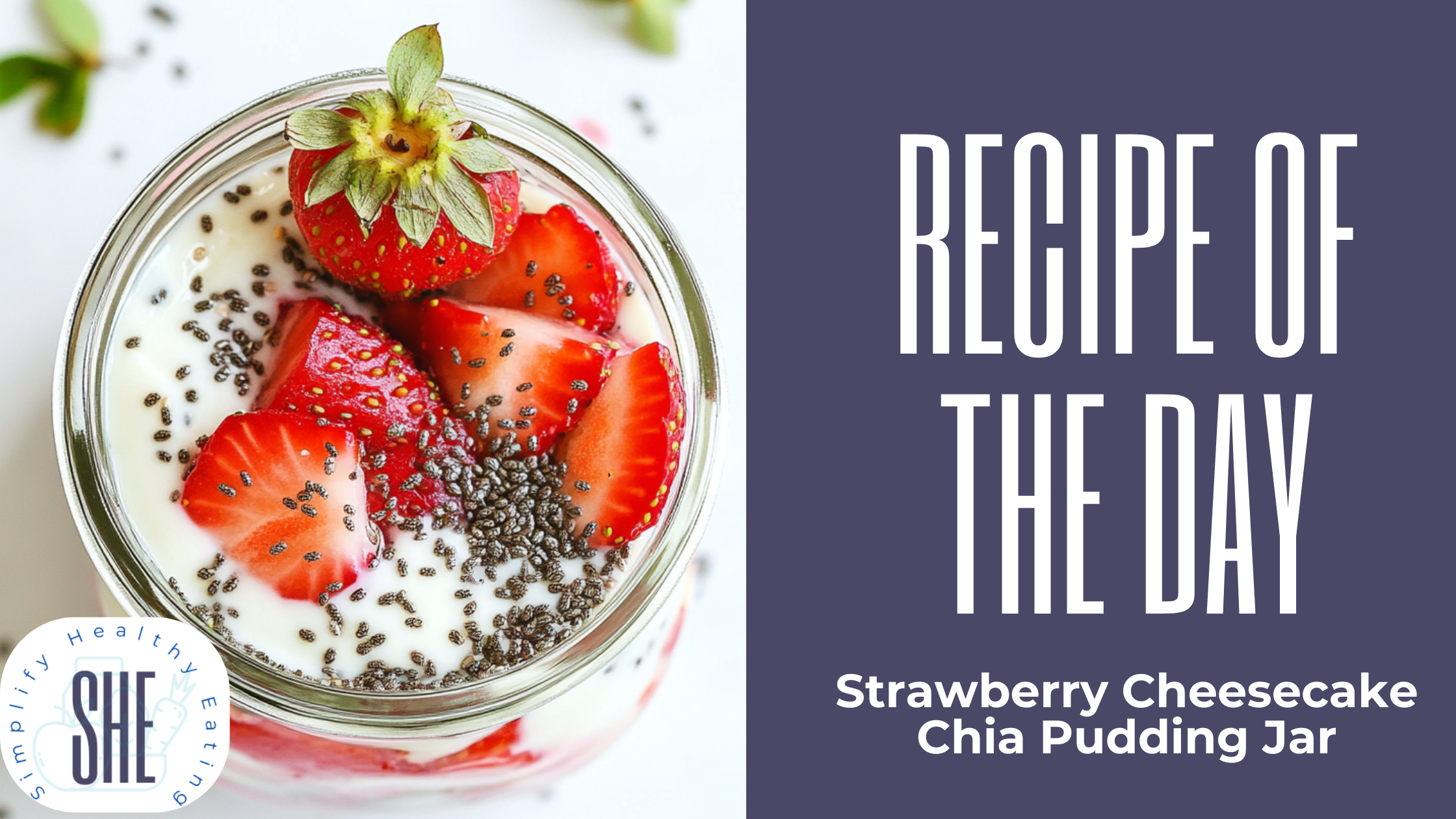
Recipe of the Day: Strawberry Cheesecake Chia Pudding Jar
This Strawberry Cheesecake Chia Pudding Jar is proof that planning ahead can feel indulgent, not restrictive. Creamy, lightly sweet, and packed with nutrients, it’s a recipe that works with your lifestyle — not against it.
This Strawberry Cheesecake Chia Pudding Jar is proof that planning ahead can feel indulgent, not restrictive. Creamy, lightly sweet, and packed with nutrients, it’s a recipe that works with your lifestyle — not against it.
Why This Recipe Works
Chia seeds absorb liquid and create a pudding‑like texture while slowing digestion, helping stabilize blood sugar and extend energy. Combined with protein‑rich dairy, this recipe keeps you satisfied for hours.
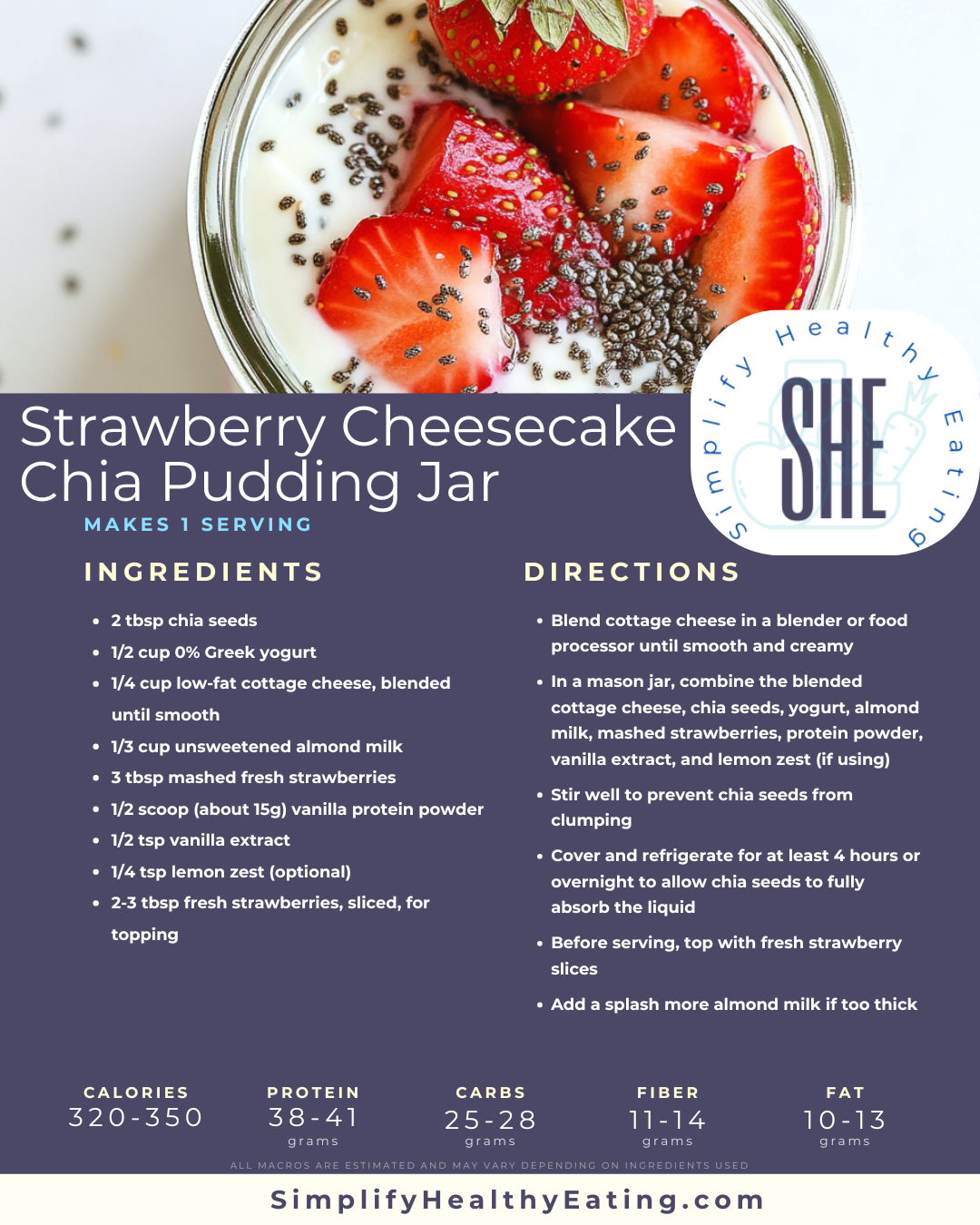
Ingredient Benefits
· Chia seeds: High in fiber, omega‑3s, and digestion‑supporting nutrients
· Greek yogurt & cottage cheese: Excellent sources of protein and gut‑supporting probiotics
· Strawberries: Naturally sweet, antioxidant‑rich, and low‑glycemic
· Almond milk: Keeps the texture light without added sugars
When to Enjoy It
· Meal‑prep breakfast option
· Afternoon snack that won’t lead to a crash
· Sweet‑tooth solution that supports consistency
✨ Consistency gets easier when your food works for you.
Visit the Simplify Healthy Eating section of our site for practical, prep‑friendly recipes that nourish your body daily.