
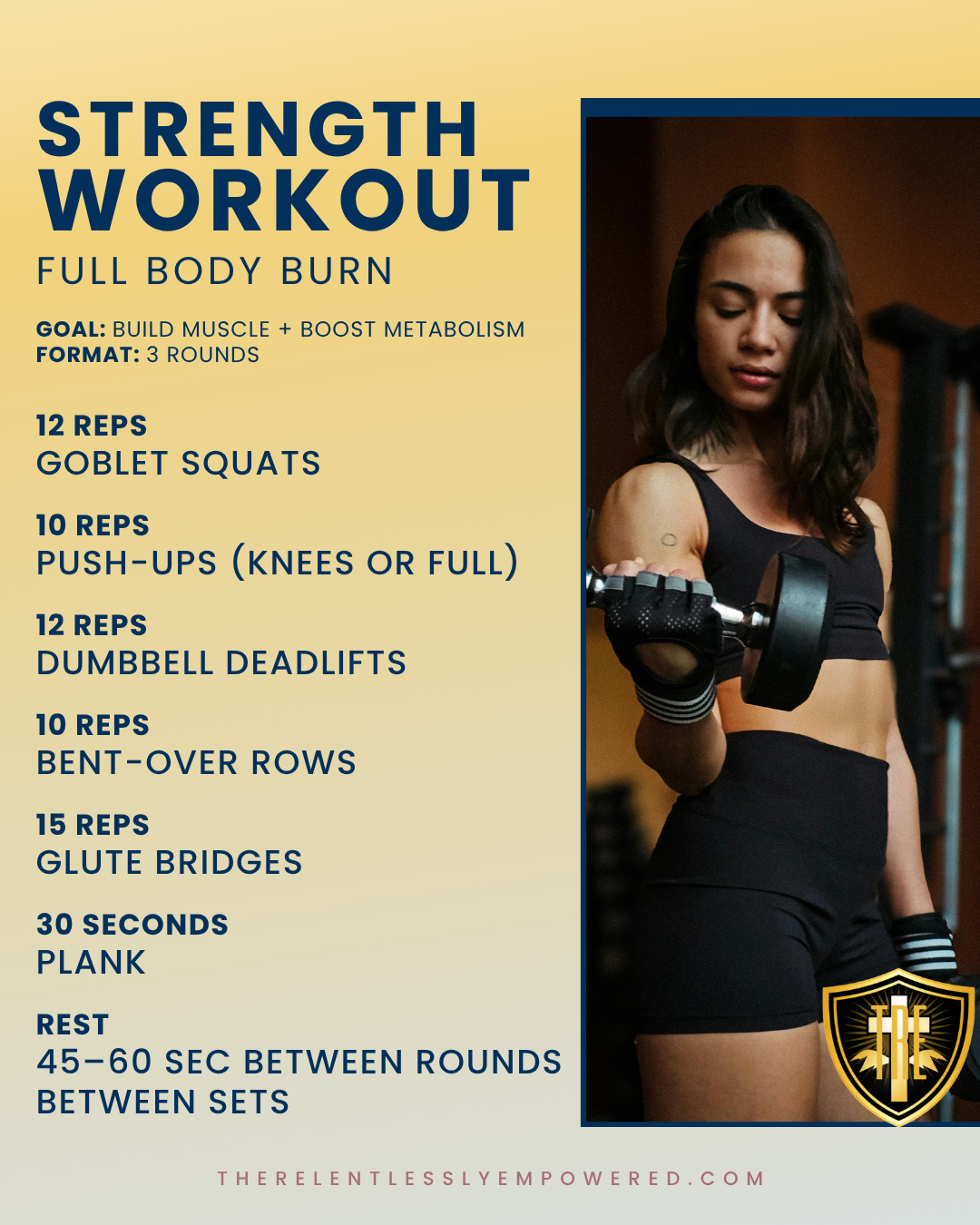
Strength Workout: Full Body Burn
Strength training is one of the most powerful things women can do for long-term wellness, energy, confidence, and sustainable fat loss.
Not because it is trendy.
Because muscle matters.
Muscle supports metabolism, strength, balance, posture, independence, and the way your body handles everyday life. For women over 35, strength training becomes even more important because muscle naturally becomes harder to maintain as we age.
That does not mean you need to live in the gym or lift the heaviest weights in the room.
It means you need a simple, repeatable plan that trains your whole body and helps you build strength safely over time.
This full body strength workout is designed to help you build muscle, boost metabolism, improve functional strength, and create that “I did something good for myself” feeling.
The Workout Format
Goal: Build muscle and boost metabolism
Format: 3 rounds
Rest: 45–60 seconds between rounds or as needed
Exercises
12 reps goblet squats
10 reps push-ups, knees or full
12 reps dumbbell deadlifts
10 reps bent-over rows
15 reps glute bridges
30-second plank
Before starting, warm up for 5 minutes with marching, bodyweight squats, hip hinges, shoulder rolls, arm circles, and gentle core activation. Choose weights that challenge you but still allow you to move with clean form.
Why This Strength Workout Works
This routine trains the whole body.
Goblet squats target the legs, glutes, and core.
Push-ups strengthen the chest, shoulders, triceps, and core.
Dumbbell deadlifts train the hamstrings, glutes, back, and hips.
Bent-over rows strengthen the upper back and posture muscles.
Glute bridges activate the glutes and support hip strength.
Planks train deep core stability.
Together, these exercises create a balanced full-body workout that supports strength, metabolism, posture, and daily movement.
This is the type of workout that helps your body become more capable, not just smaller.
How to Do Goblet Squats
Goblet squats are a lower-body strength move performed while holding one dumbbell or kettlebell at your chest.
How to do it:
Stand with your feet about shoulder-width apart.
Hold one dumbbell vertically at your chest with both hands.
Keep your elbows close to your body.
Brace your core and keep your chest lifted.
Bend your knees and push your hips back like you are sitting into a chair.
Lower until your thighs are near parallel to the floor, or as low as comfortable.
Press through your heels and midfoot to stand back up.
Squeeze your glutes at the top.
Repeat for 12 reps.
Form tips:
Keep your knees tracking in the same direction as your toes.
Do not let your chest collapse forward.
Keep your weight balanced through your feet.
Move slowly and with control.
Modification:
Perform a bodyweight squat or squat to a chair.
Progression:
Use a heavier dumbbell or slow down the lowering phase.
How to Do Push-Ups
Push-ups strengthen the upper body and core. You can do them from your knees, toes, or an elevated surface.
How to do it:
Start in a plank position with your hands slightly wider than shoulder-width apart.
Keep your body in a straight line from head to heels, or from head to knees if modifying.
Brace your core.
Bend your elbows and lower your chest toward the floor.
Keep your elbows at about a 45-degree angle from your body.
Press through your hands to return to the starting position.
Repeat for 10 reps.
Form tips:
Do not let your hips sag.
Keep your neck neutral.
Lower with control.
Exhale as you press up.
Modification:
Do push-ups on your knees or with your hands elevated on a bench, counter, or wall.
Progression:
Perform full push-ups from your toes or add a slow tempo.
How to Do Dumbbell Deadlifts
Dumbbell deadlifts train the back of the body, especially the hamstrings, glutes, and hips.
How to do it:
Stand with your feet hip-width apart.
Hold a dumbbell in each hand in front of your thighs.
Keep your knees slightly bent.
Brace your core.
Hinge at your hips by pushing your hips back behind you.
Let the dumbbells travel down the front of your legs.
Keep your back flat and chest open.
Lower until you feel a stretch in your hamstrings, or until the weights reach mid-shin.
Press through your heels and squeeze your glutes to stand tall.
Repeat for 12 reps.
Form tips:
This is a hip hinge, not a squat.
Keep the weights close to your legs.
Do not round your back.
Think “hips back, chest proud.”
Modification:
Use lighter weights or practice the movement with no weights.
Progression:
Use heavier dumbbells or slow down the lowering phase.
How to Do Bent-Over Rows
Bent-over rows strengthen the upper back, shoulders, arms, and posture muscles.
How to do it:
Stand with your feet hip-width apart.
Hold a dumbbell in each hand.
Hinge at your hips and lean your torso forward.
Keep your back flat and core engaged.
Let the dumbbells hang below your shoulders.
Pull your elbows back toward your ribs.
Squeeze your shoulder blades together.
Lower the weights with control.
Repeat for 10 reps.
Form tips:
Do not shrug your shoulders.
Keep your neck long.
Avoid swinging the weights.
Pull with your back, not just your arms.
Modification:
Do one arm at a time with one hand supported on a chair or bench.
Progression:
Use heavier weights or pause at the top of each row.
How to Do Glute Bridges
Glute bridges strengthen the glutes, hamstrings, and hips.
How to do it:
Lie on your back with your knees bent and feet flat on the floor.
Place your feet hip-width apart.
Rest your arms by your sides.
Press your lower back gently toward the floor.
Push through your heels and lift your hips.
Squeeze your glutes at the top.
Lower your hips back down with control.
Repeat for 15 reps.
Form tips:
Do not overarch your lower back.
Keep your ribs down.
Push through your heels.
Pause briefly at the top.
Modification:
Move through a smaller range of motion.
Progression:
Place a dumbbell across your hips or do single-leg glute bridges.
How to Do a Plank
Planks train core stability, shoulder strength, and full-body control.
How to do it:
Start on your forearms or hands.
Extend your legs behind you.
Keep your body in a straight line.
Brace your core like you are preparing for a gentle punch to the stomach.
Keep your glutes engaged.
Hold for 30 seconds.
Form tips:
Do not let your hips sag.
Do not lift your hips too high.
Keep your neck neutral.
Breathe steadily.
Modification:
Drop to your knees or elevate your hands on a bench.
Progression:
Hold longer, add shoulder taps, or perform a high plank.
How to Structure the Workout
Complete all six exercises in order.
Rest 45–60 seconds after the plank.
Repeat for 3 total rounds.
Move slowly enough to maintain control but with enough focus to challenge your muscles.
This is not a race. Strength training works best when your form is intentional.
Choosing the Right Weight
Choose a weight that feels challenging for the final few reps but does not cause you to lose form.
If you can barely complete the movement, the weight is too heavy.
If you finish every set and feel like you could do 15 more reps, the weight may be too light.
The sweet spot is effort with control.
Cool Down
After the workout, spend 3–5 minutes cooling down.
Stretch your hips.
Stretch your hamstrings.
Stretch your chest and shoulders.
Breathe deeply.
Let your heart rate come down.
Your recovery is part of your training.
Final Thoughts
This full body strength workout is simple, but it is powerful.
You are training your legs, glutes, chest, back, arms, and core in one efficient session. You are building muscle, supporting metabolism, and creating a foundation for long-term strength.
Remember: strength is not just about how much weight you lift.
It is about showing up consistently for the body that carries you every day.