
Strength for Better Sleep: A Full-Body Resistance Workout for Women Over 40
We tend to separate strength training and sleep into completely different wellness categories.
Strength belongs in the gym.
Sleep belongs in the bedroom.
But your body doesn't separate health into neat little folders the way Instagram does.
Muscle.
Metabolism.
Stress.
Recovery.
Sleep.
Blood sugar.
Bone health.
They interact.
And that's one reason strength training deserves a place in the conversation about better rest.
Regular resistance training supports lean muscle, physical function, bone health, and metabolic health. Exercise more broadly is also associated with improvements in sleep quality for many people.
So instead of viewing this workout as:
“How many calories can I burn?”
I want you to view it as:
“What adaptation am I asking my body to build?”
Strength.
Muscle.
Capacity.
Recovery.
That's the assignment.
Full-Body Strength Workout
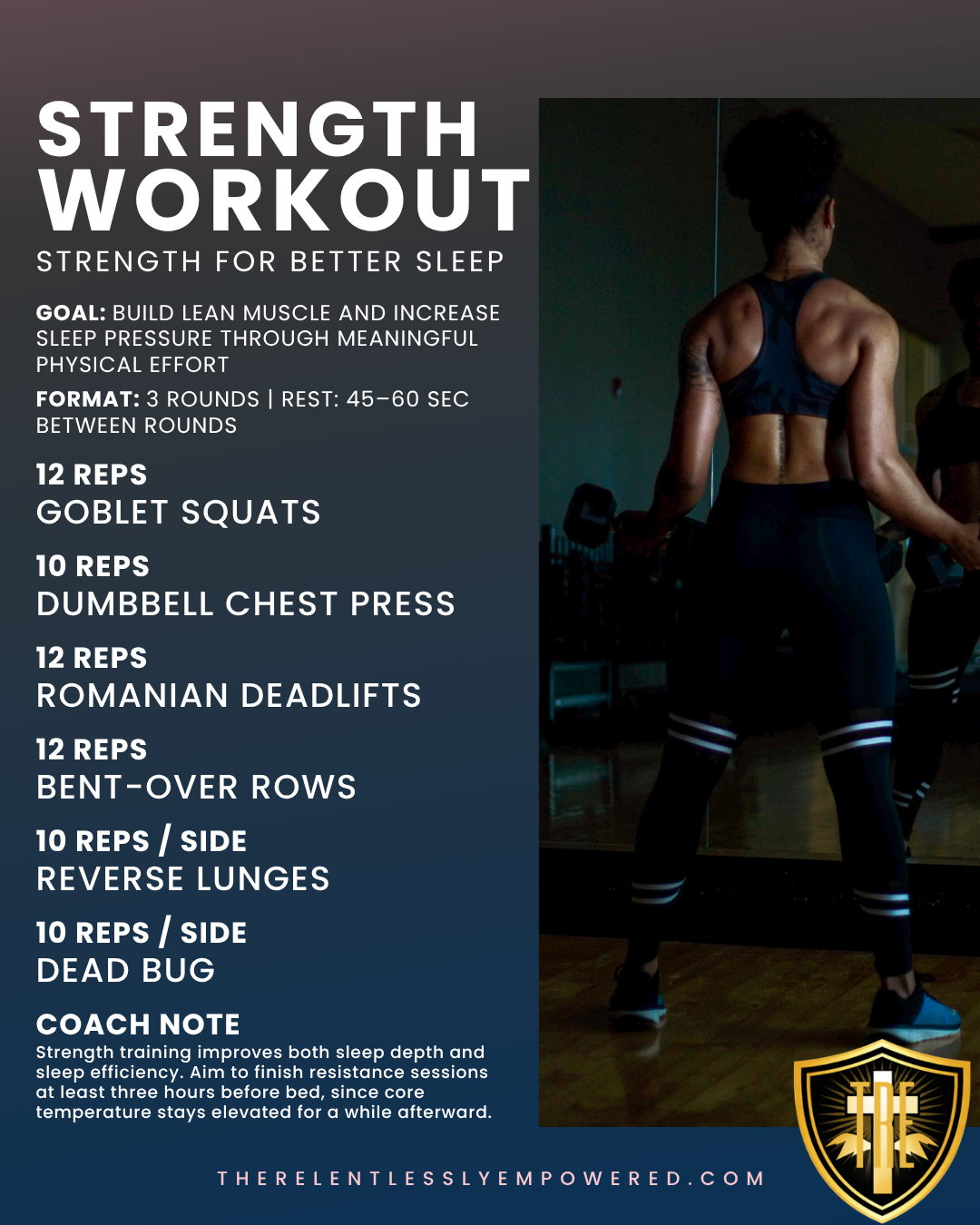
Complete 3 rounds.
Rest approximately 45–60 seconds between rounds, and take additional rest if your form starts breaking down.
You will perform:
12 Goblet Squats
10 Dumbbell Chest Presses
12 Romanian Deadlifts
12 Bent-Over Rows
10 Reverse Lunges per side
10 Dead Bugs per side
Choose weights that feel challenging while still allowing clean technique.
Exercise 1: Goblet Squat — 12 Reps
Setup
Stand with your feet about shoulder-width apart.
Hold one dumbbell vertically against your chest with both hands.
Keep your elbows pointing downward.
Movement
Brace your core.
Push the hips slightly backward.
Bend your knees and lower your body toward the floor.
Keep your chest lifted and maintain contact through your heels and the balls of your feet.
Lower only as deeply as you can without losing control.
Push through your feet to stand.
Squeeze the glutes lightly at the top.
Avoid
Letting the knees collapse inward.
Rounding the lower back.
Lifting the heels.
Beginner modification
Squat down to a chair.
Touch or sit briefly, then stand.
You can perform the movement without weight initially.
Exercise 2: Dumbbell Chest Press — 10 Reps
Setup
Lie on a bench or on the floor with a dumbbell in each hand.
Bend the knees and place the feet firmly on the floor.
Hold the dumbbells near chest level with your palms facing forward or slightly inward.
Movement
Brace the core.
Press both dumbbells upward until the arms are extended without aggressively locking the elbows.
Pause.
Lower the dumbbells slowly until the upper arms approach the floor or bench.
Press again.
Form cues
Keep the wrists stacked over the elbows.
Keep the shoulders gently pulled away from the ears.
Move slowly enough that gravity does not take over.
Beginner option
Use lighter dumbbells or perform the exercise lying on the floor, which naturally limits the range of motion.
Exercise 3: Romanian Deadlift — 12 Reps
This is one of the best movements for learning how to properly load the hips and hamstrings.
Setup
Stand tall holding dumbbells in front of your thighs.
Feet should be approximately hip-width apart.
Soften the knees slightly.
Movement
Push your hips backward.
Keep the dumbbells close to your legs.
Allow the torso to tilt forward as the hips travel backward.
Maintain a long, neutral spine.
Lower until you feel tension through the hamstrings—often somewhere between knee and mid-shin level.
Drive your hips forward to stand.
Finish tall without leaning backward.
Important cue
This is a hip hinge, not a squat.
Your hips move backward more than your knees move forward.
Beginner modification
Practice without weights first.
Imagine closing a car door behind you with your hips.
Exercise 4: Bent-Over Row — 12 Reps
Setup
Hold a dumbbell in each hand.
Soften the knees.
Hinge forward from the hips until your torso is angled toward the floor.
Maintain a neutral spine.
Let the arms hang downward.
Movement
Pull the dumbbells toward the sides of your ribs.
Draw the elbows backward.
Pause briefly.
Lower the weights with control.
Focus on
Keeping the shoulders away from the ears.
Avoiding excessive torso movement.
Thinking about pulling from your back rather than just curling with your arms.
Beginner modification
Perform a one-arm row with one hand supported on a chair or bench.
Exercise 5: Reverse Lunge — 10 Reps Per Side
Setup
Stand tall with your feet under your hips.
Movement
Step one foot backward.
Land softly on the ball of the rear foot.
Bend both knees.
Lower as far as you can while maintaining balance.
Push through the front foot to return to standing.
Repeat before switching sides.
Form cues
Keep your torso upright.
Let the front knee track in line with the toes.
Control the descent rather than dropping quickly.
Beginner modification
Hold a chair or countertop.
You can also reduce the range of motion and perform a simple step-back tap before progressing to the full lunge.
Exercise 6: Dead Bug — 10 Reps Per Side
Yes, the name is ridiculous.
The exercise is excellent.
😂
Setup
Lie on your back.
Bring your knees over your hips with the knees bent to approximately 90 degrees.
Extend your arms toward the ceiling.
Gently brace your abdominal muscles.
Movement
Slowly lower your right arm overhead while extending your left leg away from your body.
Only lower as far as you can while keeping your trunk controlled.
Return to the starting position.
Repeat with the opposite arm and leg.
Most important cue
Do not let the lower back dramatically arch away from the floor.
The goal is not to get your hand and foot as close to the floor as possible.
The goal is to maintain control.
Beginner modification
Move only the legs.
Or tap one heel toward the floor at a time while keeping both arms still.
Strength Training Is About More Than Weight Loss
Women have been sold exercise almost exclusively through the lens of shrinking ourselves.
How many calories?
How much weight?
How small can we get?
But after 40, I want us thinking much bigger.
How much muscle can we preserve?
How strong can we remain?
How well can we get up off the floor?
Carry groceries?
Protect bone?
Maintain independence?
Handle stress?
Recover?
Those are wellness goals too.
And frankly, they're some of the ones that matter most.
Can Strength Training Help Sleep?
Regular physical activity, including resistance training, may improve aspects of sleep quality for many adults.
Part of that relationship may involve physical exertion, circadian regulation, mental health, body temperature changes, and other mechanisms that researchers continue to study.
But there is no magical rule requiring everyone to stop lifting exactly three hours before bed.
Some people tolerate evening exercise beautifully.
Others find intense late workouts leave them too stimulated to fall asleep comfortably.
Use your own response as data.
If a hard 9 p.m. workout has you staring at the ceiling at midnight, move it earlier when possible.
If evening exercise fits your life and you sleep well afterward?
You don't need to invent a problem.
The TRE Principle: Train Hard Enough to Adapt, Not Hard Enough to Break Yourself
Strength training should challenge you.
It should not destroy you.
You do not need to finish every workout crawling across the floor to prove it counted.
Especially for women balancing high stress, inconsistent sleep, demanding careers, caregiving, perimenopause, or menopause, recovery belongs in the program.
Training is the stimulus.
Recovery is where adaptation happens.
Both matter.