

The Wind-Down Flow: Mindful Evening Movement to Help Your Body Transition Toward Sleep
Some of us are trying to go from:
Emails.
Deadlines.
Traffic.
Dinner.
Laundry.
Family.
Bills.
Text messages.
Scrolling.
Stress.
…straight into peaceful sleep.
In approximately seven minutes.
😂
And then we wonder why our bodies are lying in bed like:
“Ma'am, we were fighting for our lives ten minutes ago.”
This is where a wind-down practice can help.
Some of us are trying to go from:
Emails.
Deadlines.
Traffic.
Dinner.
Laundry.
Family.
Bills.
Text messages.
Scrolling.
Stress.
…straight into peaceful sleep.
In approximately seven minutes.
😂
And then we wonder why our bodies are lying in bed like:
“Ma'am, we were fighting for our lives ten minutes ago.”
This is where a wind-down practice can help.
Not because stretching is a sedative.
Not because one yoga pose magically “turns off cortisol.”
But because slowing your movements, reducing stimulation, using comfortable positions, and deliberately slowing the breath can create a useful transition between doing and resting.
The purpose of this routine is not flexibility.
We're not trying to get a split before bedtime.
The purpose is to help the body downshift.
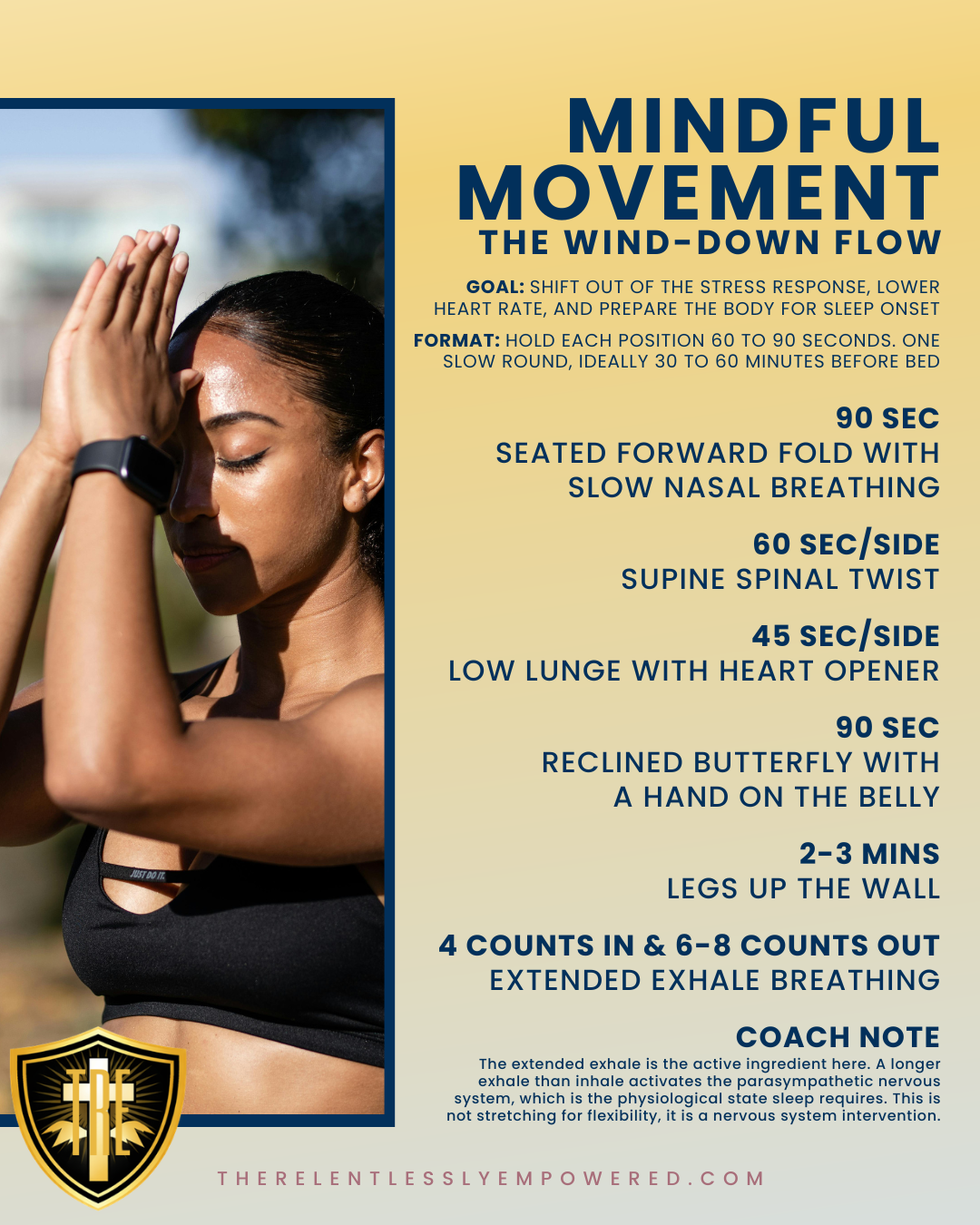
The Wind-Down Flow
Move slowly through one round approximately 30–60 minutes before bed if that fits your evening routine.
Nothing should hurt.
You should never force yourself deeper into a stretch simply because a timer says you have another 40 seconds.
The sequence:
Seated Forward Fold With Slow Breathing — 90 seconds
Supine Spinal Twist — 60 seconds per side
Low Lunge With Heart Opener — 45 seconds per side
Reclined Butterfly — 90 seconds
Legs Up the Wall — 2–3 minutes
Extended-Exhale Breathing — inhale for 4, exhale for 6–8
Move 1: Seated Forward Fold With Slow Nasal Breathing — 90 Seconds
Setup
Sit on the floor with both legs comfortably extended in front of you.
If your hamstrings feel tight or your lower back rounds dramatically, sit on a folded blanket or bend the knees.
Movement
Inhale and lengthen through your spine.
As you exhale, hinge forward gently from the hips.
Rest your hands on your legs, ankles, or wherever they naturally reach.
You do not need to touch your toes.
Allow the neck and shoulders to relax.
Breathing
Breathe slowly through the nose if comfortable.
Think about making the exhale slightly longer than the inhale.
For example:
Inhale for 4 counts.
Exhale for 6 counts.
What you should feel
A gentle stretch through the backs of the legs and perhaps the lower back.
What you should not feel
Sharp pain.
Numbness.
Tingling.
Intense pulling behind the knees.
If you feel those sensations, come out of the position.
Move 2: Supine Spinal Twist — 60 Seconds Per Side
Setup
Lie comfortably on your back.
Extend your arms out to the sides.
Bend both knees.
Movement
Bring the knees toward your chest.
Slowly lower both knees toward the right side.
Keep both shoulders as relaxed as possible against the floor.
Turn your head toward the left if that feels comfortable.
Do not force the knees all the way to the ground.
Breathe slowly.
After approximately 60 seconds, return to center and repeat on the opposite side.
Modification
Place a pillow underneath the knees if they do not comfortably reach the floor.
Focus
This should feel relaxing—not like you're trying to wring out your spine like a towel.
Move 3: Low Lunge With Heart Opener — 45 Seconds Per Side
Setup
Begin on your hands and knees or from a kneeling position.
Step your right foot forward between your hands.
Allow the left knee to remain on the floor behind you.
Place extra padding beneath the knee if necessary.
Movement
Shift the hips forward slightly until you feel a gentle stretch across the front of the left hip.
Raise the torso upright.
Bring the hands behind your back or place them gently on the lower back.
Draw the shoulders slightly backward and lift through the chest.
Do not aggressively arch the lower back.
Breathe slowly for approximately 45 seconds.
Switch sides.
Easier modification
Keep both hands resting on the front thigh instead of adding the chest opener.
Important
The stretch should come primarily from the front of the rear hip, not from compressing your lower back.
Move 4: Reclined Butterfly With a Hand on the Belly — 90 Seconds
This is one of my favorite transitions into slower breathing.
Setup
Lie on your back.
Bring the soles of your feet together.
Allow your knees to fall outward.
Place one hand on your abdomen and the other over your chest if desired.
Make it comfortable
If your hips feel strained, place pillows or yoga blocks underneath the outer thighs.
There is absolutely no award for getting your knees closer to the floor.
Comfort is the goal.
Breathing
Breathe into your abdomen.
Feel the belly gently expand as you inhale.
Let it soften as you exhale.
Try to reduce unnecessary effort in your jaw, shoulders, hands, and face.
Remain for approximately 90 seconds.
Move 5: Legs Up the Wall — 2–3 Minutes
Setup
Sit sideways next to a wall.
Carefully roll onto your back as you swing your legs upward.
Allow your heels to rest against the wall.
Your hips do not need to touch the wall.
Move farther away if your hamstrings feel tight.
Position
Let the arms rest wherever comfortable.
Relax the legs rather than actively holding them up.
Close your eyes if desired.
Breathe naturally and remain for approximately 2–3 minutes.
No wall?
Place your lower legs on the seat of a couch or chair.
You can get a similar supported resting position without trying to rearrange your bedroom furniture at 10:30 p.m.😂
Finish With Extended-Exhale Breathing
Once you're comfortable, try:
Inhale for 4 counts.
Exhale for 6 counts.
If that feels easy, experiment with:
Inhale for 4.
Exhale for 7 or 8.
Do not force a long exhale to the point that you're gasping for the next breath.
The breath should remain smooth and comfortable.
Longer, slower exhalations can encourage a calmer autonomic state and reduce breathing rate, which is one reason this technique is often incorporated into relaxation practices.
But we don't need to turn that into another wellness competition either.
If 4-in/6-out feels relaxing?
That's enough.
The Point Is Not Stretching. It Is Transition.
This distinction matters.
If your day has been stressful, your body may need more than:
“Okay, bedtime!”
A wind-down routine creates a bridge.
Bright to dim.
Busy to quiet.
Standing to reclining.
Fast breathing to slow breathing.
Problem solving to letting go.
That repeated sequence can eventually become its own cue.
You dim the lights.
You roll out the mat.
You start moving slowly.
And your brain begins recognizing:
We've done this before. The day is ending.
That's powerful.
Not because one pose has magical sleep properties.
But because human beings learn patterns.
Your Nervous System Does Not Need Another Performance Goal
This is especially important for high-achieving women.
Please don't turn relaxing into another thing you have to excel at.
😂
You don't have to achieve perfect nasal breathing.
You don't have to hold every pose for exactly 90 seconds.
You don't have to become flexible.
You don't have to buy an expensive yoga mat.
Some nights your wind-down flow may last 10 minutes.
Some nights you may only do legs up the wall and five slow breaths.
It still counts.
The goal is not:
Perfect evening routine.
The goal is:
Give your body a reliable transition from stimulation to rest.
Pair This With Your Sleep Environment
For an even clearer nighttime signal, consider combining this flow with the habits we discussed in our sleep article:
Dim the lights.
Put work away.
Reduce unnecessary stimulation.
Keep the bedroom comfortable.
Let the phone stop being the final thing your brain sees every night.
And practice the same basic routine often enough that it becomes familiar.
We aren't forcing sleep.
We're creating conditions that make rest easier to enter.
That is a very different mindset.