
The Stroke Changed My Life — But It Didn’t Get the Final Word
There are moments in life that divide everything into before and after.
Before the diagnosis.
Before the phone call.
Before the loss.
Before the health scare.
Before the moment your body forces you to stop.
For me, surviving a stroke became one of those moments.
There are moments in life that divide everything into before and after.
Before the diagnosis.
Before the phone call.
Before the loss.
Before the health scare.
Before the moment your body forces you to stop.
For me, surviving a stroke became one of those moments.
It was not just a medical event.
It was a life interruption.
A wake-up call.
A confrontation with my own humanity.
A reminder that the body is not just something we push, criticize, ignore, or drag through life.
The body is a gift.
And sometimes you do not realize how much of a gift it is until something happens that makes you wonder if you will ever move, function, or feel like yourself again.
When you have experienced something like a stroke, your relationship with your body changes.
Things you once took for granted suddenly become sacred.
Standing.
Walking.
Moving.
Preparing food.
Feeding yourself.
Having the energy to get through a day.
Being able to work out.
Being able to make choices that support your healing.
Being alive.
Those things become holy in a way they maybe were not before.
And I will never pretend that kind of season is easy.
Because it is not.
It is frightening.
It is humbling.
It is frustrating.
It is emotional.
It is one thing to talk about resilience when life is comfortable.
It is another thing to practice resilience when your body has been through trauma and you have to fight your way back one small step at a time.
When Your Body Forces You to Listen
Many of us, especially as women and professionals, get very good at ignoring our bodies.
We push through fatigue.
We normalize stress.
We skip meals.
We sleep poorly.
We overwork.
We carry emotional weight.
We function in survival mode.
We say, “I’m fine,” even when our bodies are sending warning signs.
And sometimes life has a way of making us stop.
A stroke made me look at my body differently.
Not as something to punish.
Not as something to shame.
Not as something to constantly criticize.
But as something to honor.
Something to protect.
Something to nourish.
Something to listen to.
Something to be grateful for.
After a health crisis, discipline takes on a different meaning.
It is no longer about appearance.
It is about stewardship.
It is about mobility.
It is about strength.
It is about energy.
It is about being able to participate in your own life.
It is about saying:
“I want to care for this body because it carried me through something hard.”
Resilience Looks Different After a Health Scare
When people think of resilience, they often think of big dramatic comebacks.
But after a stroke, resilience can look very quiet.
It can look like trying again.
It can look like moving slowly.
It can look like learning your limits.
It can look like crying because something that used to be easy now takes effort.
It can look like celebrating progress nobody else sees.
It can look like being grateful for small wins.
It can look like choosing nourishing food because your body deserves support.
It can look like resting without guilt.
It can look like moving your body with appreciation instead of punishment.
It can look like saying:
“I am not where I want to be yet, but I am still moving forward.”
That is relentless.
Not loud.
Not flashy.
Not perfect.
But relentless.
And sometimes relentless does not mean pushing harder.
Sometimes relentless means refusing to quit on yourself.
The Pursuit of the Other Side
Getting to the other side after a health crisis is not just physical.
It is mental.
Emotional.
Spiritual.
You have to rebuild trust with your body.
You have to process fear.
You have to accept that your life may require new rhythms.
You have to learn the difference between pushing yourself and supporting yourself.
You have to be honest about what your body needs now.
And that can be difficult when you are used to being the strong one.
The capable one.
The one who handles everything.
The one who keeps going.
But sometimes healing requires a new kind of strength.
The strength to slow down.
The strength to ask for help.
The strength to change your habits.
The strength to create structure.
The strength to honor your limitations while still believing in your capacity.
That is real resilience.
Healthy Habits Became a Form of Gratitude
After surviving something that threatened my body, healthy habits became more than wellness content.
They became gratitude in action.
Movement became gratitude.
Eating well became gratitude.
Rest became gratitude.
Hydration became gratitude.
Strength training became gratitude.
Preparing nourishing meals became gratitude.
Listening to my body became gratitude.
Because when you know what it feels like for your body to go through something serious, you stop seeing wellness as punishment.
You start seeing it as partnership.
You start understanding that every small supportive choice matters.
Not because you are chasing perfection.
But because you are honoring the life you still have.
And that is why I care so much about helping women build sustainable routines.
Because wellness should not be rooted in shame.
It should be rooted in appreciation.
Support.
Healing.
Stewardship.
And self-respect.
Your Body Deserves Support, Not Shame
If you are over 40 and feeling burned out, inflamed, tired, overwhelmed, or disconnected from your body, I want you to pause and ask yourself:
“What would it look like to support my body instead of fighting it?”
Not punish it.
Not shame it.
Not ignore it.
Support it.
With meals that nourish you.
With movement that strengthens you.
With rest that restores you.
With boundaries that protect you.
With routines that create stability.
With faith that reminds you that your story is not over.
Because sometimes the body is not asking for a stricter plan.
Sometimes the body is asking for care.
Monday Mindset Reflection
This week, I want you to think about one thing:
What is one small way you can honor your body today?
Maybe it is drinking more water.
Maybe it is going to bed earlier.
Maybe it is taking a 10-minute walk.
Maybe it is cooking a balanced meal.
Maybe it is scheduling the appointment.
Maybe it is resting without guilt.
Maybe it is simply saying, “Thank You, God, for another day to try again.”
Whatever it is, start there.
Because resilience is not always about making huge moves.
Sometimes resilience is making the next faithful move.
The next nourishing choice.
The next loving decision.
The next step toward the other side.
If you are in a season where your body, mind, or spirit feels tired, I invite you to explore our FREE and low-cost resources.
They were created to help you nourish your body, renew your mindset, and build simple routines that support your life — especially when life feels hard.
You are still here.
You are still becoming.
And your story is not over.
Discipline as Self-Love: Why Structure Creates Freedom Instead of Restriction
There’s a reason so many people struggle with consistency.
Not because they’re lazy.
Not because they don’t care.
Not because they lack potential.
But because many of us were taught to view discipline through the lens of punishment instead of self-respect.
There’s a reason so many people struggle with consistency.
Not because they’re lazy.
Not because they don’t care.
Not because they lack potential.
But because many of us were taught to view discipline through the lens of punishment instead of self-respect.
We learned to associate routines with restriction.
Boundaries with deprivation.
Consistency with pressure.
Structure with losing our freedom.
So every time we try to “get disciplined,” it can trigger resistance instead of peace.
But what if discipline isn’t about controlling yourself?
What if discipline is actually one of the deepest forms of self-love?
The Problem With the “All or Nothing” Mindset
Many women—especially women over 35—have spent years cycling between extremes.
Starting over every Monday.
Being “good” all week.
Feeling guilty after one off-plan meal.
Trying to rely on motivation to carry them through difficult seasons.
But motivation is emotional.
And emotions fluctuate.
That’s why relying on motivation alone often leaves people feeling inconsistent and frustrated.
Discipline, however, is different.
Healthy discipline says:
💛 “I deserve habits that support me.”
💛 “I deserve routines that protect my peace.”
💛 “I deserve nourishment, rest, and care.”
That’s not punishment.
That’s self-honoring behavior.
Structure Creates Safety
One of the most overlooked truths about routines is this:
Structure creates nervous system safety.
When life feels chaotic, routines provide predictability.
And predictability helps the body feel calmer and more regulated.
Simple habits like:
Drinking water consistently
Preparing balanced meals
Going to bed earlier
Taking daily walks
Journaling
Setting boundaries around overstimulation
…all communicate safety to the body and mind.
That’s why healthy routines often improve not only physical wellness but emotional resilience too.
Discipline Is Keeping Promises to Yourself
At its core, discipline is trust-building.
Every small action matters.
Every time you:
✔️ Follow through
✔️ Show up for yourself
✔️ Choose long-term peace over short-term comfort
✔️ Protect your energy
✔️ Prioritize your well-being
…you strengthen self-trust.
And self-trust changes everything.
Because confidence isn’t built by thinking differently.
It’s built by repeatedly proving to yourself that you can depend on yourself.
Freedom Comes From Supportive Habits
Ironically, the structure many people resist is often the very thing that creates freedom.
Healthy routines:
Reduce decision fatigue
Lower stress
Improve energy
Stabilize moods
Support metabolic health
Reduce overwhelm
Create emotional steadiness
Discipline is not about becoming rigid.
It’s about creating systems that make your life feel more supported.
Ask Yourself This Instead…
Instead of asking:
“Why can’t I stay disciplined?”
Try asking:
✨ “What would support look like for me right now?”
✨ “What habits make me feel nourished?”
✨ “What routines create peace in my life?”
That shift changes the entire conversation.
Because discipline rooted in self-love feels sustainable.
It doesn’t feel like punishment.
It feels like care.
And the truth is:
The life you want is often built through small, loving choices repeated consistently over time.
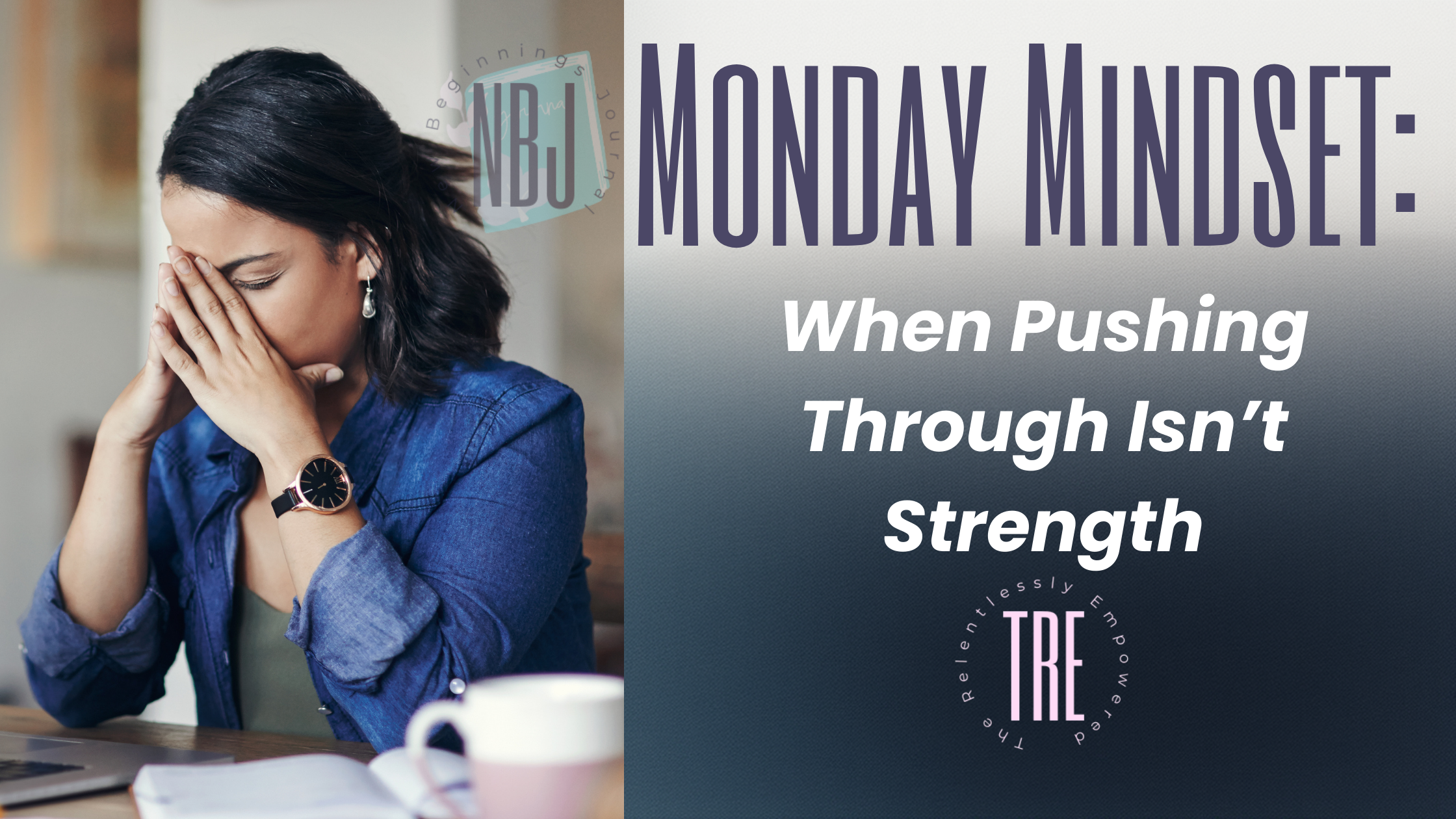
MONDAY MINDSET: When Pushing Through Isn’t Strength
There is a version of strength the world glorifies.
Push harder.
Sleep less.
Grind more.
Don’t complain.
Don’t slow down.
For years, I believed that version.
Until my body forced me to learn something different.
There is a version of strength the world glorifies.
Push harder.
Sleep less.
Grind more.
Don’t complain.
Don’t slow down.
For years, I believed that version.
Until my body forced me to learn something different.
After my stroke, there was a week where I realized I could not “push through.”
Not physically.
Not mentally.
Not emotionally.
And it humbled me.
Because for most of my life, if something felt hard, I worked harder.
If I felt overwhelmed, I tightened my grip.
If I felt tired, I told myself to push anyway.
But recovery doesn’t respond to force.
Healing requires alignment.
That season taught me three lessons that reshaped everything I now teach about wellness.
1️⃣ Strength Is Not Always Intensity
Intensity looks impressive.
Recovery looks quiet.
But sustainable health is built in the quiet.
If you only know how to operate at 100%, you will eventually burn out.
The body does not reward constant pressure.
It responds to rhythm.
Work.
Recover.
Adapt.
Repeat.
That’s how muscle grows.
That’s how resilience grows.
That’s how character grows.
2️⃣ Productivity Is Not Identity
When I couldn’t move the way I used to, I had to confront something uncomfortable:
Who am I if I’m not “producing”?
So many people tie their worth to output.
But your worth does not fluctuate with your energy levels.
You are not more valuable on your most productive days.
You are not less worthy on your hardest ones.
That shift alone will change your relationship with stress.
3️⃣ Rebuilding Is Stronger Than Pushing
When you can’t push through, you rebuild.
You adjust.
You simplify.
You create smaller systems.
You respect capacity.
That is not quitting.
That is wisdom.
Sometimes the strongest move you can make in a difficult week is:
• Going to bed earlier
• Scaling the workout down
• Eating balanced meals instead of chasing perfection
• Saying no
• Choosing peace over performance
Recalibration builds resilience.
If This Week Feels Different
Maybe you’re navigating stress.
Maybe your energy feels low.
Maybe life hit harder than expected.
Instead of asking,
“Why can’t I push through?”
Ask,
“What does rebuilding look like right now?”
That question changes everything.
You Don’t Have to Navigate It Alone
If you need structure that supports you during rebuilding seasons, explore the FREE and low-cost wellness and mindset tools available at:
👉 TheRelentlesslyEmpowered.com
Because health isn’t built by punishment.
It’s built by alignment.
And sometimes alignment begins with slowing down long enough to listen.
Your transformation goes beyond intensity.
It’s built in resilience.
💛