
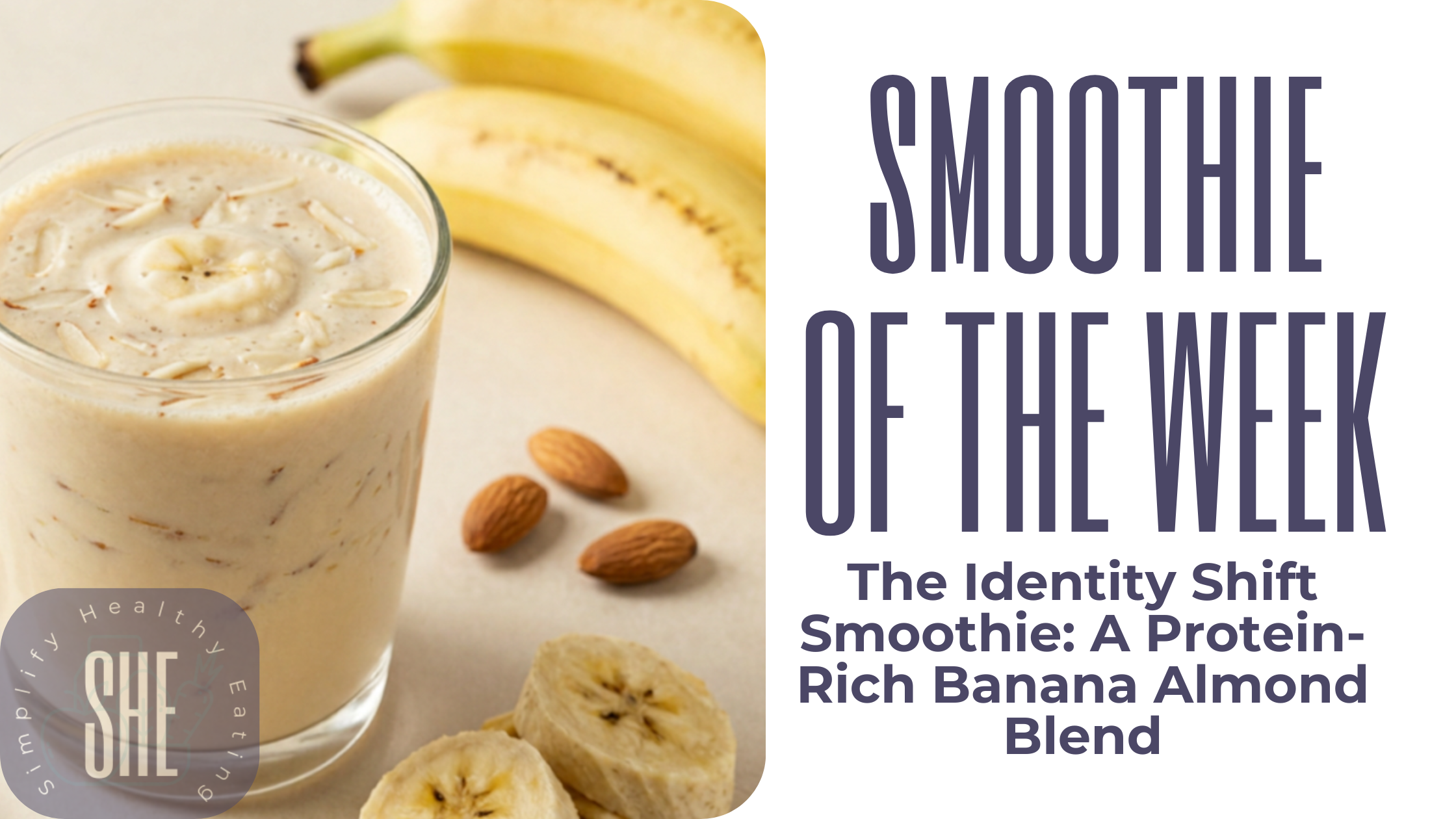
The Identity Shift Smoothie: A Protein-Rich Banana Almond Blend
Blend banana, almond butter, flax, cinnamon, and protein into a satisfying smoothie, with an evidence-aware safety guide for optional ashwagandha
A smoothie cannot shift your identity. But keeping one small promise to yourself can become evidence that a new identity is taking root.
The Identity Shift Smoothie combines almond milk, frozen banana, ground flaxseed, almond butter, cinnamon, and vanilla protein powder. The graphic also includes optional ashwagandha—but the word optional is doing important work here.
The supplement is not the identity shift
Wellness marketing often assigns transformation to a single ingredient. That can make the ordinary actions that actually shape our lives—planning, choosing, repeating, adjusting—look less exciting than they are.
The identity shift is not in the powder. It is in the decision to gather good information, make a choice that fits your body and circumstances, and repeat supportive actions without requiring perfection.
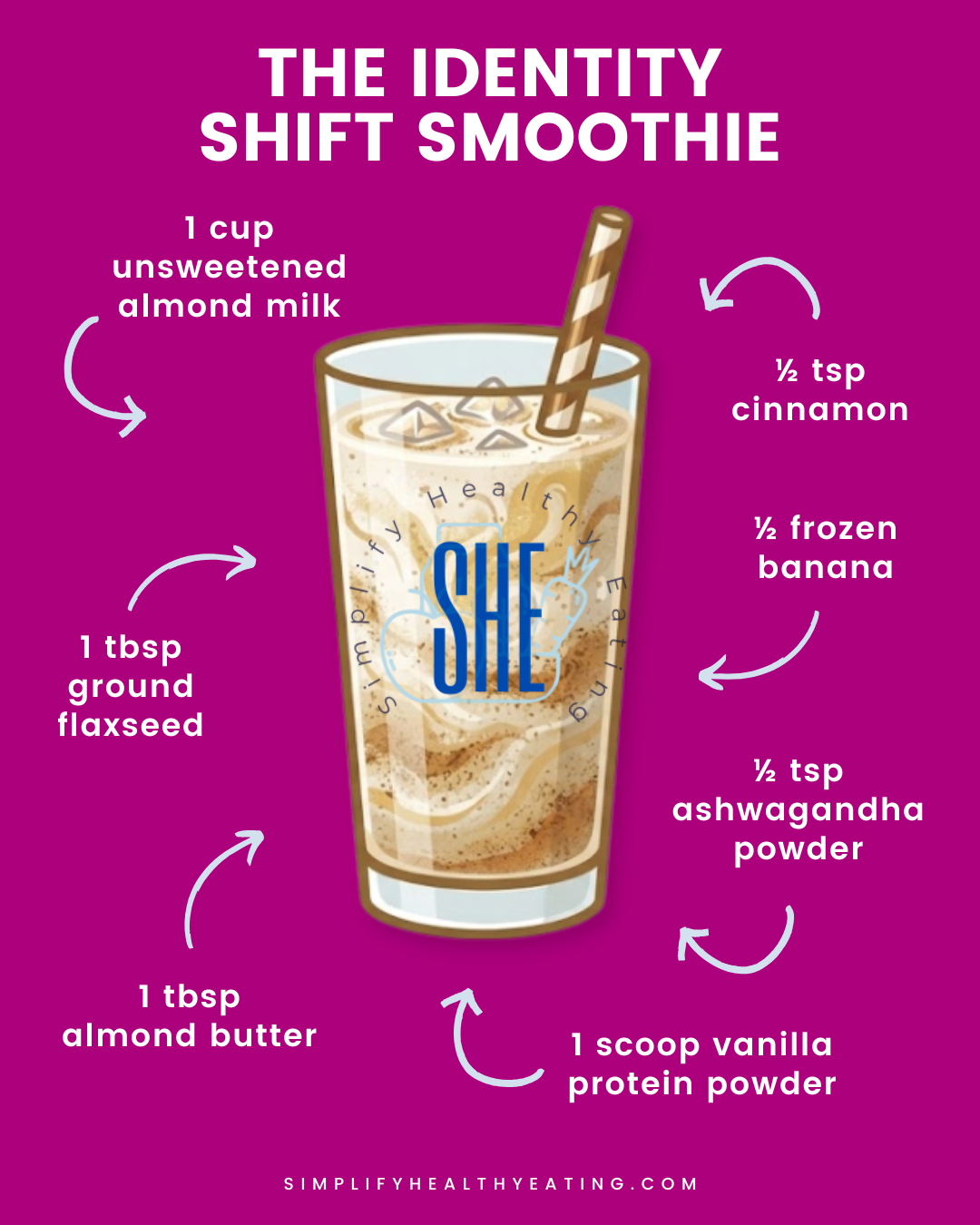
Banana almond protein smoothie with flaxseed, cinnamon, and optional ashwagandha.
What the base recipe provides
Banana supplies carbohydrate, potassium, sweetness, and texture.
Almond butter contributes satisfying unsaturated fat, vitamin E, magnesium, and flavor.
Ground flaxseed adds fiber, ALA, and lignans.
Protein powder lifts the blend to an estimated 26–31 grams of protein.
Ashwagandha: benefits, limits, and safety
Some studies of specific standardized ashwagandha extracts suggest possible benefits for stress or sleep in certain adults. Those findings do not establish that every powder, dose, or smoothie will have the same effect.
Long-term safety remains uncertain. Possible adverse effects include drowsiness and digestive symptoms, and rare liver injury has been reported. It should be avoided during pregnancy and breastfeeding and may be inappropriate with thyroid or autoimmune conditions, before surgery, or with several medication classes.
If it is not clearly appropriate for you, skip it. The smoothie is still nourishing without it.
The TRE takeaway
Becoming her is a practice—not a powder. Let your identity be shaped by informed choices, self-respect, and the evidence you collect through repetition.
Ready to practice a more supportive mental filter? Join TRE’s FREE 21-Day Happy Brain Challenge.
The Identity Gap: How to Become the Woman You Already See in Your Mind
Learn how to close the identity gap between who you are and who you are becoming through small daily actions that build confidence and self-trust.
You can see her clearly: she keeps promises to herself, protects her peace, cares for her body without punishment, and follows through without waiting for perfect motivation.
The distance between the woman you currently believe yourself to be and the woman you desire to become is the identity gap. It does not mean you are fake or failing. It means the desired identity does not have enough supporting evidence yet.
Your current identity was built through repetition
Your current identity is the collection of stories, labels, experiences, and conclusions accumulated over time. “I always fall off.” “I cannot trust myself.” “I am too old to begin again.” Those conclusions were reinforced until the story sounded like who you are.
Your history is evidence of what has happened so far. It is not proof of what must happen next.
Why the desired identity feels unfamiliar
The desired identity may feel authentic in your imagination but awkward in daily life. You can believe you are becoming more confident and still hear the old voice warning you not to speak. The discomfort may not mean the identity is wrong. It may mean it is new.
Why women get stuck in the gap
The gap becomes discouraging when you judge the desired identity using evidence collected by the former one. You ask a new identity to defend herself with receipts from before she was being practiced.
The old identity is louder because it has more evidence. The new one may only have today. Give her more days.
Small actions close the identity gap
· One supportive meal is a vote for caring for your body.
· One maintained boundary is a vote for self-respect.
· One five-minute promise kept is a vote for self-trust.
· One return after a setback is a vote for consistency.
Identity is not only something you announce. It is something you practice.
Five ways to begin
1. Name the current identity without shaming yourself.
2. Define the desired identity through observable behavior.
3. Make the daily vote small enough to complete on an ordinary day.
4. Track evidence instead of only outcomes.
5. Give the new identity more days, including difficult and imperfect days.
Faith and the woman you are becoming
God is not limited to evidence from your past. You may see the woman who struggled or delayed while He is developing endurance, wisdom, courage, and compassion through the process.
TODAY’S VOTE
Ask: What is one small action I can take today that agrees with the woman I am becoming? Then complete it without demanding that one action prove everything.
NEXT STEP
Join the FREE 21-Day Happy Brain Challenge to develop healthy habits for your mind, body and spirit!
5 Signs You’re Still Living in Your Old Identity—and How to Shift It
Changed your habits but still feel like the old you? Learn five identity clues and simple ways to build evidence for the woman you are becoming.
You changed the groceries. You started walking. You kept a boundary you used to abandon. From the outside, the evidence says you are changing. So why does the new life still feel like something you are borrowing?
Because behavior can change before identity catches up. Your old self-story has had years of repetition. Your new one may have only a few weeks of evidence. That does not mean your progress is fake. It means your brain and your language need time to update the file.
Here are five signs that your old identity may still be narrating the journey—and what to do instead.
Sign 1: You say, “I’m trying to be healthier.”
Trying sounds harmless, but it can keep the behavior at arm’s length. It positions health as something you visit rather than something you practice as part of who you are.
Try this reframe: “I’m someone who prioritizes my health.” You do not have to perform that identity perfectly. You simply need to keep casting believable votes for it: drink the water, make the balanced plate, take the walk, keep the appointment.
Sign 2: You celebrate the result but dismiss the effort.
You hit a milestone and immediately say, “I just got lucky,” “It probably won’t last,” or “It wasn’t that hard.” That is the old identity protecting its familiar story by refusing to count your work as evidence.
Name the effort accurately: “I planned ahead.” “I kept going after an imperfect day.” “I asked for support.” Receiving a win is not arrogance. It is honest data.
Sign 3: You self-sabotage when things start working.
Sometimes success feels more threatening than struggle because struggle is familiar. When momentum appears, the old identity may create urgency, chaos, or an all-or-nothing test so you can return to the role you already know.
Instead of asking, “Why am I ruining this?” ask, “What about this progress feels unfamiliar or unsafe?” Then make the next step smaller. Safety and consistency often grow together.
Sign 4: You explain your new habits with apologies.
“I know it’s weird, but I’ve been trying to…” is a request for permission from your old self and the people who knew her. You are allowed to take a lunch break, protect your sleep, order the meal that supports you, or decline what drains you—without a courtroom defense.
Use a clean sentence: “This works better for me now.” Full stop.
Sign 5: You wait to feel ready or worthy before going all in.
The new identity does not arrive after the results. It is built before them. Readiness often grows after the first courageous action, not before it.
Ask, “Who do I need to be in this moment?” Then choose one action that woman would take. Not a dramatic reinvention—one honest vote.
The shift: become an evidence collector
Stop asking only, “What do I need to do?” Ask, “Who am I practicing being?” At the end of the day, write down one piece of evidence: “I stopped when I was satisfied.” “I rested before I crashed.” “I spoke to myself with respect.”
Your old identity is not the enemy. She was built from past experiences, protection, and repetition. Thank her for getting you here, then update the story with new evidence. Grace makes room for growth; consistency gives growth somewhere to land.
If you want a guided way to strengthen attention, emotional well-being, and more supportive daily patterns, join TRE’s FREE 21-Day Happy Brain Challenge.