

Why Strength Training Matters More Than Chasing Calorie Burn
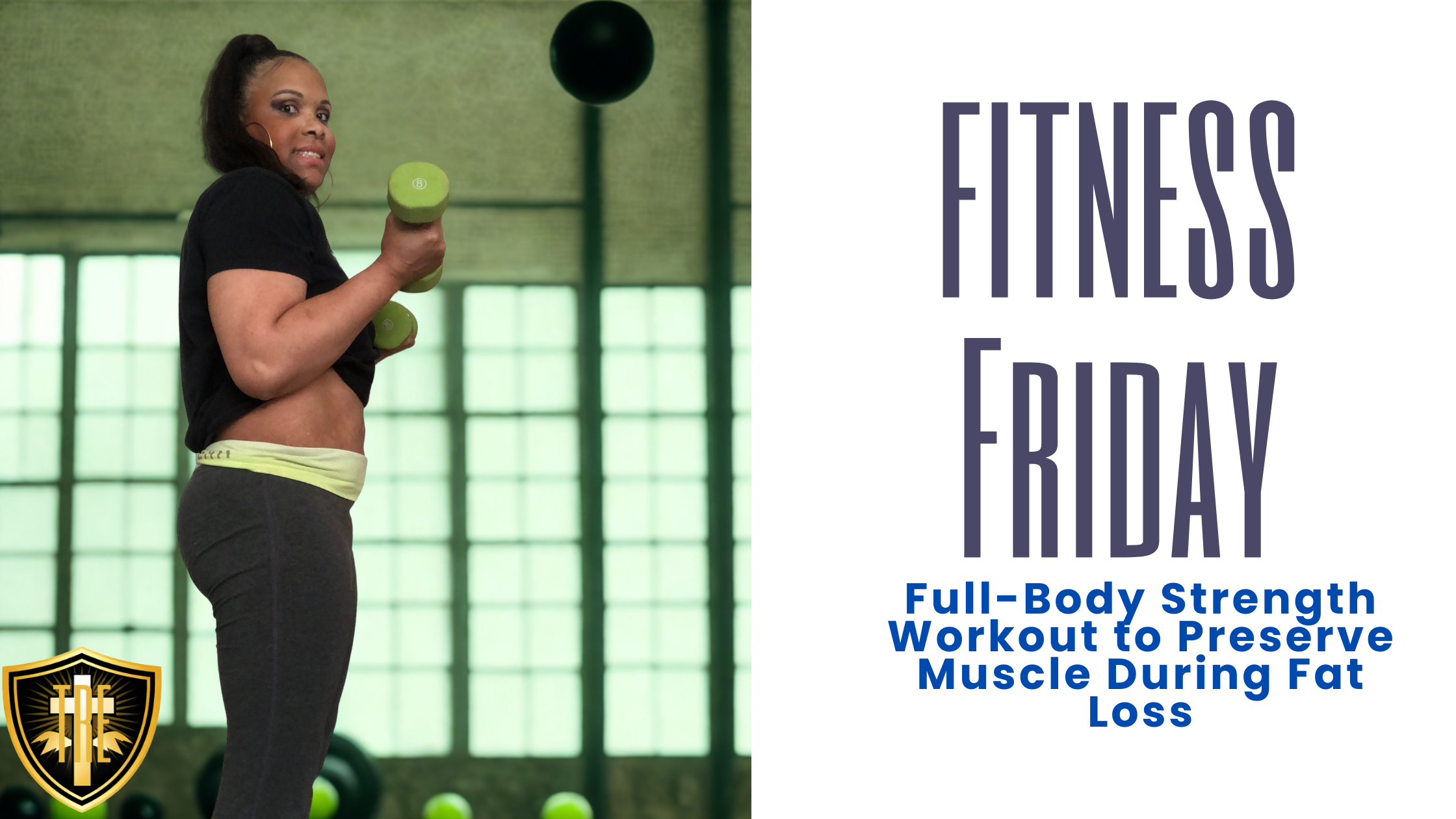
Follow this full-body dumbbell workout with squats, push-ups, deadlifts, rows, lunges, and shoulder taps to support strength and preserve muscle.
When weight loss stalls, many women immediately add cardio.
But if you are not already protecting your muscle, strength training may deserve more attention than another session focused solely on burning calories.
Muscle supports strength, mobility, balance, glucose use, physical independence, and long-term function. Resistance training performed alongside an appropriate nutrition plan can also help preserve lean mass while body fat decreases. In a randomized trial, resistance training combined with dietary intervention reduced body fat while preserving lean mass even though resting metabolic rate did not meaningfully change. (PubMed)
That distinction matters.
Strength training is valuable even when it does not produce a dramatic “metabolism boost.”
Is Muscle Really “Your Metabolism”?
The phrase is memorable, but it oversimplifies the science.
Skeletal muscle is metabolically active tissue and contributes to resting energy expenditure. Some studies have found that resistance training can raise resting metabolic rate, but the average increase is generally modest and individual responses vary. One nine-month trial reported an average increase of approximately 5%, with considerable variation between participants. (PubMed)
Strength training should therefore not be sold primarily as a way to burn large numbers of calories at rest. Its stronger benefits include preserving lean mass, improving strength, supporting function, and helping the body maintain more muscle during a calorie deficit.
Federal guidelines recommend muscle-strengthening activity involving the major muscle groups on at least two days each week. (Health.gov)
The Full-Body Strength Circuit
Format
Complete three rounds.
Rest for 45–60 seconds between rounds, with additional rest when your form or breathing requires it.
The workout includes:
12 goblet squats
10 push-ups
10 single-leg Romanian deadlifts per side
12 dumbbell bent-over rows
10 reverse lunges per side
20 plank shoulder taps
Beginners may complete one or two rounds. The number of repetitions is a starting framework, not a rule that requires sacrificing form.
Warm-Up: Five to Eight Minutes
Prepare with:
Marching or easy walking
Hip hinges
Body-weight squats to a chair
Wall push-ups
Arm circles
Supported reverse steps
Gentle trunk rotations
Use the warm-up to practice the patterns you will perform with resistance.
How to Perform Each Strength Exercise
1. Goblet Squat — 12 Repetitions
How to do it
Hold one dumbbell vertically at chest height, supporting one end with both hands. Keep the weight close to your body.
Stand with your feet around shoulder-width apart, with the toes turned slightly outward if that feels natural.
Brace your abdomen, send your hips slightly back, and bend your knees as though sitting between your heels.
Lower only as far as you can while keeping your feet planted and torso controlled.
Press through your feet to stand.
Beginner option
Squat toward a chair and lightly touch the seat before standing.
No-weight option
Hold your hands at chest level and perform a body-weight squat.
Form reminders
Keep your knees tracking in the same general direction as your toes. Avoid allowing the knees to collapse inward.
2. Push-Ups — 10 Repetitions
How to do them
Place your hands slightly wider than shoulder-width apart on the floor, a bench, a countertop, or a wall.
Create a straight line from your head through your hips. Bend your elbows and lower your chest toward the support.
Press the surface away and return to the starting position.
Progression options
Move from wall push-ups to countertop push-ups, then bench, knees, and finally full floor push-ups.
Form reminders
Do not allow your lower back to sag. Keep your neck in line with your spine and your elbows angled slightly back rather than flared directly outward.
3. Single-Leg Romanian Deadlift — 10 Repetitions Per Side
How to do it
Stand on your left leg with a soft bend in the knee. Hold a dumbbell in the opposite hand, both hands, or use no weight.
Hinge at your hips while extending your right leg behind you.
Keep your hips mostly square to the floor as your torso tilts forward. Stop when you feel tension in the back of the standing leg or before your balance breaks.
Press through the standing foot and squeeze the glute to return upright.
Supported option
Hold a wall, chair, or dowel with one hand.
More stable alternative
Perform a staggered-stance or “kickstand” Romanian deadlift. Keep the toes of the back foot on the floor for balance.
Form reminders
This is a hip hinge, not a squat. Keep your back long and avoid reaching the dumbbell toward the floor by rounding your spine.
4. Dumbbell Bent-Over Row — 12 Repetitions
How to do it
Hold one dumbbell in each hand.
Soften your knees and hinge forward from the hips. Keep your back neutral and allow the weights to hang beneath your shoulders.
Pull the dumbbells toward the sides of your ribs while drawing your shoulder blades gently back.
Lower the weights under control.
Supported option
Perform one arm at a time with the other hand supported on a chair or bench.
Form reminders
Avoid shrugging your shoulders toward your ears or rocking your torso to move the weights.
5. Reverse Lunge — 10 Repetitions Per Side
How to do it
Stand tall with your feet hip-width apart.
Step your right foot backward and lower your body by bending both knees.
Keep most of your pressure through the front foot. Press through that foot and return to standing.
Alternate sides or complete one side before changing.
Supported option
Hold a chair, wall, or countertop.
Alternative
Use a shallow reverse step and return without lowering into a full lunge. You may also perform split squats while holding support.
Form reminders
Step back far enough that you can lower without feeling crowded. Maintain control rather than dropping quickly.
6. Plank With Shoulder Tap — 20 Total Taps
How to do it
Begin in a high plank with your hands beneath or slightly wider than your shoulders.
Separate your feet enough to create a stable base.
Brace your abdomen and lift one hand to tap the opposite shoulder.
Replace the hand and alternate sides.
Try to keep your hips from rotating substantially.
Beginner options
Perform the movement from your knees, against a bench, or standing with your hands on a wall.
Wrist-friendly option
Use an elevated surface or replace shoulder taps with a forearm plank.
Form reminders
Move slowly. A controlled tap is more useful than rushing through repetitions while the hips swing from side to side.
Choosing the Right Weight
Use a resistance that makes the final two or three repetitions feel challenging while still allowing clean form.
A weight is probably too heavy when you:
Cannot complete the intended range of motion
Hold your breath uncontrollably
Use momentum
Lose balance
Experience sharp joint pain
Cannot control the lowering phase
A weight may be too light when you finish every set without meaningful effort and could easily perform many more repetitions.
How to Progress the Workout
You do not need to increase every variable at once.
Progress by choosing one option:
Add one or two repetitions.
Increase the weight slightly.
Add a fourth round.
Slow the lowering phase.
Improve your range of motion.
Use a less-supported variation.
Reduce rest modestly while preserving technique.
Record the weights and repetitions you complete. Progressive overload works best when you can see what you previously did and make gradual, measurable changes.
How This Workout Supports a Plateau Strategy
Strength training does not “reverse metabolic adaptation” in one session. It may, however, help you preserve the lean tissue you already have while losing weight and provide a structured reason to maintain adequate protein and recovery.
A plateau review should also examine:
Whether the calorie deficit is still appropriate
Protein intake
Everyday movement
Sleep
Stress
Menstrual or hormonal changes
Training progression
Consistency across the full week
More exercise is not always the answer. Better-targeted exercise may be.
Suggested Weekly Schedule
A simple beginner structure could include:
Monday: Full-body strength
Tuesday: Walking or low-impact cardio
Wednesday: Recovery or mobility
Thursday: Full-body strength
Friday: Walking or light cardio
Weekend: Recreational movement and recovery
Allow at least a day between demanding full-body sessions when you are new to resistance training.
Safety Considerations
Stop when you experience sharp pain, chest discomfort, unusual shortness of breath, dizziness, or new neurological symptoms. Adapt the range of motion and use support when balance is limited.
People managing injuries, osteoporosis, pelvic-floor concerns, cardiovascular conditions, uncontrolled blood pressure, neurological conditions, pregnancy, or recent surgery should obtain individualized exercise guidance.
Explore Support for Preserving Muscle and Breaking a Plateau
The Relentlessly Empowered offers resources that support the complete system surrounding your workouts:
The FREE 7-Day Reset
The FREE 14-Day Belly Fat Reset
The FREE Busy Woman’s Veggie Reset Guide
The FREE 3-Day Anti-Inflammatory Meal Plan
The FREE Clarity Over Cocktails Mocktail Guide
Visit the Home page to explore the next step that supports your nutrition, movement, recovery, and sustainable fat-loss goals.
References
Cava, E., Yeat, N. C., & Mittendorfer, B. (2017). Preserving healthy muscle during weight loss. Advances in Nutrition, 8(3), 511–519. https://doi.org/10.3945/an.116.014506
Morton, R. W., Murphy, K. T., McKellar, S. R., Schoenfeld, B. J., Henselmans, M., Helms, E., Aragon, A. A., Devries, M. C., Banfield, L., Krieger, J. W., & Phillips, S. M. (2018). A systematic review, meta-analysis and meta-regression of the effect of protein supplementation on resistance training-induced gains in muscle mass and strength in healthy adults. British Journal of Sports Medicine, 52(6), 376–384. https://doi.org/10.1136/bjsports-2017-097608
U.S. Department of Health and Human Services. (2018). Physical activity guidelines for Americans (2nd ed.). https://health.gov/sites/default/files/2019-09/Physical_Activity_Guidelines_2nd_edition.pdf
Villareal, D. T., Aguirre, L., Gurney, A. B., Waters, D. L., Sinacore, D. R., Colombo, E., Armamento-Villareal, R., & Qualls, C. (2017). Aerobic or resistance exercise, or both, in dieting obese older adults. The New England Journal of Medicine, 376(20), 1943–1955. https://doi.org/10.1056/NEJMoa1616338
Bibliographic details were verified against the journal and federal records. (PubMed)